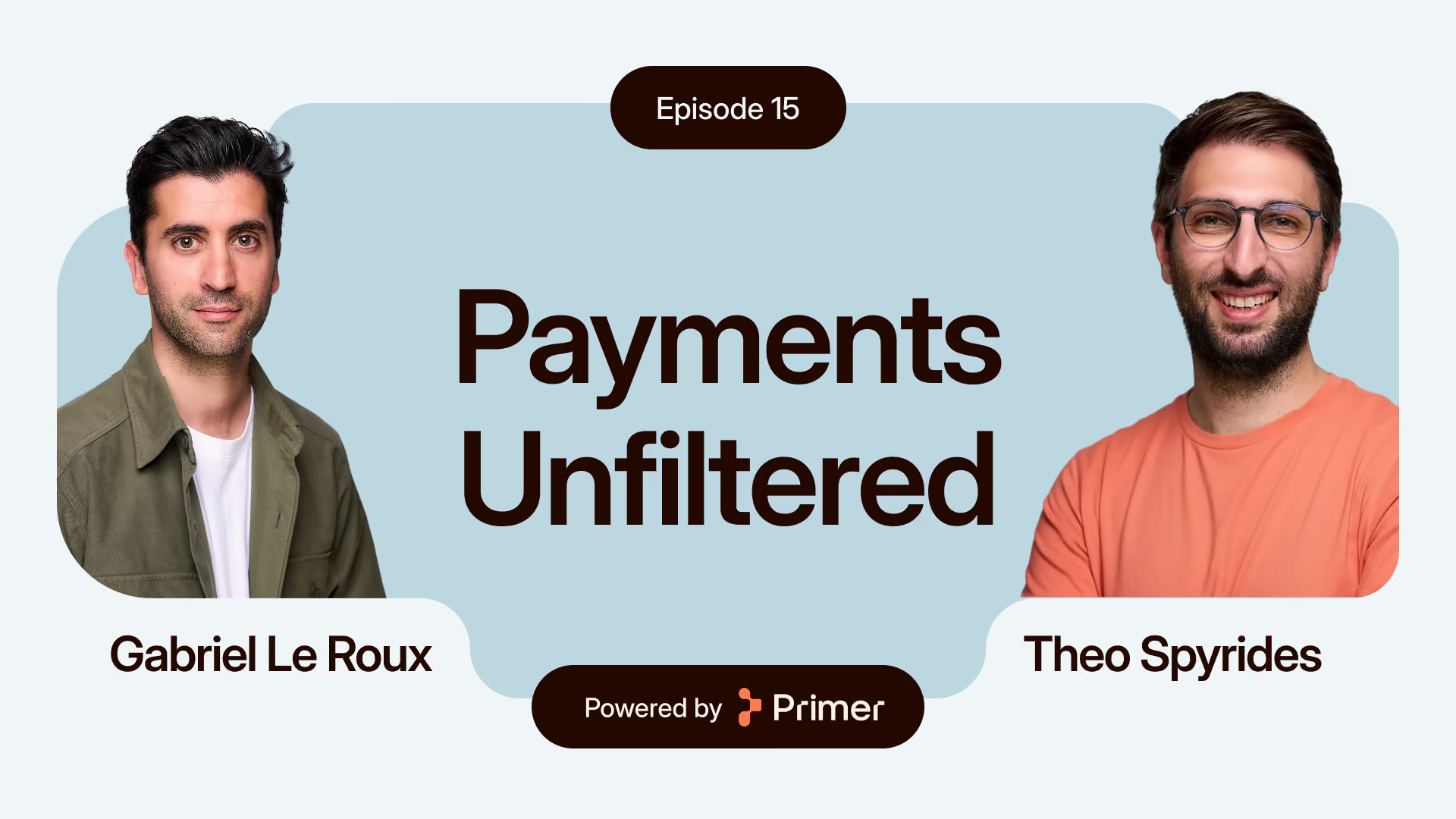
The next era of payments: AI, data & the end of the “black box”
In this episode of Payments Unfiltered, Theo Spyrides sits down with our co-founder and CEO Gabriel Le Roux to discuss where payments are heading next, why AI in payments is more about context than prompts, and what payments intelligence actually looks like in practice for merchants.

Theo Spyrides
Host of Payments Unfiltered

Gabriel Le Roux
Co-founder & CEO @ Primer

Theo Spyrides: Hello, and welcome to Payments Unfiltered, powered by Primer. I'm your host, Theo Spyrides, VP of Product at Primer. Gab, welcome back to the show. You were our very first guest, so thanks very much for coming back. But a lot's changed since then. You've recently announced with Primer a Series C of $100 million, and I'd love to know, how do you feel?
Gabriel Le Roux: First of all, when was the last time we recorded a podcast?
TS: It must have been at least 18 months ago, at least.
GL: 18 months, at least. I remember. It was, it was fun. Listen, it's, yeah, it's a great moment for Primer. As I said to, to, to the team and the Primigos, as we call the Primer employees, this is a result of a lot of hard work. We are fundamentally disrupting payments. When I was at Braintree and PayPal with my co-founder, we saw a huge opportunity that the world of payments was changing, that customers across the globe were looking to expand with more services. They were looking to connect, not just with one PSP, but with many of them, including adjacent services to the PSPs, the fraud vendors, the data tooling, the APMs, the wallet, the Buy Now Pay Laters, things that would be used even after a payments, right?
And, and we took it on ourself to actually create that infrastructure that connects to all these services. We worked very closely with our customers. Primer is a merchant-first organization. We listen a lot to what our customers are saying, and our partners as well, and I'll probably discuss about the partners at some point in the conversation that we're having. But this has allowed us to build a unique product with a very unique value proposition, now allowing you as a merchant to just achieve that roadmap, connect to whatever you want to power your payments, and transform the way you're managing payments. And I think it's, this fundraising is essentially the result of us achieving that vision and also working closely with our customers.
And, and, if you look at the results, they're quite phenomenal, right? We have 100% retention rate with all our top accounts. We have a share of platform, which is the amount of payments a customer will send to us, which is around 95%, if not above that, which is unique in payments, just to make it clear, right?
TS: Could you maybe make that clearer?
GL: If you think about the way customers and merchants are managing the payments without Primer is that they're gonna connect to all those different services, which means that- Each of these services will have a share of platform, right? But if you have many of them, obviously, you distribute the share of platform across all these services. And typically PSPs with a large enterprise will have, I don't know, it depends really, but 30%, maybe 20%, 50% percent share of platform because a merchant doesn't wanna send like everything to one provider.
We are acting as the underlying infrastructure, which means that we are seeing all the payments of a merchants, and the merchants decides to send everything to us 'cause there's a compounding effect to send more payments to Primer, then you can optimize better, you have more data, you have more visibility, and so on and so forth.
And so yeah, it's a very unique KPI and a unique position we're in to see essentially like all the payments of the merchants, which also means that we have, in a lot of cases, or actually like in all cases, more data than anyone else, right? It's a good thing for our merchants as well because we take that data and we actually productize that data to drive more value, and we can talk about it.
But long story short, I think all those unique aspects of our product and our positioning has allowed us to raise this huge round. In a world that is completely changing, you need a unified infrastructure that allows you to transform the way you're managing payments. But we also allow like for the next phase of commerce, which will be AI-led and agent-led, and I think Primer is uniquely positioned to solve that.
TS: Yeah. You said a really interesting point around the data, like we see all the data. But I also think the thing that people might overlook is we unify the data into a single format. And it's not the sexiest topic, but actually making data look the same across a myriad of services is a really hard thing to do, and merchants don't even need to think about it. When they come into Primer, they see a Primer payment, they see the way that Primer reasons about the payment journey, and then they can just see okay, I've got PSP A, PSP B, PSP C, these are the variables against the payment and that would otherwise take a whole team of data scientists or data analysts to map that data and to unify payments into one language. Without that, you can't have data analytics being able to compare like for like. You can't be able to run AI on things on top of that, which I'm sure we'll dig into. So I think the unification of the data and abstracting it into one language is also something that I think people overlook when it comes to talking about data. What's really interesting in the kind of VC world is a lot of dollars are going to AI companies. So what do you think made investors want to bet on Primer and the future of Primer?
GL: There is a lot of money going to AI, and rightly right? It's a massive transformation happening across like all industries. But you have those fundamental pillars of our digital world and ecosystem, which also have to be transformed, right? And Primer is driving that innovation, right? If you think about it, for many years you had little to no innovation in payments, right? Maybe there has been a few things, but the main sort of technology out there to power payments, to accept payments, has been like PSPs, right?
And I think we can all agree on that. What Primer is saying is that the merchant are like thinking differently on how they wanna accept payments and with whom they wanna accept payments, and there is a need for a systemic shift on how they're gonna do that, and we, Primer, have been solving for this.
With any major innovation, you also need to make sure that the foundations are also changing and innovating, and we, in the world of payments, we're driving that change, right? And I think this is why there's been a lot of interest from, one, the merchant and partners, but also the investors.
TS: And so what do you wanna do with the money?
GL: First we're gonna continue to actually listen to our customers. I think this is key to our DNA. We spending hours, I spend hours, you spend hours, any Primigos are spending hours just listening to our customers and understand what do you actually wanna do? What is top of mind for you? There is things which are specific to you as a customer. There are things which are specific to you as in your industry. And there's trends, and there's hype, and there's many noise, and we need to help them navigate all this.
So we will continue to actually help them achieve their goals with when it comes to core payments. There's a lot of things that we're doing with our existing product, our existing infrastructure. Item number one. Item number two is we, as Primer, are uniquely positioned to create real intelligence in payments. We have very unique insights. As I said earlier, we're capturing that unique share of platform, +95%. We have unique data points that we're capturing for every single payments, on average around 400 data points, which is absolutely unique and massive. And we've taken that, and we've actually productized it, right?
You mentioned it yourself, if you're a merchant, you have to consume a lot of data, you have to normalize, you have to just understand what's going on. Payments in and of itself is complex, and it's been for many years a black box. Primer is saying, "No black box anymore. Transparency is key. You need to understand what's happening."
So we've took all that data, and we've actually created our own AI agents. Last year, we've launched a product called Primer Companion. And what Companion is doing is allowing you to just query the agents to understand, "Okay, what's happening? What should I do? Can you recommend me things I should do with my payments? Is there something I haven't seen that needs to be changed? Can you share trends in all these things?" So we're actually doubling down on creating that intelligence within Primer to help you as a merchant understand how you can further improve your payments. But again, we can do that, and Companion is relevant because we have that shared platform.
If Primer would have a very slim shared platform, why would you use it? Because you would only have a very slim context on your payments, right? I was in a podcast a couple of weeks ago, and we were discussing about OpenAI and Plaid, doing a partnership to allow for some level of financial advice. I wouldn't go into too much detail, but I think the point that we're discussing a lot is why this is actually relevant is because now they have context. Primer has the context that no one else has have. This is why this agent and our AI offering is extremely powerful. So we're actually gonna invest there, and we're gonna keep investing there.
The third piece is that we've seen a lot of pull and interest, not just from payments and tech team, but from like the finance and treasury persona. Now you have different, this infrastructure. You have you can act on your payments. You can optimize for performance. You can optimize for coverage. You can optimize for redundancy. You have one single place where you can consume the data. You have this AI agent that allows you to being like a lot smarter and all that. But what Primer has done is, again, because we're listening to our customers, we thought, "Okay, we also have to solve for what I used to call the other side of the office," right?
There's a lot of people consuming reports and trying to understand the fees and what. Payments has been super notorious to be like very hard to understand for absolutely no reason, right? It should be pretty simple, but I think it's almost been done by design, by players in the ecosystem. If you ask anyone what is your FX fees with some PSPs, I can tell you that no one will have a clear answer. We took it on ourself to actually solve for this through a unique offering for the finance and treasury personas, and that's something where we're gonna continue to invest in. So that's like the third piece of the deployment.
And last but not least, we're not just solving for the merchant. We're also solving for the partner and the ecosystem. If you think about Primer as a double-sided platform, in order for merchants to have optionality and to achieve their roadmap, they need to have partner. The partners wanna get fast activation because it's very hard to get activated on that very complex roadmap. So we're solving for them. So last year, we essentially launched what we call Primer for Partner, which is a no-code editor allowing anyone who's non-technical to have their product on Primer, and we're essentially like creating the app store for payments.
So all these like things are like top of mind for us, and this is where we're investing, as well as market expansion.
TS: Awesome. I'd love to dive in one by one, to be honest. So firstly around like the kind of core payments infrastructure piece, you talk to lots of merchants. It's something that is really much a culture that you set top down. Like in the product team, everyone has to try and talk to merchant at least once a week and constantly getting signals from our merchant experience teams and go-to-market teams. What are you seeing? What are the trends where it's okay, we have a core payments infrastructure today, but actually there's more that we need to do there? What is, what are you seeing there?
GL: It depends across vertical and industries. It depends also like on your size as a merchant. But let's say we take like enterprise. I am, like someone doing substantial volume online. What they are all looking to do is there's two ways to look at it. Either they don't have like many providers, they're on one, and they're like, "Okay, this is not sustainable enough. We've outgrown our existing provider for many reasons."
One, we are launching new markets where they don't have local presence, and we wanna make sure that we connect to the right providers, locally. Two, they are realizing that they're leaving money on the table 'cause performance isn't the best, and if you only have one provider, like you can't do much. You have to connect to someone else to start comparing A-B testing, improving things. Three is simply redundancy. I think a lot of companies out there realize that relying on a single provider for your payments is putting your business at risk. I was with a customer last week, and they had only one provider. Actually, they had two. But let me actually explain. They had two. They had one primary, and they had one they had integrated as a backup, but it was not really maintained. The primary provider went down for five hours, I think. The backup obviously didn't work, not obviously, I shouldn't say that, but it didn't work because it wasn't maintained, and they didn't really think about it. And so five hours, nothing happening, right? I don't think this is acceptable for anyone, right?
And I think generally speaking, the merchant out there are a lot more educated on the power of payments. This is pretty high level if you think about it, but just think, I think there's a real shift right now on how businesses are thinking about payments. It's not just something that needs to work, it's something that drives a lot of value for customer retention, for obviously from a revenue standpoint, to understand like where you need to invest in terms of product. There's lots of value you can get from your payments. And I think that's a shift that converged to Primer as the product and the infrastructure.
TS: Sounds so there's a suite of problems. They need the right toolkits to help them solve it. If they try and build it themselves, it can prove difficult, it can prove challenging, and actually payments is core to every business. And I do think people overlook this sometimes. You have to accept funds for your goods or services. Otherwise you don't have a business. And if that's a binary choice, it feels like the obvious thing is to do it well, and you're right. The things it can unlock. I always say this with the likes of Uber, Booking.com, and some of these other large enterprises. One of their competitive edges was, like, they had 1,000 people in their fintech organization. They built fintech internally as a function, and that allowed it to become a differentiator.
GL: I would go as far as saying that Uber is Uber because they actually thought about payment as a core value proposition. We all book Ubers and payment has disappeared. You don't even realize you're paying, right? And I think this is very unique where value proposition where the only thing that matters is the actual service, but the rest is completely seamless. I think this should be a case for anyone.
At Primer, we have a product called Fallbacks. Because we capture the data agnostically, right? Through our Universal Checkout. We have our own vault. We capture data agnostically, which means that, if it fails with someone, with a PSP, we can take that data and a 3DS cryptogram without being too technical and send it to someone else. That's how you achieve that seamless experience. And we've all been on a checkout trying to buy and it fails and there's absolutely no reason for the transaction to fail. And so what the likes of Uber and some others have done because they have as you said, thousands or hundreds of people now is possible through Primer. And that's something that is very unique for any merchant out there.
TS: So how do you see the AI layer complementing that? So the goal is single unified infrastructure, capturing all the payment flows, having one language to reason about all your payments across all your providers. But then you're talking around like making payments intelligent. So what's the vision there? Maybe you can talk to some tangible examples and outcomes for the merchant, with what we're trying to achieve, with that focus area.
GL: When we founded Primer, like the first we had many goals. One of them was we need to provide you visibility, transparency on your payment data. Without Primer, you either have one dashboard that doesn't bring you much, or you have many, and you have to just make sense of all of them. We've all been there, where you open like many tabs and you're like, "Okay, so there's this here, this here. How do I make sense of all this?"
It's not great. This is not a great experience for anyone, right? Then, what I've seen myself is, merchants trying to download the data, create like those massive Excel file, and the data is not up to date, it's not in real time, and there's data points missing and all that. So we actually thought, "Okay, how are we gonna solve that?" And we launched a product called Observability, right? And this allows you to just have an understanding of your payment data end-to-end, right? We actually even launched a new product called Costs Overview, which allows you to go super granular on how much you're being charged by any of the provider across the value chain.
And that's the, that was the first step for us. So now you wanna understand something. It's not a black box. You can actually go and do some analysis. What we realize is that it's not that simple, right? There's lots of nuances. You need a lot of context. If you wanna do like super deep analysis, it's not an easy task. And we actually talked to our customers, and we understand that we understood that this was like one of the key thing that they were trying to resolve, and that's why we've launched Companion. We thought, "Okay, what if we can actually provide you that extra layer of intelligence so that you can actually go much deeper, much faster? You can be a lot more sophisticated on the analysis you're doing to in turn like improve your payment strategy and of course, delight your customers at the end of the funnel." And that's essentially what Companion is doing.
I am personally amazed every time I use Companion. I do demos every single week. I meet customers every single week, and every time I actually open Companion and demo the product, I'm amazed by how sophisticated the answers are. These are answers that would take like hours, if not days, to actually produce, and we can do that like in milliseconds. Why? Because we have context which the merchant, the merchant has their context. They don't have the context of others, right? And we've actually now obviously securely and all that, like bringing that context to our pool of customers. And I think this is where payment should be heading. You need to provide yeah, tools, but also the right level of intelligence for someone to really push the boundaries of what they can do with their payment stack.
TS: And I think you talked on the context there a lot, and I think it is worth just double-clicking on that. I think when these AI agents came out, it was all around prompt engineering. You even had jobs like prompt engineer at companies, right? And it's okay, how do I write a prompt for an AI agent to get the best possible answer back? And I think what you've seen, like realized in the trend that's happening is like we're transitioning from prompt engineering to context engineering. The prompt bit is actually the easy bit. You even have stuff like Claude Code that can actually even do some orchestration layer for the AI agent. So that's the emphasis on prompt has reduced, but the burden on the context is even higher. And context can mean lots of things. Context on payments. What is an auth adjust? How does auth adjust work? How can I capture this type of payment method in this market? Do I have to do auth then capture or do I have to go straight to capture? Why is this BIN bound? What is a BIN? How many digits is a BIN? Like all of these things that is constantly changing in the payments ecosystem is context. And if you're not feeding that context to the AI agent, they don't know what payments is. And they cannot advise you. And they cannot be an extension of your team. And then you have the data and then the context of the data. What is a network transaction ID? If you don't tell the AI agent that a network transaction ID has nothing to do with a network token, then it'll get, make mistakes, right? And I think when we've spoken to customers with using Primer Companion, the thing is like they've tried to build their version of Companion with Claude with ChatGPT and they can't. Exactly. And I think that's the beauty of the direction that we're heading in is like there's this compounding effect of intelligence, more data, more context, more partners providing context, more data, more merchants, and all of a sudden you create this context library that is like nothing else. And if you have that with smart AI leveraging that in a sophisticated way and the way that we've built it, then you create something incredibly powerful. And I think people always overlook the nuance of what it goes into building these products. And I think that's the journey I think, yeah, I'm excited to be going on, to be honest.
GL: Absolutely. No, you've nailed it. And what we actually see right now which I find personally interesting is a lot of our customers and users of Primer are just interacting with Companion now, which actually, it's a complete shift on how they've been using our product.
TS: Do you have a favorite quote? I have one. I might get it tattooed on me. It's "Companion's my best friend."
GL: I was thinking of this one, which is a good one, which is great, payment has never been the best friend of anyone. And because it's again it's been that sort of black box, we took it on ourself to change that. But having someone saying this about Companion is absolutely phenomenal. And, yeah, listen, we're really changing the behavior of merchants towards payments, and I think this new product allows to go even further. Really, when we think about Primer, we're thinking about the other side of the platform. The work we've done for the partners is also very unique, right? For many years, and I was myself, I was at Braintree and PayPal before founding Primer. My co-founder was there as well, right? And we both saw how difficult it was commercially, but also from a product standpoint, to actually get our customers or prospects to integrate our product.
Again, because you're on that sort of really complex and huge roadmap and, if you wanna add another provider, you need to learn their API, you need to get resource allocated from an engineering standpoint, all these things. So the partners themself, they have a lot of challenges, to get their product live, to realize revenue, to get the merchants to ramp, all these things. And we wanna solve for them as well. And we've added hundreds of partners ourself, and the demand to be on Primer is so big from the ecosystem but also our customers asking for more. We had to think, "Okay, how are we gonna be solving this?" And that's what we've done with Primer for Partners, which essentially the app store for payments. You can just be on Primer if you want to be there.
And the way we've done that is actually through a no-code editor, which means that even if you're actually not technical at a PSP or a buyout operator or a fraud provider, wallet, whatever, you can have your product in Primer, right? And I, again, this is something that very unique to how we're thinking about ecosystem. We're solving for everyone pretty much. And we were at Money20/20 last week. Great event. Been there almost every year for the past six or seven years. And we actually did a demo to a group of partners. We had a breakfast, and we had great attendance from some of our top partners, but also new ones. And we actually demoed Primer for Partners. Most people think it's actually a reverse API.
TS: So could you explain what that is before you tell the story? What, the reverse API?
GL: Yeah. Essentially, you expose an API to partners, and they have to consume that to essentially be on our marketplace, simply put, right?
TS: Three months of engineering, half a million dollars.
GL: You have to get engineers to have this in their roadmap. They have to consume your API. They have to learn it. It's complicated. And we actually, when we thought about Primer for Partners, we thought, "Okay, what's gonna be the way for partners to interact with us?" And one easy route would have been, "Here is an API. Just consume that. Here's a link to the docs, and just do it," right?” We thought, "Yeah, this is not us," right? We were the first one in the world to build this concept of no code for payments with our workflow. We thought, "Okay, we need to apply the same principle to the partners."
And that's essentially what Primer for Partners is. It's a no-code editor which allows you to be on Primer by essentially just doing some form of mapping, right? And it's super simple, super elegant, and so when we explain that to partners, most of the time they're like, "Yeah, too good to be true. No, it's a reverse API." I am quite passionate about it because it's not a reverse API. So last week we were at Money20/20. We had a room full of partners. It was great, and Luke, which is one of our technical product manager, decided to actually do a live integration. Actually, I shouldn't even call it an integration. Do a live demo of how a partner can actually use Primer Partner, and he added two payment methods in five minutes. Luke, amazing guy, but he's not an engineer, and the room was like dead silence. We're like, "Whoa, okay. We've never seen that before."
We are actually thinking very deep to actually really disrupt the industry, and what we've seen over the past couple of years is that the industry is listening, and they are converging to us, and in some cases even try to copy us, which is okay, right? But yeah, it's been quite unique to see the reaction in the room.
TS: Yeah, that was, the first time I saw a merchant see it, it was a very special moment, right? Because the whole landscape changed for them immediately when they saw that, right? The way that they can go to market, the way that they can activate, the way that they can distribute their products, the way they can reason about their product, changed. And, yeah, I remember helping Luke brainstorm around, "How should we do this partners breakfast?" And I said... And he said "Should we just not show the product? Just let the product do the talking." And, yeah, adding two payment methods in five minutes, even had a timer. It was great.
GL: The reaction in the room was like, "But really? That simple?" "Yeah, why not?" Again, you can just redo what has been done or just fundamentally try to disrupt the industry, right? The partners wanna gain adoption. They wanna understand their performance. Because again, the one thing that Primer can do then is provide you insights. Now you understand how you're performing as a PSP or a fraud or wallet or a buyer operator or local payment methods. You can understand your share of platform. You can start having data you never had.
And why this is relevant, is because if you provide that data, then the partners, the service providers can improve. If they can improve their product, the merchant will have better performance, it's a flywheel.
TS: And it's a meritocracy. Best provider wins, right? Exactly. So you have this core payments infrastructure, you have this intelligence layer on top of it that you're building out, and on the other side of the ecosystem, you have partners plugging in in an order of hours with clicks, not code, to create more services that core infrastructure can adopt, more data that the AI intelligence layer can play with. Makes sense. You talked around the CFO, the finance team. I don't wanna go too deep there just 'cause of the sake of time. There was a couple of other topics. But maybe you can talk to me around, high level, what's the direction behind this something that Primer announced recently around the money movement journey. Like, why go from core payments towards this money movement journey?
GL: So we've solved for the first half of the journey, if you think about it. Now you have Primer. You can accept payments with any services you want. You can have a beautiful checkout which is completely dynamic, which allows for what we call dynamic presentment. You can optimize every single aspect of your payments with different tools that we have, like Fallbacks in order to network tokenization, adaptive 3D Secure, A/B testing, all these things. We have data centrally. You have the agents now. And think about it. You've solved for the payments team, the product team, the tech team, the data team, and all that. So now, they can just add whatever they want, right? When you do that, you're also creating a lot of work for finance and treasury teams. There's actually no standards. Yeah, no standards, I think that's the right word here.
TS: It's a bit of a Wild West.
GL: It's a Wild West. No one is actually dictating how settlement reports should be constructed, how you should report data. You just do whatever you want as a provider or whatever you can, all right? Depending on the local providers you have, the acquirers you're using, and all these type of things. And I saw that myself when I was at Braintree. Even with just Braintree, the reconciliation work is very, very difficult, right? And so imagine if you would have to do that across, I don't know, 5, 6, 7, 10, 15 partners, right? Or services that you would have integrated across your payment stack, payment methods, wallet, PSPs, and so on and so forth.
So we thought it's quite unfair to actually not solve for the finance team, the treasury team, which now has to consume all these reports. And we've talked to customers again, the theme is pretty clear. And they were like, "Yeah, we download all these files. I have a team of I don't know, seven people. We've built that sort of tool internally to just consume these things, do like some mapping and all that.” We thought, okay, that doesn't make any sense. We need to solve this. And so what we've done at Primer is we actually thought, okay, let's look at the second half of the money movement journey, and let's solve for the actual stakeholders of that second half.
And so we've launched a product called Reconciliation. And what Reconciliation is doing, we haven't been super creative on the name, right? We take all these file, simply put, right? And we actually normalize them in one single file. So Primer becomes the sort of unified ledger, and we are doing the reconciliation. So now you only have to reason through the Primer file as opposed to like through all those different file, which are all different. I know you often share this anecdote, or maybe you can actually share yourself, like how much time you spent without mentioning the name of the partner trying to understand their file. I think it was on a Friday night we were chatting.
TS: So we were rolling out a reconciliation support for a PSP. We went live with some test payments, and the data didn't make sense. They did three payments. One of the payments was like $2, but the fee was like 500 bucks. And I was like, "This just makes no sense." And I wanted to fix the problem that week. We have some time urgency at Primer, and that was the thing I wanted to fix. I tried to solve it myself. I couldn't. I spoke with the partner. We had a three-hour call on the Thursday, and like they just didn't have a clue. On the Friday, it was like 4:00 PM that, their team was based in the US and it was like they brought 15 people onto a call, just me, which was fun. It took us four hours to figure out what on earth was going on, and it's because they were batching the transactions into a batch, and then they were averaging the fee across that batch. And it required different people to stitch together the information to create that picture for us to actually understand what was going on for us to then build the right abstraction layer. So yeah, it's a Wild West. Devil's in the detail, and it's so easy to overlook something.
GL: Imagine if you need 15 people on the provider side to understand the fees, what it is on the merchant side. So this is not acceptable. So we've solved for this. So we've really thought deep on, okay, how are we gonna solve the second part of the journey? And that product is very unique. Again, when our customers are using it, it's a game changer for them. And now you have the finance team like consuming, or the treasury team or whoever, is doing that on the merchant side, consuming those files, reasoning through Primer and all that. As we were doing that, the one thing that we realized is, okay, like we have a better understanding of the cost structure now. And as you have a better understanding of the cost structure, you can start asking questions. What do you think about those fees? What do you think of how you're being charged when you're accepting payments in one currency and settling into another one and all these things?
And one thing that we realized is that it's pretty difficult for merchants out there to optimize for FX. The industry hasn't really been thinking how to resolve that because they've made a lot of money on FX by charging like insane fees when you don't do like for like settlements. And we thought, again, not normal. We need to solve this, and that's what we've done with the launch of global accounts. So now if you're on Primer and you wanna settle into a currency for which you don't have a bank account, you can just open one and you can start doing like for settlement. You can optimize for FX, you can pay out your vendors and so on and so forth. So that's essentially what we mean when we said that we've been solving for the second half of the money movement journey.
TS: So we have this unified platform with core payments infrastructure, core finance infrastructure being built out to cover the end-to-end money movement journey. Ambition there is to go deeper, go wider and solve for more pain points.
GL: Yes. And we become the intelligent control plane or interface for every stakeholders that interact with the money movement journey from acceptance to optimization to payout.
TS: Gotcha. And then as more merchants are consuming more of the services, there's more data, there's more compounding effects because we have this intelligence layer sitting across everything. And everything's in a single Primer language. Then on the other side, we have partners onboarding, and then now the app store for payments and finance makes sense, right? We have this kind of iPhone that we've built. We have the partners that we work really closely with coming on board as applications, and it's our job to power that ecosystem. And that's the vision.
GL: Absolutely right, summarized.
TS: Thanks. We've spoken about it lots. So you talked briefly around market expansion. I'm gonna get shouted at if we ever run too much, but, could you maybe talk around like your big ambition there, what market, why, and what do you see as the opportunity?
GL: First of all, if we actually think about the vision you just summarized here, do we think that this is just something for EMEA or just something for APAC, or do we think that this is global? I will let anyone listening to this actually make their own opinion, but I don't think this is a market-specific thing. I think anyone out there is looking to optimize for all the things we've been discussing until now. And when we launched Primer, we actually decided to be global from day one. The reason why we can also do that is because we're not financially regulated. We're not in the flow of funds. We're not touching the money, right?
And, and yeah, it was hard work, long hours, but today we have customers across EMEA, UK, APAC, US. We're now gonna be doubling down on the US market where we see massive growth, lots of demand for our product.
TS: Why is there this demand? Is it anything specific with the US market, or do you think more broadly, it's just the same problem we're seeing everywhere else? But the US is just a hub for fantastic payments processing?
GL: Yeah. But the thing is, the US isn't immune to fragmentation of payments. The US isn't immune to lack of transparency across the payment stack. The US isn't immune to challenges with FX. The US isn't immune to willingness to create some redundancy and improve for performance. It's as simple as that, right? And that's why we've been working with a lot of US customers today which are using Primer to do all these things. I think you have some trends which are very local. But it's not the case for Primer. We are very much solving for a systemic shift on how companies are thinking about their payment stack.
TS: That makes a lot of sense. So with the rise of AI, and AI writing code, could a merchant build Primer?
GL: Interesting question. No, we’ve built a lot to achieve where Primer is today. We're talking about payments here just just to to make sure that everyone is on the same level. One area where we invest a ton is reliability of our infrastructure, right? We spend a lot of time making sure that, you know, Primer is the most reliable infrastructure for your payments full stop. And that means that we had to spend a lot of time on making sure that our checkout is best-in-class, our vault is best-in-class, our API, you know, works for all the use cases a merchant want to do with with primer and with their payments. We spend a lot of time building the abstraction to add like those services. And now for primer for partner to be the mechanism that you know partners will use to be uh to be on primer. There's like the abstraction on the data side. There's many things that that makes primer in and of itself a very very sophisticated product that you can't just like replicate like that right? The the unique aspect of primer as well is that we have again all this context, all this knowledge that has allowed us to create the offering that we have right now both on the infrastructure side but also on the data side right and that's not something that you can replicate and that's not something I think you should replicate either right? As a merchant. You should actually use like you know providers out there to help you solve like for these challenges.
TS: I think you're absolutely spot on. Like a merchant could try but they'd have to become a payments company. Yeah. Which makes no sense to me. Like focus on what you're good at and uh you don't build your cloud infrastructure. You use AWS. Exactly. And going back to the conversation we had around like context engineering. Um an AI agent needs context. Well, guess what? Even just building integrations, my advice to any merchant is be very careful because we've built a lot of integrations. We work with a lot of partners every single day. No, even all the documentation is public. Just even that on a basic level, you're going to be building an integration that's wrong. Yeah. And as a former engineer, maybe not a great one, but as a former back end engineer, like uh yeah, you can write the code quick. I could write the code quick for an integration, but I have to test it. I've got to test it across all the use cases. Sometimes the partner doesn't even have a sandbox, right? And so these are the things I think people overlook that AI cannot solve. And if it does, it will do it at a subpar standard. And as you said, payments is critical.
GL: The other thing as well is you don't want to be um you don't want to be exposed to sensitive data, right? You don't want to have to be PCI compliant like all these things. And again, like if you the one thing that you know we're doing at Primer is we are like you know taking all all those those data and the use cases that we have from other industries, other merchant, other regions, all these things. And now this is something that you have access to to improve like you know your payment stack and your payment strategy. Like solving for your strategy with only the things that are um related to your business you won't go super far right you need like to have like you know more data to solve for this and and so yeah it's an interesting question um but uh yeah it's not that simple.
TS: I agree. Okay, so my last question, Gab. Exciting vision, the cash to go and execute at pace, great team. Just wanna shout out to the Primer guys.
GL: The best people I ever worked with, by far.
TS: Let's say you come back to the podcast, you grace us with your presence, that's a joke, in three years' time. Where do you want Primer to be?
GL: I want Primer to be the de facto way anyone is actually using to accept, optimize, and manage payments. I want us to be the go-to platform from anyone from small to very large enterprises when they think, "Okay, I am now gonna create, grow, expand a business, and it needs to be with a platform that would allow me to use payment at its full potential, empower my payments and finance and treasury team with some intelligence." I want that to be Primer. And I think we are on track to achieve that.
It's a lot of hard work, but we have the confidence of our customers, the confidence of the partner ecosystem, and we have the best team out there to achieve that. So in three years when we have a chat about this, this is what we would have achieved.
TS: That's a pretty good note to end on. Awesome. Thanks for coming.
GL: Thanks a lot, Theo.
Meeting with the best in the business
Primer puts you in control of how money moves across the business. With our unified infrastructure you can orchestrate every flow, reduce friction, and capture more revenue everywhere.







Latest episodes
February 11, 2025
Buyer liars, AI fraudsters & lost revenue with Galit Shani-Michel
Featuring:
Theo Spyrides
&
Galit Shani-Michel
Fraud is evolving, and merchants can’t afford to fight it alone. In this episode of Payments Unfiltered, our host, Theo Spyrides, speaks with Galit Shani-Michel, VP of Payments at Forter, to discuss the rise of AI-powered fraud, the growing threat of friendly fraud, and why false declines cost businesses more than they realize. They also discuss why traditional fraud rules no longer work, how merchants can leverage data-sharing networks, and the real impact of 3DS on fraud prevention and conversion rates.

October 8, 2024
How partnerships power payments with Michaela Weber
Featuring:
Theo Spyrides
&
Michaela Weber
Join host Theo Spyrides as he dives deep with Michaela Weber, SVP & GM of Payments & Global Business Development at BigCommerce, to reveal how partnerships are reshaping the payment ecosystem. Discover how these alliances are fueling innovation and unlocking massive value for merchants. Theo and Michaela also discuss the breakthrough ecommerce trends and cutting-edge tactics merchants use to redefine their customers' checkout and payment experience.
August 7, 2024
Driving change in fintech with Parvinder Dahri-Cooper
Featuring:
Theo Spyrides
&
Parvinder Dahri-Cooper
Join host Theo Spyrides as he sits down with Parvinder Dahri-Cooper to explore her extensive experience in the payments ecosystem. Parvinder shares insights from her pivotal role in taking Worldpay to IPO and discusses her impactful efforts in driving diversity, equity, and inclusion (DE&I) within the fintech industry. Discover why fintech must champion diversity and how it can lead the charge in supporting underserved communities. This episode also delves into the challenges of balancing product innovation with regulation and the potential for fintech to drive social good.
April 25, 2024
Behind the scenes with a Fintech VC, featuring Rob Moffat
Featuring:
Theo Spyrides
&
Rob Moffat
Rob Moffat, a partner at Balderton Capital, joins Theo Spyrides to discuss his journey into the VC space and his passion for payment and fintech innovation. He also discusses the trends He believes have shaped the payment industry in the last five years, how He spots and evaluates promising payment startups, and the essential skills and traits that payment entrepreneurs need to thrive.

February 22, 2024
The Founder's Story with Gabriel Le Roux
Featuring:
Theo Spyrides
&
Gabriel Le Roux
Primer CEO & Co-Founder Gabriel Le Roux speaks on the Payments Unfiltered Podcast about his journey in payments, his experiences founding a successful start-up, and the evolution of the payments ecosystem over the past decade and where it’s going.