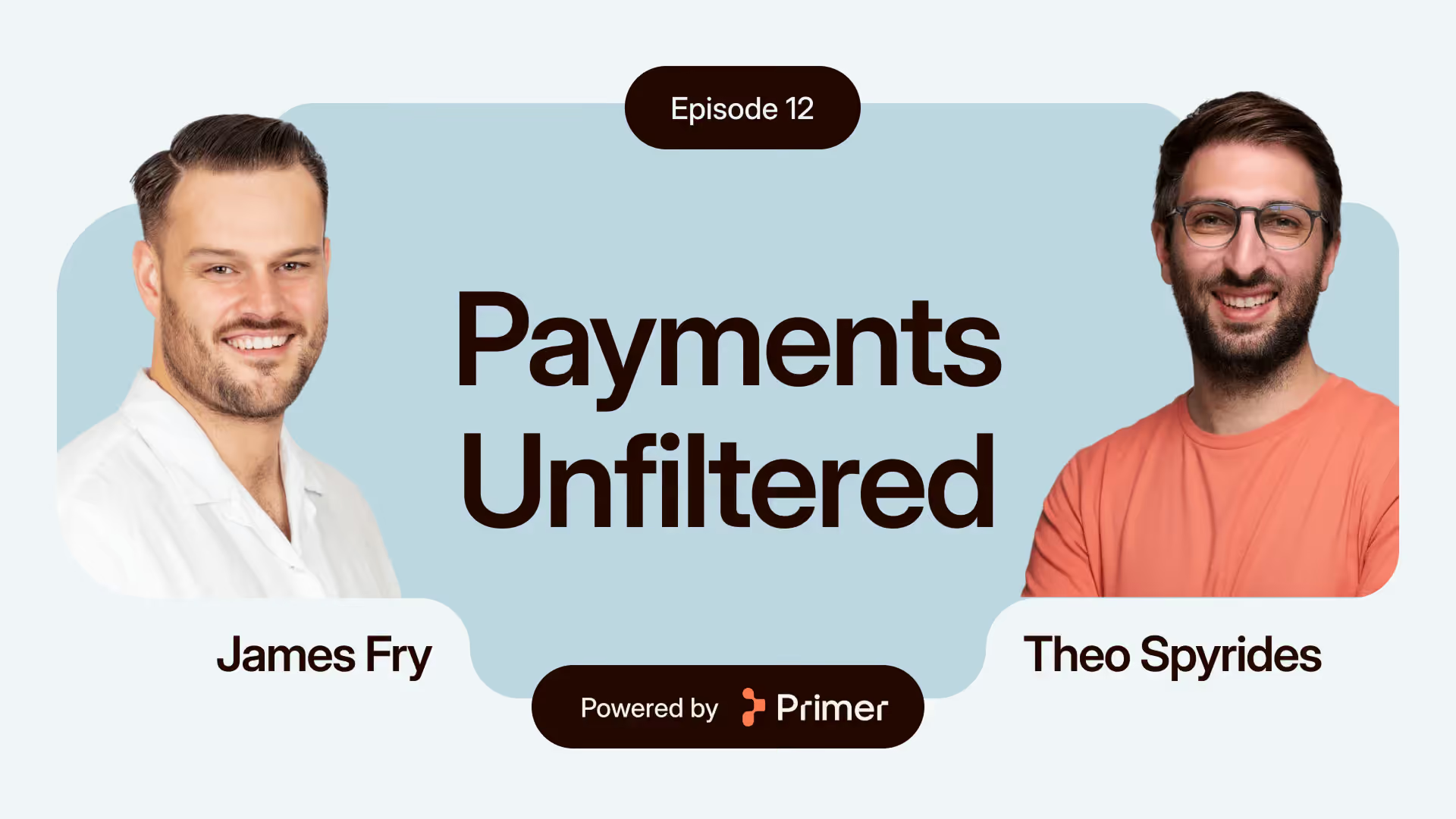
From commodity to competitive advantage with James Fry at Worldpay
In this episode of Payments Unfiltered, Theo Spyrides, Head of Product at Primer, sits down with James Fry, Head of Enterprise Product at Worldpay (now part of Global Payments), to explore how merchants have evolved their approach to payments, and what that means for the payment providers supporting them. James also shares his perspective on two of the biggest trends reshaping the space: stablecoins as an additional payments rail for global merchants, and agentic commerce as a new channel that will require the industry to solve for trusted agents, fragmented protocols, and a whole new model of intent verification.

Theo Spyrides
Host of Payments Unfiltered

James Fry
Head of Enterprise Product @ Worldpay

Theo Spyrides: Well James, thanks so much for joining us. I think to start off, you’ve been in payments for over a decade, not to age you, but I’d love to hear your opinion on how merchants have changed their approach to payments over the last few years.
James Fry: I think the biggest thing is that, years and years ago, payments were seen as a bit of a commodity or a vendor relationship. It was a necessity to commerce. It was very much: “I want to sell my products, I want to reach customers, and I need a payment provider.” It would typically be aligned with incumbent banks, where you might have existing business relationships and they’d provide some level of payment processing. More and more, as time has gone on and sophistication and complexity have entered the payment space, there’s a lot more expected from payments. There’s a realization of the power of increasing acceptance rates and creating a better customer experience. If the payment experience is clunky and difficult, you might have the best products in the world, but if people can’t complete a purchase, they’ll go to a competitor. So payments have increasingly become a business differentiator and an enabler of growth. That’s really shown up in merchants hiring dedicated payment teams, actual experts who can help build a strategy around geographies, payment methods, and, importantly, optimization. Whether that’s reducing costs or improving acceptance rates, there’s much more focus across almost every industry on how you partner with your payments provider to power your payments. That’s really been the shift, particularly over the last three to five years.
TS: Awesome. There’s so much to unpack there. You mentioned payment teams being hired more. Is that a big shift you’ve seen? Maybe five or ten years ago, who was the persona you were speaking with? How big was the payments team? And what are you seeing now with some of the world’s leading brands you work with?
JF: Good question. The buying cycle is very different now. When I first started, I did tech pre-sales, going out with the business development teams to help sell products. The buying decision typically sat with the finance department, and that’s still the case at some merchants. But now you’re also selling to developers and CTOs, making sure they understand your technology stack and are comfortable with the integration. So there’s been a big change there. When it comes to payments expertise specifically, historically there was a real reliance on the payment service provider to do everything and lead the way. You’d go in and say, “I need payments. I’ll go to my incumbent bank, who provides other services,” and that would be it. Whereas now, merchants realize there’s so much more they can get out of payments. They need people who can engage directly with payment experts and providers to understand what’s being done and how they can get more value. Some industries have always had more tech-savvy, payments-focused people, but now every industry has that, which wasn’t the case a few years ago.
TS: Interesting. I’ve also noticed a dissemination of talent. Everyone used to work at Mastercard or Visa, then move on, and now there’s much more expertise spread across the market. Maybe ten years ago there were fewer payment companies with smaller headcounts. Now there’s a real distribution of people who were on the PSP side and are now working in-house on the merchant side. Do you see that too?
JF: 100%. There are a lot more companies now and a lot more specialization. You’ve got the big payment companies, your Visas, Mastercards, Worldpays, and people move through all different areas of payments: the merchant side, schemes and networks, payment companies, and then maybe scale-ups. It’s a small world. You go to a payments event and it’s almost a reunion as much as a networking opportunity. There’s a lot of expertise across the industry now, which is great to see. Ultimately, the biggest benefit is for merchants.
TS: That’s awesome. I was in the US a couple of weeks ago and met a ticketing platform. The person we spoke to had worked at a PSP for 15 years in product, then moved to a merchant. It was great hearing his perspective from the other side.
JF: Yeah, it’s that thing of knowing what it’s like on the other side. If someone joins a company like Worldpay from a merchant, especially someone who has worked with Worldpay before, they understand the pain points and the customer experience journey. That allows you to continually learn, improve, and iterate. Sharing that knowledge is key to challenging ourselves to innovate and make things easier.
TS: Makes sense. You mentioned more focus on performance optimization recently. Is that something you're seeing beyond enterprise, in mid-market and SMB too, or is it still mainly an enterprise focus?
JF: It's always been a focus for enterprise customers, but historically it was more complicated and required much more work on the merchant's side. As we've reduced that burden by using data to better understand transaction flows and improve acceptance rates with issuers, it's reached a point where those capabilities are genuinely beneficial for smaller merchants too. Everyone wants a great customer experience and strong acceptance rates. The difference is how much effort is required to achieve them. It started with an enterprise focus. Things like debit routing in the US, using ATM and debit networks for cost or acceptance benefits, or network tokenization, were typically available only to larger merchants. But as those services mature, they become almost turnkey products that can work across an entire merchant estate, benefiting businesses of any size. So it's definitely expanding beyond what was historically an enterprise-only focus.
TS: So the barrier to entry drops, and things that used to be a luxury reserved for billion-dollar merchants become accessible to everyone.
JF: Exactly. The more you reduce the burden and make payments easier, the more likely everyone is to benefit from better performance. It's about understanding the data and products available, then making them as easy to use as possible. Ideally, they're turnkey products running in the background, with metrics showing the value they're delivering. That approach works for businesses of any size.
TS: Like a flywheel effect. You try something and see the results straight away, which maybe wasn't possible before. That's actually a nice segue into my next question. I've noticed companies growing faster than ever. I recently read about Lovable and other AI companies going from zero to $100 million in 12 to 24 months. Is there now an element of future-proofing growth, where if you don't solve a problem immediately, you simply can't keep up with competitors?
JF: When you look at areas experiencing explosive growth, like AI and agentic commerce, there are lots of companies trying to solve similar problems across the ecosystem. Everything is moving incredibly quickly, so you have to fail fast and keep building solutions that work for merchants. The biggest challenge, as we've seen in other fast-growing areas of payments, is that there will inevitably be some consolidation as the market figures out what wins. The pace of change just keeps accelerating. More has happened in the last five years than in the previous twenty, and I'm sure we'll be saying the same thing again a few years from now. The ability to demystify that complexity and make it simple is really what customers are looking for.
TS: Nice segue into my next question. What should payment managers be thinking about? If you're sitting across the table from an enterprise merchant, what's your advice?
JF: It starts with understanding their business. What do they sell? Which markets do they operate in? What's important to them? Then you need to understand their actual pain points. Is the challenge in the payment flow? Is it in backend processing? Is it disputes? There's a whole payment lifecycle to think about, including things like how they pay suppliers and third parties. From there, it's about putting together the right proposition. What's the easiest way to enable payment acceptance? What's the right mix of payment methods for the markets they're operating in? Germany, France, and the UK all have different customer preferences. There's also a growing focus on fraud prevention, particularly in card-not-present payments. Do they already have a fraud provider? Do they need one? How do you maximize good transactions while stopping fraudulent ones? Beyond that, it's about helping merchants understand how to operate with a payment provider, both financially and operationally. It's not just, "Here are the products." It's also, "Here's how you integrate them, how they work together, and the benefits you'll see."
TS: That's a great summary of how complicated payments become once you start digging into them. We always talk about the payment journey and all its different stages. How should I think about prioritization? You listed a lot of different areas. How do I know what needs improving, what's a good benchmark, and where I should invest first?
JF: A lot of it, especially in enterprise, comes down to dedicated account teams checking in through quarterly business reviews or ad hoc meetings. They're asking questions like: "How are things performing?" "Where are you seeing good results?" "Where could things improve?" Then it's about using data to identify trends. For example, maybe you're not using 3DS in a market where it's actually preferred. You can even build that intelligence into a product so merchants don't have to think about it. We have one called the Authentication Optimization Service, which automatically determines whether a particular market or issuer would benefit from using 3DS. It's about getting merchants set up correctly in their core markets and then continuously iterating over time. Data is the most important part of that process.
TS: That's exactly what I see too. It's almost like you need an experimentation framework. I always tell my team that payments is empirical. You learn by doing, not by reading a book.
JF: Exactly. The reality is issuer behavior isn't formulaic. Something that works with one issuer won't necessarily work with another. Take network payment tokenization. The card schemes want it used everywhere, but not all issuers have fully adopted it yet. So even when there's an industry-standard approach, implementation varies. That's where the expertise of a payment service provider becomes really valuable. If you're operating across multiple countries, you'll naturally see different outcomes. Acceptance rates in an emerging market won't necessarily look the same as they do in the UK. As long as you understand the benchmarks for each market, you can judge whether performance is actually good. And ultimately, the data tells that story.
TS: I have a maths degree, so I love this. As a merchant, how do I put that into practice? Do I build my own experimentation framework, normalize and visualize the data myself, or is that a service you and other providers offer?
JF: Some merchants, usually the largest global companies that want full autonomy, will build their own teams and run their own A/B tests. But that's not realistic for every merchant. Our approach is to reduce that burden by giving merchants the data, the understanding, and the expertise to get the most from their payments. There's always a mix. Some things merchants want to own themselves, and some they're happy to hand over to a payment service provider. That's the value of a good PSP. They're a partner, not a vendor. A merchant's success is genuinely the PSP's success. It's mutually beneficial and, ultimately, it's the consumer who benefits from a smoother experience.
TS: That's such a lovely way of putting it. Our CEO, Gab, says almost exactly the same thing: our merchant's success is our success. You just said the same thing. I've noticed you build better products that way because you're more intimate with the actual problem, rather than shipping features and hoping they solve it. Being deeply coupled to the customer leads to better solutions.
JF: Our vision is enabling merchant success, which in turn drives ours. It's easy to fall into building what you think you want, rather than what your customers actually want. That's why it's important to keep going back to users and asking, "Is this what you want? Would you buy this?" The merchant has to stay at the heart of everything.
TS: You mentioned some optimization opportunities, like markets where 3DS isn't mandated. Is there other low-hanging fruit that usually comes up, or is it mostly unique to each merchant?
JF: Some of it is very specific. It can come down to the exact message that's sent to a particular issuer, scheme, or acquirer. But there's also plenty of common optimization we've been doing for years. Is the payment page easy to navigate? Have you covered the happy path and the unhappy path? Even small things, like American Express using a four-digit security code instead of three, genuinely affect acceptance rates more often than you'd expect. Then there are opportunities around understanding where 3DS should be applied, whether an issuer prefers a network token over a full PAN, or even how you send AVS information. There have been cases where sending AVS data actually reduced acceptance rates. Beyond the customer experience improvements, there's also the underlying messaging and formatting that someone experienced can identify and improve. Ideally, those optimizations become automated, so you're not reacting after the fact. That's really the goal for the industry: getting the best results without manual intervention.
TS: Funny you mention AVS. I heard a story about a PSP finding huge efficiencies just by tweaking the formatting of an address field, like removing extra spaces. Do you have an example of a surprisingly small optimization that led to an outsized performance gain?
JF: The content in address fields can fundamentally change acceptance rates in ways you wouldn't expect. Those are probably the best examples of small tweaks having a material impact.
TS: Makes sense. All right, last topic. What upcoming trends are you focused on right now? What's keeping you busy, and where do you see the exciting opportunities?
JF: Payment performance remains a core priority. You need a stable, performant, and compliant platform, alongside continued investment in value-added services around acceptance and cost. But I'd be remiss not to mention the two hottest topics in payments right now, which seem to dominate LinkedIn: the growth of stablecoins, particularly the "fiat sandwich," and how that complements traditional payment rails.
TS: Could you unpack that for listeners?
JF: Historically, payouts went through a bank account via SWIFT or domestic clearing, using traditional banking rails. Over time, that's expanded to pushing funds to cards using services like Visa Direct or Mastercard Send. The money still lands in a bank account, but via a different mechanism. In markets where wallets are more common, you can push funds directly to a wallet. As crypto and the underlying technology matured, stablecoins emerged as another channel alongside those traditional rails. It's not a full replacement. There will always be corridors with currency volatility where stablecoins enable near real-time, low-cost payouts that are otherwise difficult to service. So they're another tool for moving money globally. There's also a growing role for stablecoins in settlement, for example receiving your settlement in USDC.
TS: Is that theoretical, or are you actually seeing real-world impact?
JF: It's real. We already offer settlement via stablecoin and remittance via stablecoin. There's genuine demand because it solves a real problem. Money that previously passed through multiple banks and lost value to transfer fees can now move faster and at a lower cost. It will continue to become more important. It's not theoretical. It's more about how stablecoins fit into the wider payments ecosystem as a complementary asset.
TS: If I'm a merchant, should I go and speak to my PSP about this right away?
JF: It really comes down to whether you have a genuine business need to receive or remit money using stablecoins. If you don't, then it's probably not something you need to worry about today. But if you operate globally or have use cases where stablecoins make sense, it's definitely worth having that conversation with your payment provider.
TS: Awesome. That's topic one. What's topic two? I think I know...
JF: I'm going all in on agentic commerce. There are lots of ideas behind this. Some versions already exist, like a chatbot helping someone through the buying process before handing off to a human. The next stage is autonomous payments, where an agent acts on behalf of a consumer, with permission, to actually complete a transaction without them being present. Think about a consumer saying, "Buy me a ticket to this show at this price point," or "Do my weekly grocery shop." The agent is acting on their behalf. We see this as a new channel. As a PSP, you already support point-of-sale and e-commerce, and agentic commerce is becoming a genuinely different channel. It changes the relationship between the consumer and the merchant because there's now a trusted third party involved. That means we need to build frameworks so you can trust that a transaction is legitimate. A lot of work has already gone into stopping bad bots, and now there's a new challenge: how do you distinguish trusted agents from bad actors? How do you keep the ecosystem safe from fraud and misuse as new players enter? It's already clear there are multiple competing protocols and players trying to own different parts of the ecosystem. Companies have to treat this as a bet, be ready to fail fast, and adapt as adoption plays out.
TS: That's exactly the fragmentation I wanted to ask about. There's no unified standard, and every week there's a new acronym on LinkedIn. It's overwhelming for merchants. We talked about "merchant success is our success." I'm not sure that's been consistently applied across all these protocols because the merchants I speak to feel genuinely overwhelmed. What advice would you give them?
JF: This kind of fragmentation shows up repeatedly in payments history. Even when 3DS first launched, there were multiple similar-but-different frameworks to integrate. Ultimately, merchants want someone to demystify that and handle it on their behalf. Someone to say, "There may be a few protocols involved, but here's how we make that as simple as possible for you," regardless of which agents or protocols are involved downstream. Trying to solve this alone would be expensive. As an industry, we need to avoid creating unnecessary complexity and cost for merchants because ultimately we exist to let consumers buy from merchant websites. Making that too hard defeats the purpose. The goal is to simplify or hide that complexity. We already see this in open banking. There's no single global scheme, and banks implement things slightly differently. It's a recurring pattern where multiple parties solve the same problem in slightly different ways. A payment service provider should be there to help merchants navigate that.
TS: One of my biggest concerns here, and 3DS is a good analogy, is that historically card networks held clear authority to define the standard. EMVCo created the specification. Implementation and enforcement varied, but at least everyone agreed on who owned the standard. Now, with agentic commerce, you've got AI companies like OpenAI and Google holding a lot of power because they own the interface, while card networks are also defining their own standards. How do you see that playing out? Who wins? Any hot takes?
JF: It's hard to say. I think it'll likely come down to consumer adoption, or whoever has already proliferated across the ecosystem. One of the things we're trying to do at Worldpay is help solve "know your agent." How do we understand whether an agent is trusted? Whether that verification comes from traditional KYB/KYC players, the schemes, or the banks, there's a lot of different approaches converging here. I think one of our roles is helping the industry standardize as much as possible without overcomplicating things for merchants. I don't think there'll be a single protocol. More likely, there will be a few that work together as part of an end-to-end solution. As with any fast-growing space, there'll be a lot of companies before eventual consolidation and simplification. There's a lot of work happening across different bodies and agent companies to keep this from becoming wildly fragmented. There are common themes around knowing your agent, verifying shopper intent, and training fraud engines and LLMs to distinguish trusted agents from bad actors. It's going to be an exciting few years navigating all of this.
TS: I think so too. Well, that's an amazing place to leave it, James. Thanks so much for your time. It's been great speaking with you.
JF: No worries. Thank you very much for having me.
Meeting with the best in the business
Primer puts you in control of how money moves across the business. With our unified infrastructure you can orchestrate every flow, reduce friction, and capture more revenue everywhere.







Latest episodes
February 11, 2025
Buyer liars, AI fraudsters & lost revenue with Galit Shani-Michel
Featuring:
Theo Spyrides
&
Galit Shani-Michel
Fraud is evolving, and merchants can’t afford to fight it alone. In this episode of Payments Unfiltered, our host, Theo Spyrides, speaks with Galit Shani-Michel, VP of Payments at Forter, to discuss the rise of AI-powered fraud, the growing threat of friendly fraud, and why false declines cost businesses more than they realize. They also discuss why traditional fraud rules no longer work, how merchants can leverage data-sharing networks, and the real impact of 3DS on fraud prevention and conversion rates.

October 8, 2024
How partnerships power payments with Michaela Weber
Featuring:
Theo Spyrides
&
Michaela Weber
Join host Theo Spyrides as he dives deep with Michaela Weber, SVP & GM of Payments & Global Business Development at BigCommerce, to reveal how partnerships are reshaping the payment ecosystem. Discover how these alliances are fueling innovation and unlocking massive value for merchants. Theo and Michaela also discuss the breakthrough ecommerce trends and cutting-edge tactics merchants use to redefine their customers' checkout and payment experience.
August 7, 2024
Driving change in fintech with Parvinder Dahri-Cooper
Featuring:
Theo Spyrides
&
Parvinder Dahri-Cooper
Join host Theo Spyrides as he sits down with Parvinder Dahri-Cooper to explore her extensive experience in the payments ecosystem. Parvinder shares insights from her pivotal role in taking Worldpay to IPO and discusses her impactful efforts in driving diversity, equity, and inclusion (DE&I) within the fintech industry. Discover why fintech must champion diversity and how it can lead the charge in supporting underserved communities. This episode also delves into the challenges of balancing product innovation with regulation and the potential for fintech to drive social good.
April 25, 2024
Behind the scenes with a Fintech VC, featuring Rob Moffat
Featuring:
Theo Spyrides
&
Rob Moffat
Rob Moffat, a partner at Balderton Capital, joins Theo Spyrides to discuss his journey into the VC space and his passion for payment and fintech innovation. He also discusses the trends He believes have shaped the payment industry in the last five years, how He spots and evaluates promising payment startups, and the essential skills and traits that payment entrepreneurs need to thrive.

February 22, 2024
The Founder's Story with Gabriel Le Roux
Featuring:
Theo Spyrides
&
Gabriel Le Roux
Primer CEO & Co-Founder Gabriel Le Roux speaks on the Payments Unfiltered Podcast about his journey in payments, his experiences founding a successful start-up, and the evolution of the payments ecosystem over the past decade and where it’s going.