
Operating in the iGaming sector requires unique resilience because banks and processors often label the industry as high risk. This classification means you need a setup that prevents a single point of failure from paralyzing your deposits or withdrawals.
Implementing a multi-PSP strategy provides the technical and commercial buffer you need to handle sudden account closures, frozen funds, or regional outages without losing your player base.
Implementing a multi-processor strategy for redundancy
It's crucial for iGaming merchants to never rely on one PSP. In this industry, risk appetites among providers change fast. A processor that supports you today might tighten its belt tomorrow and offboard high risk books with very little notice.
At the minimum, you should have:
- Primary PSP(s). These handle the majority of transactions where performance is stable and costs are optimized.
- Secondary or backup PSP. These automatically take over in case of failures, downtime, or local restrictions. Having redundancy in payment processing ensures that if your primary gateway is blocked or suffers an outage, your checkout remains live.
Best practices for iGaming redundancy:
- Diversify PSPs across regions. Some payment service providers perform better in specific countries due to local payment methods or regulatory compliance.
- Include high-risk specialists. Include at least one PSP that specializes in high-risk gaming transactions to reduce chargeback and fraud exposure.
- Support fiat and crypto. Consider PSPs that cover both fiat and crypto payments if your operator accepts multiple currencies to meet player demand for instant settlements.
Read more: Why one payment processor isn't enough
With a tool like Primer, you can effortlessly activate multiple PSPs, which enables you to set up smart routing. As Aladin Taleb, Optimization Product Manager at Primer, puts it:
"Smart routing isn't just about sending a payment from A to B; it's about giving every transaction the best chance of success while balancing performance, cost, and risk."
By directing each transaction to the processor most likely to approve it based on data like geography, transaction value, or card type, you maximize your top line while maintaining a failsafe stack.
Why iGaming operators need payment orchestration for PSP redundancy
Implementing each PSP to your platform directly can be resource-intensive. Every time you want to add a new processor, it means engineering tickets, long waits, and weeks of development. You are also in charge of any issues, maintenance, or API updates that are required for every individual connection.
Payment orchestration completely removes the engineering demand from building a multi-PSP strategy. Instead of stitching together separate integrations, you connect to a unified payment infrastructure once.
For example, if you want to expand your sports book into a new market like Brazil, you don't need your devs to spend months building a new integration. You simply activate a local provider through the orchestration layer. The platform handles the heavy lifting of normalizing data and mapping decline codes across all your providers.
Why iGaming merchants use Primer for PSP redundancy
Primer is a unified infrastructure platform enabling you to completely remove the engineering demands from the equation. We act as the control center for how your gaming business moves money globally.
Integrate with us once, and you can activate new PSPs at the touch of a button. This gives your payment team direct control to optimize your stack without waiting on a technical backlog.
Here's how it works:
- Activate integrations instantly. You can add multiple payment methods and processors through the Primer dashboard without writing code.
- Standardize your data. Primer standardizes the language of payments across every provider, making it easy to compare performance and fees in one place.
- Automate with Workflows. You use Primer Workflows to design routing logic that sends high-value deposits to your most reliable processor.
Read more: Payment orchestration for iGaming
You can also activate Fallbacks with Primer. This enables you to set up a fallback processor with no code. Once set up, any failed transactions that can be recoverable (soft declines) will be automatically recovered.
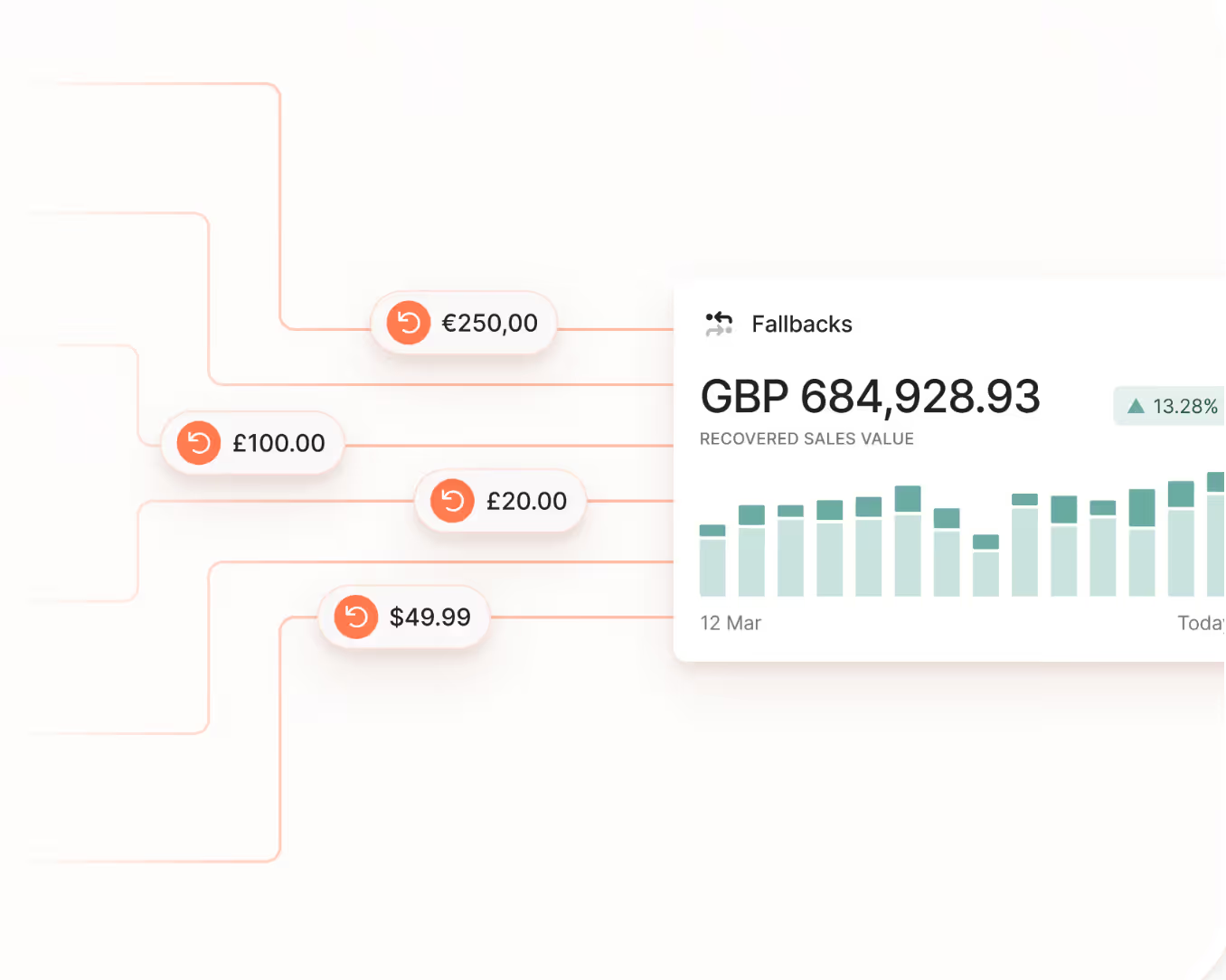
If Processor A declines a deposit due to a technical timeout, Primer instantly retries the transaction behind the scenes with Processor B. The player never sees an error message, and you don't lose the revenue.
For example, Banxa, a global leader in crypto infrastructure, recovered US$7 million in revenue by using Primer’s native Fallback functionality. They achieved a 22% success rate on transactions that would otherwise have been lost to soft declines.
Read the full case study: Banxa deploys Primer to break down barriers to crypto adoption
Build a resilient iGaming stack with Primer
Managing redundancy in the iGaming space shouldn't be a technical burden that slows down your growth. By using Primer, you gain the freedom to build a resilient, multi-PSP stack that protects your revenue and improves the player experience.
Build a resilient multi-PSP stack with Primer. Contact us to get started.
FAQs: iGaming PSP redundancy
1. What is the difference between smart routing and fallbacks?
Smart routing happens before a transaction is attempted, choosing the ideal processor based on data like region or bank. Fallbacks happen after a transaction fails, automatically retrying the payment with a secondary processor to recover the sale.
2. How many PSPs should an iGaming operator have?
Most successful operators use a minimum of two or three PSPs. This usually includes one global processor for card volume, a high-risk specialist, and local providers for specific regions or alternative payment methods.
3. Does implementing multiple PSPs increase PCI compliance work?
If you integrate each PSP directly, your PCI burden increases significantly. Using Primer's centralized vault reduces this burden because Primer handles the secure storage of sensitive card data on your behalf.
4. Why is local acquiring important for iGaming?
Local acquiring often leads to higher authorization rates and lower fees. Issuing banks are more likely to approve transactions that stay within their own domestic networks rather than cross-border payments.
5. Can I use a primary processor for cards and a different one for crypto?
Yes. A multi-PSP strategy allows you to route card payments to a traditional acquirer while using a specialized provider for crypto deposits. This ensures you use the best-in-class tool for each transaction type.

%20(1).png)