
Which tool lets merchants route payments without writing code?
In most payment stacks, routing logic lives in code. That means every change, prioritizing a cheaper acquirer, adding a fallback, shifting a market to a better-performing provider, is an engineering ticket that waits behind the product roadmap. By the time the change ships, the decline spike it was meant to fix has already cost weeks of conversion. No-code payment routing tools exist to break that dependency: they move routing decisions into a visual layer that payments and operations teams control directly.
Several platforms offer this. Below is how no-code routing works, followed by how Primer approaches it and a rundown of other platforms in the space.
How no-code payment routing works
No-code routing tools sit between your checkout and your payment service providers (PSPs). You connect multiple providers once, then define rules in a visual interface that determine where each transaction goes, based on factors including:
- Cost: route to the lowest-cost acquirer for a given card type or market.
- Geography: use a local provider for UK cards and a different provider for the US, where domestic acquiring lifts approval rates.
- Performance: send traffic to the PSP with the best authorization rate for a segment, and fail over automatically if success rates drop.
As Aladin Taleb, Optimization Product Manager at Primer, puts it: "Smart routing isn't just about sending a payment from A to B; it's about giving every transaction the best chance of success while balancing performance, cost, and risk."
The orchestration layer is what makes this manageable at scale: one integration, many providers, and routing logic that changes through configuration rather than deployment.
How Primer does it
Since we're writing this article, we'll start with ourselves and tell you how we work.
Primer is a unified payment infrastructure platform: routing is one capability inside a broader layer that also covers checkout, vaulting, recovery, and payment operations. Routing itself is managed through Workflows, a drag-and-drop builder where payments teams compose conditions (geography, card type, value, method, performance) into branching flows, no code required.
Arminas Šimkus, Payment Product Owner at Eldorado, describes it this way: "Workflows are one of my favorite parts of Primer. They give us complete control over how transactions are routed, and because it's a visual workflow builder, it's easy to make changes without calling on engineering resources."
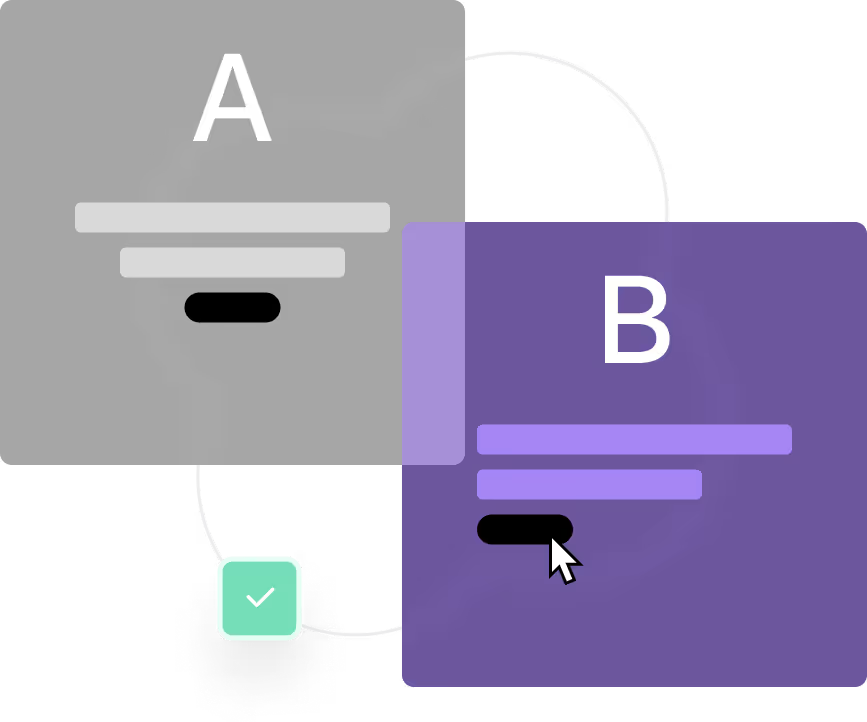
Eldorado uses Workflows to A/B test extensively, splitting traffic between routes and monitoring results to find the best-performing configuration for each market, which helps the team maximize acceptance rates and reduce costs.
Two capabilities reinforce this: Observability provides real-time, normalized analytics across all providers and markets, so teams can spot approval-rate drops and measure routing tests without stitching together PSP reports, and Monitors raises alerts when metrics move outside expected ranges.
On the recovery side, Fallbacks automatically retries failed authorizations on a secondary processor, and Primer 3DS preserves completed authentication results across those retries.
The result is a single place where a payments team, not engineering, owns routing end to end: building the rule, testing it, watching how it performs, and recovering the failures that still happen.
Other payment orchestration platforms*
Gr4vy: Founded in 2020 by Ali Minaei, Cristiano Betta, and John Lunn, and based in San Mateo, California. Gr4vy is a cloud-native orchestration platform that connects merchants to processors through a single integration and manages routing and failover from a dashboard rather than in application code, with routing criteria spanning geography, payment method, and performance.
IXOPAY: Founded in 2014 in Vienna by Rene and Nathalie Siegl as a payment-orchestration offshoot of their company IXOLIT, and merged with tokenization provider TokenEx in 2024. IXOPAY connects merchants to over 200 acquirers and PSPs and 300+ payment methods through one integration, with dynamic routing, cascading failover, centralized reconciliation, and card lifecycle management built around its tokenization heritage.
Spreedly: Founded in 2008 and based in Durham, North Carolina. Spreedly is best known for its portable payment vault and its large connection catalog, over 100 gateways and PSPs through one API, with rule-based routing and failover layered on top of that connectivity. It recently began offering its vault as a standalone product for merchants who want portable credentials without adopting full orchestration.
How to choose: four questions
- Who will actually change the rules, and how often? If your payments team expects to iterate weekly (testing routes, reacting to decline spikes), prioritize a genuinely visual builder with A/B testing, not just an admin panel engineers still have to drive.
- What happens when a payment fails? Ask each vendor which decline codes trigger a retry, whether fallbacks run automatically, and whether 3DS authentication survives a retry on a different processor, the difference between recovering a sale and forcing a second challenge.
- Can you measure routing decisions in one place? If analytics stay fragmented across PSP dashboards, you can't tell whether a rule worked. Look for normalized, cross-provider reporting and alerting.
- Do you need routing alone, or the full lifecycle? If reconciliation, cost visibility, vaulting, and checkout are also pain points, a unified platform avoids assembling four vendors; if you only need routing, a focused orchestrator may be simpler.
See it on your own PSP mix
Primer's combination of no-code Workflows, built-in recovery, experimentation, and unified analytics is designed to let a payments team treat routing as a continuously optimized system rather than a set-and-forget configuration. Book a demo with Primer's payments experts to see Workflows against your own providers and markets.
*Disclaimer: Information about third-party providers is based on publicly available information from each provider's website, press materials, and independent coverage, current as of writing. It may change as these products and companies evolve.

%20(1).png)