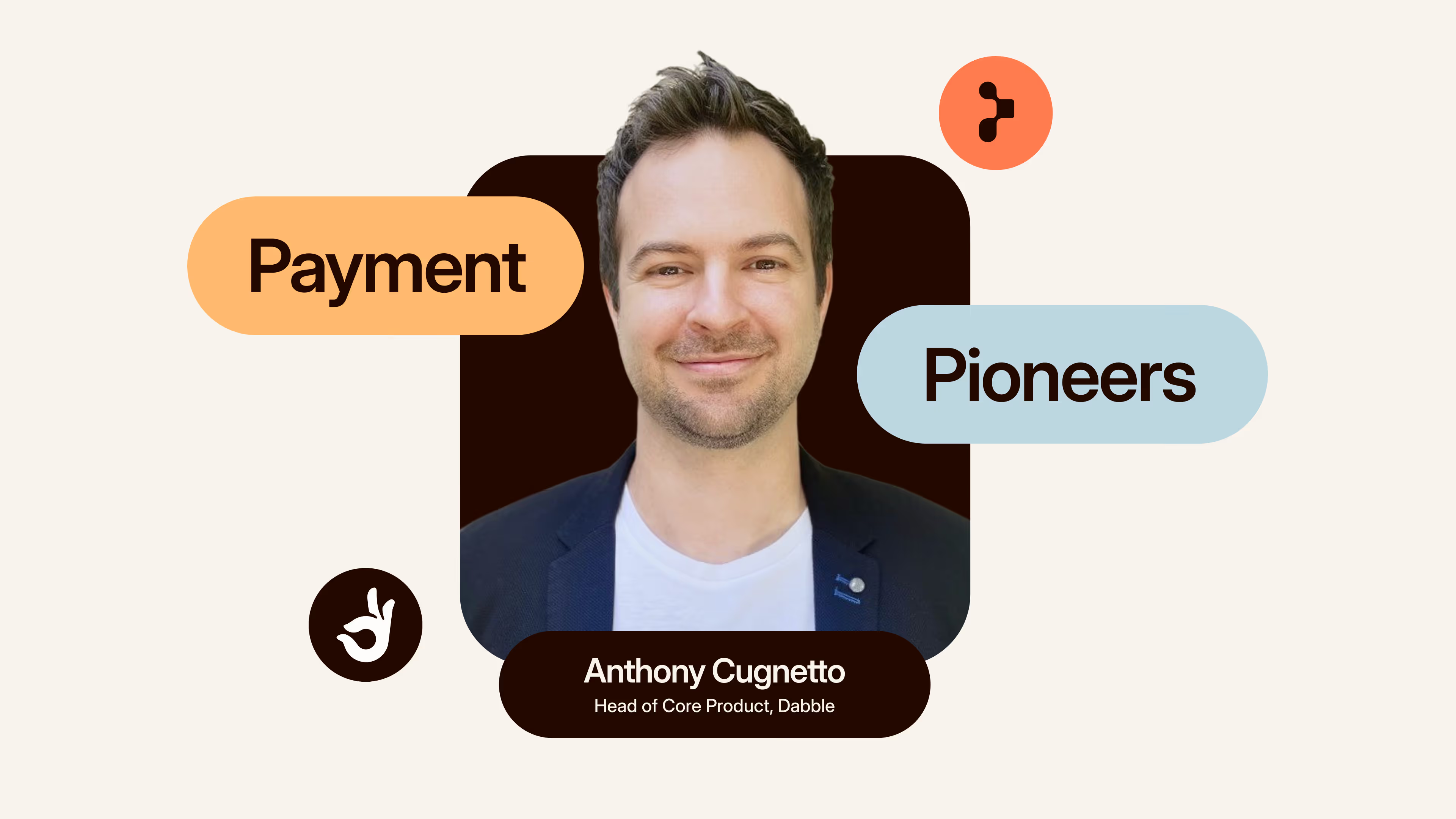
Like most people in the industry, Anthony Cugnetto didn't set out to work in payments.
He joined Dabble in 2023 and payments was just one part of his remit, one vertical among five. But the more he got into it, the more he put into it. What started as one piece of a broader product role became the area he kept coming back to.
It's that context, payments sitting inside a wider set of product responsibilities, that shapes how Anthony thinks. He's had to develop a view that goes well beyond the transaction itself.
We spoke to Anthony about what draws people into payments, why payout speed drives five-star reviews, and what it means to see the full picture.
You'd describe yourself as a product person first. How did payments end up becoming such a big part of what you do?
Technically, payments is one vertical of about five that I look after. I think about payments in the context of a lot of other things, but I do love payments. I'd been adjacent to it for a while.
Previous roles gave me some exposure within a product context, but I never really owned payments integrations and the overall payments product until I joined Dabble in 2023. And Primer was a big part of my initiation into the space. I had a lot to learn quickly.
Once I started working on it properly, I enjoyed it far more than I expected. I shifted my attention there and put a lot of focus into it. If anything, I'm quite new. But considering how fast payments move, I don't think that's necessarily a bad thing.
What pulled you in?
As a consumer, payments seem so simple. Hold your phone, tap, done. But when you open the hood and see how that payment actually happens, a $5 payment turns out to be immensely complex.
That's what pulled me in. I enjoyed taking it apart to understand each piece.
I wouldn't say payments is more complex than other domains, but it feels like it has more going on across more different areas, and each of those areas breaks down into sub-areas. Fraud alone is a world of its own. And they all interconnect. Getting a full picture of the end-to-end lifecycle, understanding how each step influences the next, is genuinely difficult. That's what keeps me interested.
Was there a moment when you realized payments wasn't just a back-office process and that it is actually central to the customer experience?
Probably two moments, from two different angles.
From a customer perspective, you don't hear much about the payment experience until things go wrong. When they do, you see immediately how critical it is. A good payment should be invisible. But when customers feel friction, it doesn't just affect that single transaction. It impacts their trust in the brand, their willingness to come back.
In fact, one of Dabble's most consistent drivers of five-star reviews in Australia is customers being able to deposit and withdraw quickly and easily. The payment experience sticks in people's minds, even when they're not consciously thinking about it.
From a product perspective, the realization was simpler: if you remove payments entirely, the app is unusable. If something that fundamental isn't getting enough attention, that has to change.
Sports betting has its own dynamics with high volumes, frequent small transactions, and event-driven peaks. Has that shaped how you think about payments?
The goal is the same whatever the industry: get the customer to pay for something, and make that experience as smooth as possible. I don't think I'd approach the fundamentals any differently working in e-commerce versus gambling.
What sports betting does underscore is frequency. Customers aren't making one large purchase; they're making many small ones, often in rapid succession. Any friction compounds fast.
And payouts are a trust signal in a way that's specific to the model. When someone gets their winnings in seconds, they're more comfortable putting money back in. That trust loop is built, or broken, entirely by how well payments perform.
You mentioned payments is one of five verticals you own. Is there an advantage in seeing payments as part of a broader set of objectives rather than as a standalone function?
Yes, and I think it's underrated.
If your only goal is to increase authorization rates, you can probably do that, but you might end up with a higher fraud rate or rising costs, because everything is interconnected. With payments, optimizing one metric in isolation often creates pressure somewhere else.
Looking at the full picture, from onboarding and KYC through to the payment itself and the payout, means you're not just focused on the transaction. Experiences earlier in the customer journey can directly affect whether a payment succeeds or fails. Seeing that context makes you a better decision-maker in my opinion.
Dabble is always on. How do you manage the pressure of owning something that can't go down?
Honestly, it's not something I actively worry about. The big days like the Melbourne Cup can make you nervous, but all the work is done beforehand so that when those moments arrive, everything runs smoothly. And it generally does.
From a day-to-day perspective, we have support teams across Australia, the US, and the UK, so there's global coverage. The operational teams have their processes and real-time alerts. If something goes wrong out of hours, we can identify it and react quickly. As long as the reporting infrastructure is in place, the system largely looks after itself.
What separates a good payments product leader from a great one?
Curiosity about how payments actually work. You can't just think about the checkout experience. You need to understand the technical stack underneath it, and how each part of the payment flow works, to understand why the experience looks the way it does.
The other thing is not seeing payments in isolation. The payment is the culmination of an entire customer journey. Things that happen before someone even reaches the payment page can affect whether that payment succeeds or fails. A great payments leader sees the whole picture, not just the checkout.
What advice would you give to someone considering moving into payments?
If you have a genuine interest in how money works and how money moves, go for it.
Practically: use as many payment methods as possible. Pay with different apps, wallets, cards, in different markets if you can. And then ask yourself what's actually happening behind the scenes. Start pulling it apart.
Build that curiosity into a habit. Because in payments, there's always more to understand.
Want to hear more about Dabble? Read how they use Primer to power their payments experience.
.avif)
%20(1).png)