
You might use one PSP for your core European volume, another for high-risk transactions, and a third for local payment methods in APAC. On paper, this multi-processor strategy is excellent for redundancy and conversion. In practice, it’s a reporting nightmare.
When your data doesn't speak the same language, you spend more time stitching spreadsheets together than you do actually optimizing your performance.
So, how do you move from fragmented silos to a single, actionable source of truth?
The hidden cost of fragmented payment data
- Invisible leakage: It’s almost impossible to spot a subtle drop in authorization rates in a specific market if that data is spread across three different logins.
- The reconciliation trap: Finance teams spend days, sometimes weeks, manually matching settlements to orders because every PSP uses a different reporting format.
- Guesswork over Evidence: Without unified data, A/B testing a new routing rule or fraud setting is virtually impossible. You can't see the "cause and effect" clearly if the results are split between systems.
Primer is a unified payments infrastructure designed to solve this. We consolidate your entire stack into a single interface, providing standardized, granular data that lets you act in real-time.
Book a call with Primer to see our platform in action
Three steps to unifying your payment data
1. Standardize the "language" of your payments
The first step to unification is normalization. You need a way to translate every status code, fee structure, and transaction type into a common format.
Instead of looking at three different ways to describe a 3DS failure, you need a single dashboard that categorizes them. This allows you to compare the performance of PSP A against PSP B on a level playing field.
2. Move from batch reporting to real-time observability
Relying on "Day+1" CSV exports is no longer enough. In 2026, a technical glitch at an acquirer can cost you thousands of euros in minutes.
To truly unify your data, you need near real-time observability. This means a dashboard that doesn't just show you what happened yesterday, but alerts you the moment an authorization rate dips below a certain threshold in a specific region.
3. Centralize with a Unified Payments Infrastructure
You have two choices: build a massive internal data warehouse (which requires constant engineering maintenance as PSPs update their APIs) or use a unified infrastructure layer.
A platform like Primer acts as the "connective tissue" for your entire stack. By routing all payments through one unified layer, every transaction, regardless of which PSP processed it, is automatically standardized and visualized in one place.
How Primer provides a single source of truth
At Primer, we believe that you can’t optimize what you can’t see. We provide the tools to turn fragmented data into a competitive advantage.
- Observability: Unify your entire payment flow into one dashboard with 400+ data points per payment. Slice and dice your data by processor, region, or payment method with over 30 filters.
- Monitors: Don’t wait for a weekly report to find a problem. Set up automated alerts that notify your team the moment a KPI moves outside of its expected range.
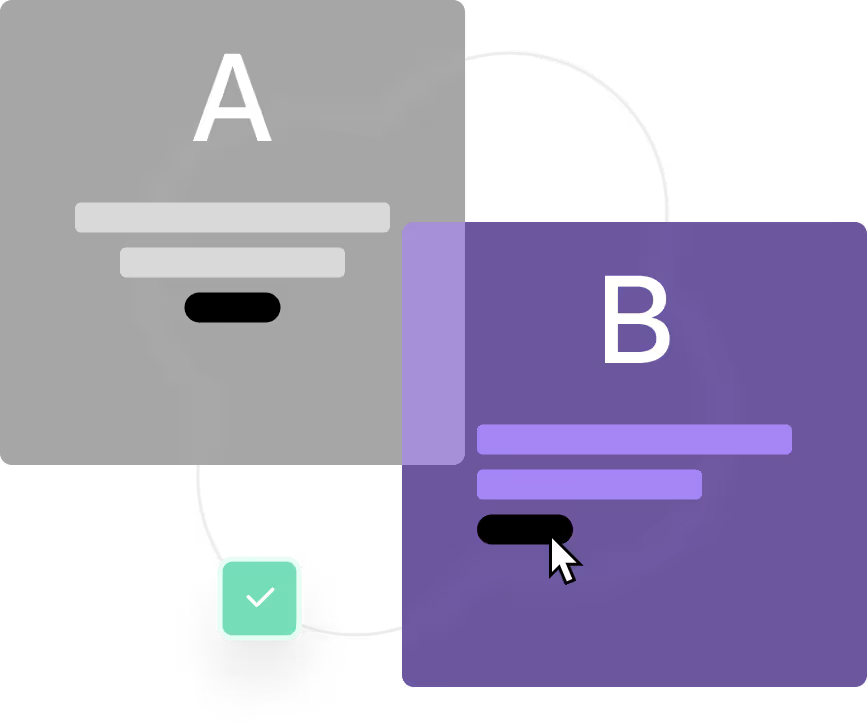
- Workflows & A/B Testing: Once you have unified data, you can act on it. Use our drag-and-drop Workflows to test different routing strategies and see the impact on your unified dashboard immediately.
“With Primer, we have complete visibility and control over our payments,” says Lucas Quinio, the first Head of Payments at Conforama. “We can connect all the services we need, adapt in real time, and optimize every step of the payment flow.”
Want to see how Primer can unify your specific PSP mix into a single dashboard? Get in touch with our team for a demo.
FAQs: Unifying Payment Data
Can I unify data if I use local payment methods like iDEAL or Pix?
Yes. A unified infrastructure should capture data from every method in your stack, from credit cards to local digital wallets, and present them in a standardized format for easy comparison.
Does unifying data require a total rip-and-replace of my current PSPs?
Not with Primer. We sit on top of your existing stack, meaning you keep your current PSP relationships and contracts while gaining a single, unified view and control layer.
How does unified data help with reconciliation?
By standardizing data across all processors, you reduce reconciliation time by up to 90%. Instead of manual matching, you can use intelligent matching and data standardization to close your books faster.

%20(1).png)