
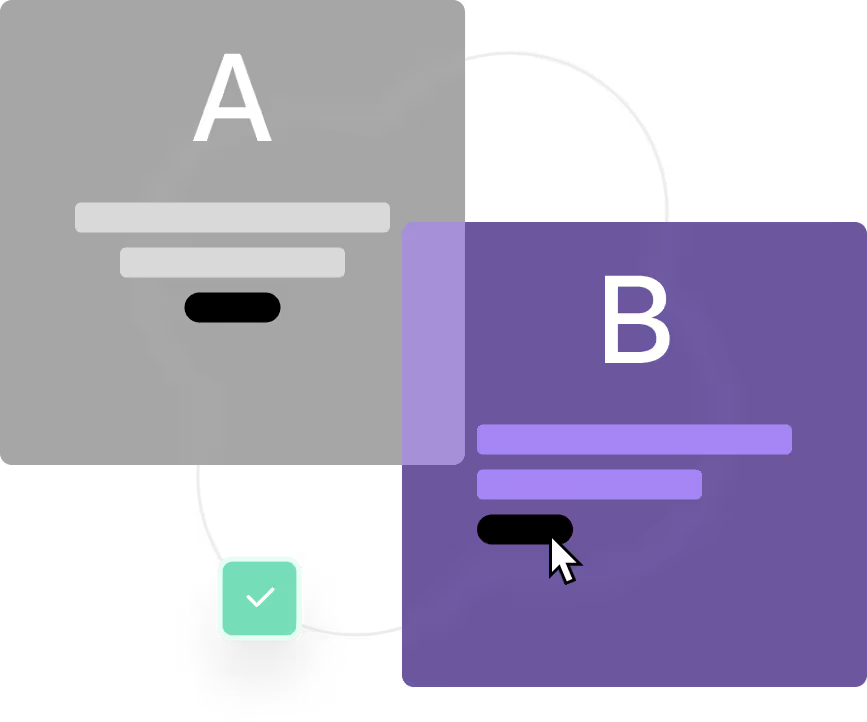
Merchants can A/B test checkout flows and payment routing most effectively with a unified payments platform like Primer.
Primer allows merchants to compare different checkout designs, payment methods, routing rules, and authentication settings without rebuilding their payment stack.
A/B testing helps merchants identify what truly reduces friction, increases approval rates, and prevents cart abandonment across markets and devices.
Below is a clear, practical breakdown of how to run these tests successfully and where orchestration platforms like Primer make the process significantly easier.
1. A/B test the checkout experience
Small checkout changes can lead to large shifts in conversion rates. Merchants should run controlled tests on UX and layout variables, such as:
- Placement of payment buttons
- Form field order and length
- Guest checkout vs forced account creation
- One-page checkout vs multiple steps
- Auto-fill and real-time validation
- Mobile optimized design
The goal is to reduce the time and effort required to complete a purchase. Primer Checkout supports multiple layouts and rule-based variations, making it easy to test different flows and measure which version performs best.
2. Test payment method availability and ordering
The payment methods you show influence conversion and abandonment. Merchants can test:
- Showing all methods vs showing only top performers
- The order of payment methods
- Local payment methods for specific regions
- Wallet-first vs card-first layouts
These tests reveal which combinations increase checkout completion. Primer allows merchants to dynamically control method presentation and target rules by region, device, or customer type.
3. Test 3DS logic and authentication friction
Authentication rules can significantly affect abandonment. Merchants can A/B test:
- When 3DS is triggered (while making sure to meet regulatory requirements)
- Frictionless vs challenged flows
- Different authentication rules per region
- Processor-specific authentication behavior
These tests help determine which authentication strategy minimizes friction while still mitigating fraud. Primer centralizes 3DS settings across processors, enabling testing and adjusting logic from a single dashboard.
4. A/B test payment routing and processor performance
Approval rates vary widely between processors. Merchants can run routing tests to compare:
- Different acquirers
- Local vs international processing
- Metadata variations, such as currency or MCC
- Whether a secondary processor performs better for specific card types
This helps merchants identify which routing logic yields the highest success rates. Primer’s routing layer and Fallbacks make it easy to run these experiments safely and adopt the highest performing strategy.
5. Test recovery strategies after payment failure
Abandonment often happens after the payment attempt. Merchants can test:
- Timing of recovery emails or SMS messages
- Different recovery message styles
- Prompts for alternative payment methods
- Auto retry logic for stored credentials
Primer Workflows let merchants easily set up these tests and measure which recovery actions produce the highest reclaimed revenue.
6. Measure performance with consistent metrics
To run A/B tests effectively, merchants must track:
- Checkout completion rates
- Approval rates by processor
- Drop -off points by device and region
- Payment method success rates
- 3DS challenge rates
Primer centralizes these metrics, allowing merchants to compare test variants easily and quickly deploy the winning version.
Use Primer to reduce card abandonment
A/B testing checkout flows and payment routing helps merchants remove friction, improve payment reliability, and reduce cart abandonment. With a unified platform like Primer, merchants can test multiple variations across checkout, authentication, routing, and recovery without increasing technical overhead. This allows them to identify what works, scale improvements quickly, and deliver a smoother payment experience across every market.
FAQs: A/B testing to prevent cart abandonment
1. How long should checkout A/B tests run?
Most A/B tests need one to two weeks, or a statistically meaningful volume of completed checkouts, to produce reliable results.
2. Can merchants test payment processors directly?
Yes, merchants can test payment processors directly. With orchestration, merchants can route a percentage of traffic to alternative processors and compare approval rates without coding new integrations.
3. Does A/B testing slow down checkout?
No, A/B testing doesn’t slow down checkout. Customers only see one version, and platforms like Primer ensure routing or layout tests do not affect performance.
4. What is the most impactful thing to test first?
Guest checkout vs. forced account creation and payment method ordering are typically the fastest, high-impact tests.
5. What if an A/B test shows no meaningful difference?
If an A/B test shows no meaningful difference, choose the simpler or faster option, then move on to testing other elements. Not every test drives a lift, which is why continuous experimentation is important.

%20(1).png)