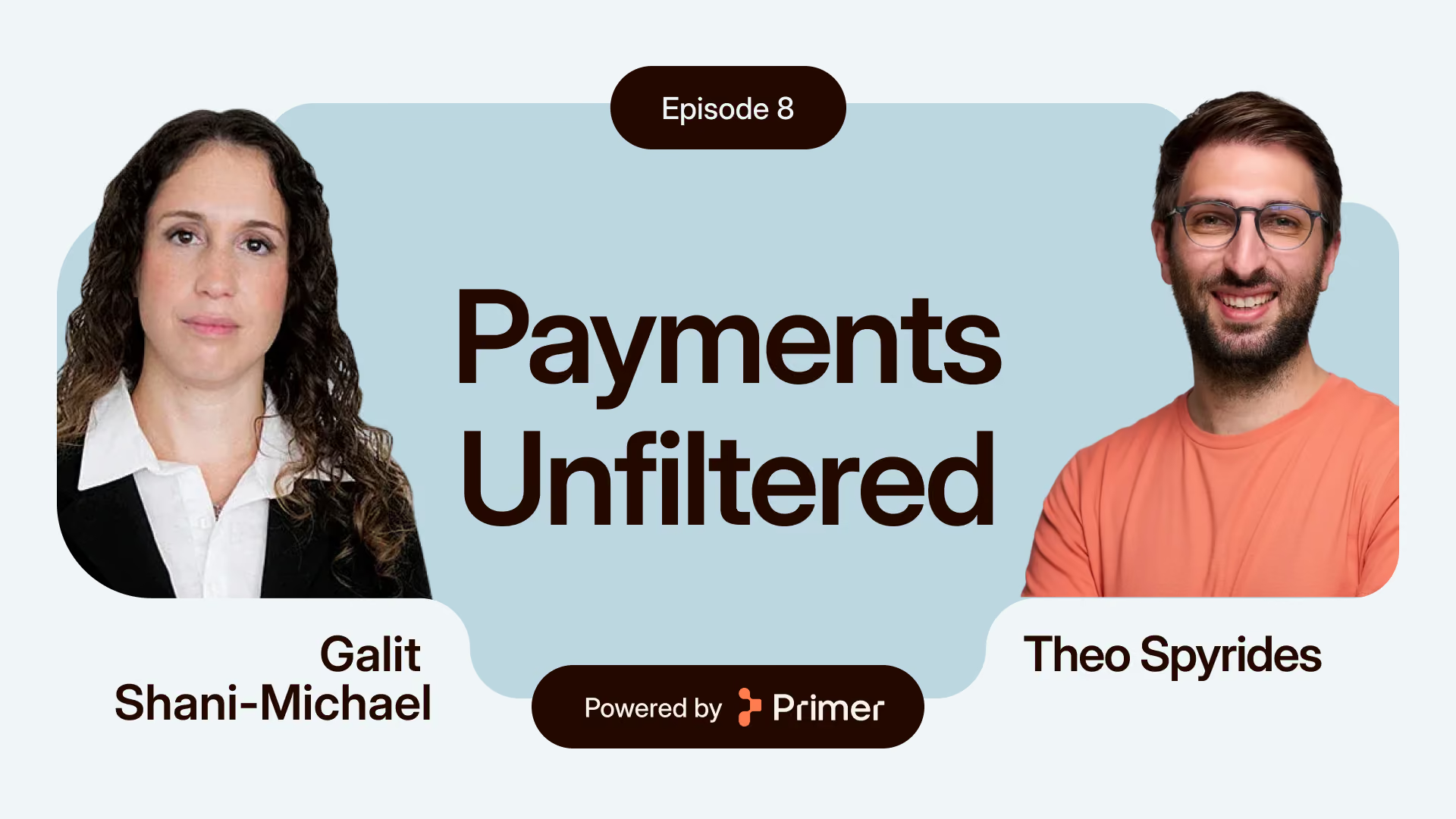
Why low fraud isn’t always a win, with Galit Shani-Michel of Forter
Low fraud and chargeback rates? Great. But what if it’s costing you customers? In this episode of Payments Unfiltered, host Theo Spyrides is joined once again by Galit Shani-Michel, VP of Emerging Products at Forter, to explore the hidden risks of a “zero fraud” mindset. From KPI misalignment to false declines and friction-filled 3DS flows, Galit explains how well-meaning fraud strategies can quietly damage conversion, customer experience, and long-term growth.

Theo Spyrides
Host of Payments Unfiltered
Galit Shani-Michel
VP of Emerging Products @ Forter

TS: Welcome back, Galit. Great to be speaking again. Today we're going to be diving into how we can help merchants think and manage their fraud strategy better. You've obviously had lots of experience even before Forta managing fraud for businesses, how do you approach building a fraud prevention strategy for a merchant?
Galit Shani-Michel: It's a really good question. I think the most important thing today is to realize that the technology has changed — a lot of the ways merchants used to fight fraud in the past aren't necessarily best practice anymore. A lot of things happened manually in the past. When I managed fraud, I had fraud rules and a team reviewing them, deciding if a transaction was fraudulent. Everything happened post-authorization — the authorization would go to the bank, then if a rule caught the transaction, it would wait for manual review. A lot of the riskier or flagged transactions would be reviewed by a fraud analyst who'd decide to void the transaction. Back then, the most important thing to get from your PSP was a long window between auth and capture, so you could still void the transaction if the agent thought it was fraud. Today, with all the technology, you can make real-time decisions using AI and other tools — you don't need to manually review transactions. You might still manually review a very small percentage, but best practice is doing it before authorization, so you can clean the traffic before sending it to the banks. Issuers and acquirers love you more when you only send them good traffic. When an issuer sees a lot of fraud, they block a lot of it — they don't know you'll catch it later, so they think they're blocking it all for you, and your risk level with them stays high, even if your chargeback rate is great. I recently talked to Bank of America about a merchant doing a great job with fraud post-authorization. I asked what their risk level was — "very high." I said there were no chargebacks. They said, "Look how many transactions we block for fraud" — they think it's thanks to them. That merchant moved their fraud detection to pre-authorization — real-time decisioning, no manual review needed (manual review can't happen before authorization anyway). They cleaned all the traffic, blocked fraud before it even went to authorization, and saved on decline fees. Issuers stopped seeing all that fraud. Two months later, Bank of America said the merchant was now low risk — "We don't have to decline fraud anymore." When issuers like you better, they lower their defenses, and the auth rate goes up over time. Fraud strategy ties closely into payment strategy. Some businesses separate fraud and payment managers, but we're seeing more consolidation there. To optimize your payments, you need a proper fraud prevention strategy. If your fraud strategy isn't great, your payment acceptance rate won't be either. Number one: make sure merchants are handling fraud pre-authorization.
TS: Is there any reason to do anything post-authorization in this modern world, with all the tools available pre-auth?
GS-M: Not really. Some merchants still want to manually review some traffic, depending on their business. We always advise: do everything pre-auth, then handle whatever's left post-auth if there's a real reason.
TS: And you save on headcount, right? You could take the budget for fraud analysts reviewing payments manually and put it toward the tooling instead.
GS-M: Exactly. Merchants moving to pre-auth and automating fraud don't need all those people reviewing it. It's more than that. With manual review, how do you double your headcount just for Black Friday and Cyber Monday? Consumers also want fast service; waiting three days in a queue isn't great customer experience, and that matters a lot today. When you automate and move to pre-auth, everything scales regardless of peak season, as long as you have the right fraud vendor. Merchants can redeploy that headcount to more strategic work — reviewing performance, understanding machine learning outputs. You still need people to decide how much risk to take on, per segment — automation doesn't mean handing the world over to a computer. In the US especially, 3DS used to be post-auth for years, but more merchants now understand the advantage of moving fraud to pre-auth. The other reason is to properly leverage 3DS: risky transactions should go to 3DS (not be declined outright), pure fraud should be declined, and good transactions should get a frictionless experience. You can't do that if your fraud check happens after the transaction — it's too late to apply 3DS then. Fraud strategy today has to span the whole flow — registration, login, checkout, post-purchase. Fraud can happen anywhere in that journey. If your checkout fraud defenses are strong, fraudsters will abuse you elsewhere — account takeover is a big one. They log into accounts that aren't theirs, change the address, and order freely since a card's already saved. Same with return abuse — claiming items weren't received, or returning something else entirely. The key is understanding identity at every interaction. Say "Garet" is registering — is it really Garet? It depends on your strategy: some merchants don't mind fake accounts (looks good for growth metrics), others want one account per person, especially to prevent coupon abuse. You have to decide whether to block at registration, at login, or only apply friction like 3DS at checkout, and understand what's actually at risk in that account (saved credit card, loyalty points, etc.).
TS: It sounds like you need to think very holistically about fraud strategy. You mentioned some companies have a head of fraud and a head of payments as separate roles. But maybe siloing fraud isn't the best approach. As a merchant, how would you advise setting up a fraud team? Separate from payments, or under one leader steering both strategies?
GS-M: It really depends on the merchant. There's also digital, customer experience, e-commerce management roles in the mix, so the structure varies. But the most important thing is that whoever leads fraud and whoever leads payments work together, with aligned KPIs. For example: if I'm the fraud manager measured purely on chargeback rate, I might send everything to 3DS (even using EU regulation as an excuse) — no chargebacks, looks great for me, but conversion tanks. The payment manager gets blamed for conversion, even though it was the fraud team's 3DS decision. Conversion isn't just auth rate — it's overall "complete rate": how many people tried to buy vs. how many succeeded. If your complete rate is 85%, that 15% loss might break down as 5% fraud declines, 5% 3DS drop-off, 5% bank declines — but it's all lost revenue. Someone needs to own that combined KPI, along with payment optimization (smart routing, data sharing with banks, etc.) and customer experience — which is often owned by someone else entirely. When I started managing fraud at one company, I proudly told the CEO chargebacks were really low. He said, "It's too low — can you show me your fraud decline rate?" I didn't have that report. He asked if I was sure I wasn't blocking good customers. That's when I realized I had it wrong. I fixed the strategy, fraud declines dropped, and average transaction value went up — because higher-value transactions that used to get flagged as fraud were now going through. Fraud needs to be low, but not zero — how low depends on your business, your chargeback losses, your 3DS exemption thresholds with your PSP. The real question is: are you measuring fraud decline rate and false decline rate? False declines are harder to track, but issuers can tell you that rate after the fact.
TS: How would you advise merchants on iterating and experimenting, like apply to all volume, a subset, use specific tools?
GS-M: With all the technology and fraud vendor networks available today, number one is understanding identity — hard to do alone since you only know identities you've seen before. Using a fraud vendor with a broader network helps determine legitimacy. Most large enterprises don't handle fraud in-house anymore, because even a 0.5% improvement in approvals is pure bottom-line revenue — and we're seeing merchants gain 2-3% more approvals with proper fraud prevention. A/B testing is critical — before/after data on any strategy change. For example, moving from post-auth to pre-auth: auth rate goes up, fraud declines go up, bank declines go down — but is your overall complete rate actually improving? You need to watch KPIs per segment too — new regions, new regulations (like Japan requiring 3DS) — and break it down further: 3DS success rate, auth completion rate, fraud detection rate. Measuring each step, across segments and countries, shows you exactly where the gaps are — e.g., "auth rate in India isn't great, but 3DS is fine, so what's happening?" You can loop in your PSP or peers in the community to investigate. The key is continuously monitoring KPIs to catch what's changed.
TS: Amazing. What's the one piece of advice you'd want businesses to take away when building their fraud strategy?
GS-M: Keep your customer in mind. A lot of fraud thinking assumes everyone's bad — instead, assume everyone's good unless proven otherwise. Think about the experience: customers want a frictionless, one-click checkout. They've already spent time finding what they want to buy, now they just want to get through payment and look forward to their package arriving. (My daughters ask "did my package arrive?" before they even say hello!) Payment shouldn't be the thing that stops that excitement. Build your strategy around detecting and protecting good customers while still catching bad actors. But if you treat everyone as a suspect, you'll block a lot of good customers too. Customer experience has to stay at the center.
TS: That's amazing advice. Thank you so much for your time. It's been great speaking with you.
GS-M: Thank you so much.
Meeting with the best in the business
Primer puts you in control of how money moves across the business. With our unified infrastructure you can orchestrate every flow, reduce friction, and capture more revenue everywhere.







Latest episodes
July 23, 2026
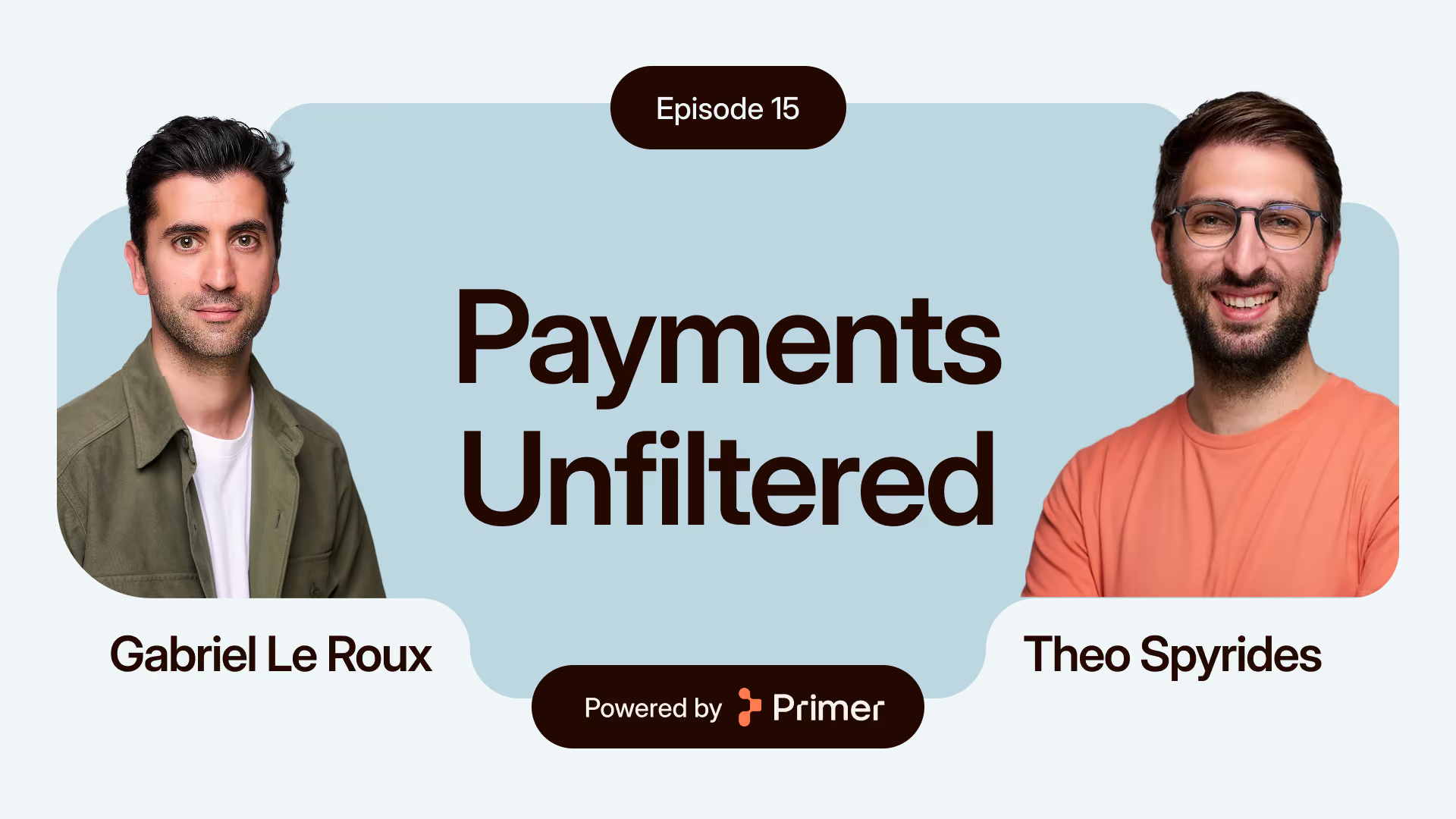
The next era of payments: AI, data & the end of the “black box”
Featuring:
Theo Spyrides
&
Gabriel Le Roux
In this episode of Payments Unfiltered, Theo Spyrides sits down with our co-founder and CEO Gabriel Le Roux to discuss where payments are heading next, why AI in payments is more about context than prompts, and what payments intelligence actually looks like in practice for merchants.
.avif)
June 15, 2026
Everything merchants need to know about chargebacks with Chargeblast’s Qi Cao
Featuring:
Theo Spyrides
&
Qi Cao
Most merchants think hitting their chargeback target means they're safe. Spoiler alert: they're not. In this episode of Payments Unfiltered, Theo Spyrides speaks with Qi Cao, co-founder and CEO of Chargeblast, to unpack chargebacks, what the Visa Acquiring Monitoring Program (VAMP) actually means for merchants, and why the merchants who manage disputes best are the ones who've already fixed their business model.
April 30, 2026
What is really takes to build and run a PSP at global scale with Worldpay’s James Fry
Featuring:
Theo Spyrides
&
James Fry
This is Part 2 of our conversation with James Fry, Head of Enterprise Product at Worldpay (now part of Global Payments). Most people know what a PSP does. Far fewer know what it actually takes to build and run one. In this episode of Payments Unfiltered, Theo Spyrides, VP of Product at Primer, and James pull back the curtain. James also shares how he thinks about structuring product teams inside a large payments organization and his advice for anyone building payment technology today.
March 19, 2026
From commodity to competitive advantage with James Fry at Worldpay
Featuring:
Theo Spyrides
&
James Fry
In this episode of Payments Unfiltered, Theo Spyrides, Head of Product at Primer, sits down with James Fry, Head of Enterprise Product at Worldpay (now part of Global Payments), to explore how merchants have evolved their approach to payments, and what that means for the payment providers supporting them. James also shares his perspective on two of the biggest trends reshaping the space: stablecoins as an additional payments rail for global merchants, and agentic commerce as a new channel that will require the industry to solve for trusted agents, fragmented protocols, and a whole new model of intent verification.
February 19, 2026
The shifts reshaping enterprise payments with Citi’s Will Artingstall
Featuring:
Theo Spyrides
&
Will Artingstall
In this episode of Payments Unfiltered, Theo Spyrides, Head of Product at Primer, is joined by Will Artingstall, Global Head of Digital Asset Payments and ecommerce Services at Citi. Will shares how Citi is working more closely with enterprise merchants as payment flows become more complex and new rails begin to emerge. They discuss how large organizations are approaching these changes in practice, and what it means for how payments are designed and managed.
January 21, 2026
How AI shoppers are forcing merchants to rethink fraud with Riskified’s Jeff Otto
Featuring:
Theo Spyrides
&
Jeff Otto
In this episode of Payments Unfiltered, Theo Spyrides, Head of Product at Primer, sits down with Jeff Otto, CMO at Riskified, to explore what happens when software starts acting on behalf of customers and what that means for risk, fraud, and merchant exposure. They discuss how agentic commerce changes who initiates a transaction, how trust is established, and why introducing an agent into the flow raises new questions around risk ownership and liability.
September 24, 2025
The business of play with Xsolla’s Berkley Egenes
Featuring:
Theo Spyrides
&
Berkley Egenes
Payments aren’t just infrastructure in gaming, they’re critical to the industry’s growth. From local wallets and currencies to mobile browser checkout, the way players pay now decides how studios scale. In this episode of Payments Unfiltered, Berkley Egenes, Chief Marketing & Growth Officer at Xsolla, joins host Theo Spyrides to outline a practical playbook for global game monetization.
April 16, 2025
Merchants, money & the mechanics behind the scenes with Natasha de Teran
Featuring:
Theo Spyrides
&
Natasha de Teran
In this episode of Payments Unfiltered, Theo Spyrides speaks with Natasha de Teran, author of The Payoff and former Head of Corporate Affairs at SWIFT, about the hidden complexity behind everyday transactions. Together, they unpack the frictions built into today’s payment rails, the rising role of regulators, and whether CBDCs and account-to-account payments are viable challengers to cards. Natasha brings a rare blend of policy insight and hands-on merchant experience to the conversation, questioning what’s changing in payments and who those changes are actually for.
March 12, 2025
Setting up payments for success with André Moeller (Elli)
Featuring:
Theo Spyrides
&
André Moeller
In this episode of Payments Unfiltered, Theo Spyrides sits down with André Moeller, Payments, Risk, and Fraud Professional Lead at Elli (Volkswagen Group’s energy and charging solutions provider). They explore the key strategies for setting up payments correctly, including defining the optimal payment flow: Understanding the difference between Customer-Initiated Transactions (CIT) and Merchant-Initiated Transactions (MIT); selecting the right payment methods: Aligning payment options with customer preferences, average order values, and regional trends; avoiding misalignment: Why businesses must involve payment experts early to prevent friction, fraud, and failed transactions; optimizing checkout experiences: How too many payment options can create unnecessary complexity and reduce conversion rates; the role of data: Using insights to optimize payments, reduce fraud, and improve business strategy; and building a strong payments team: Why hiring experienced payments professionals is critical for success.