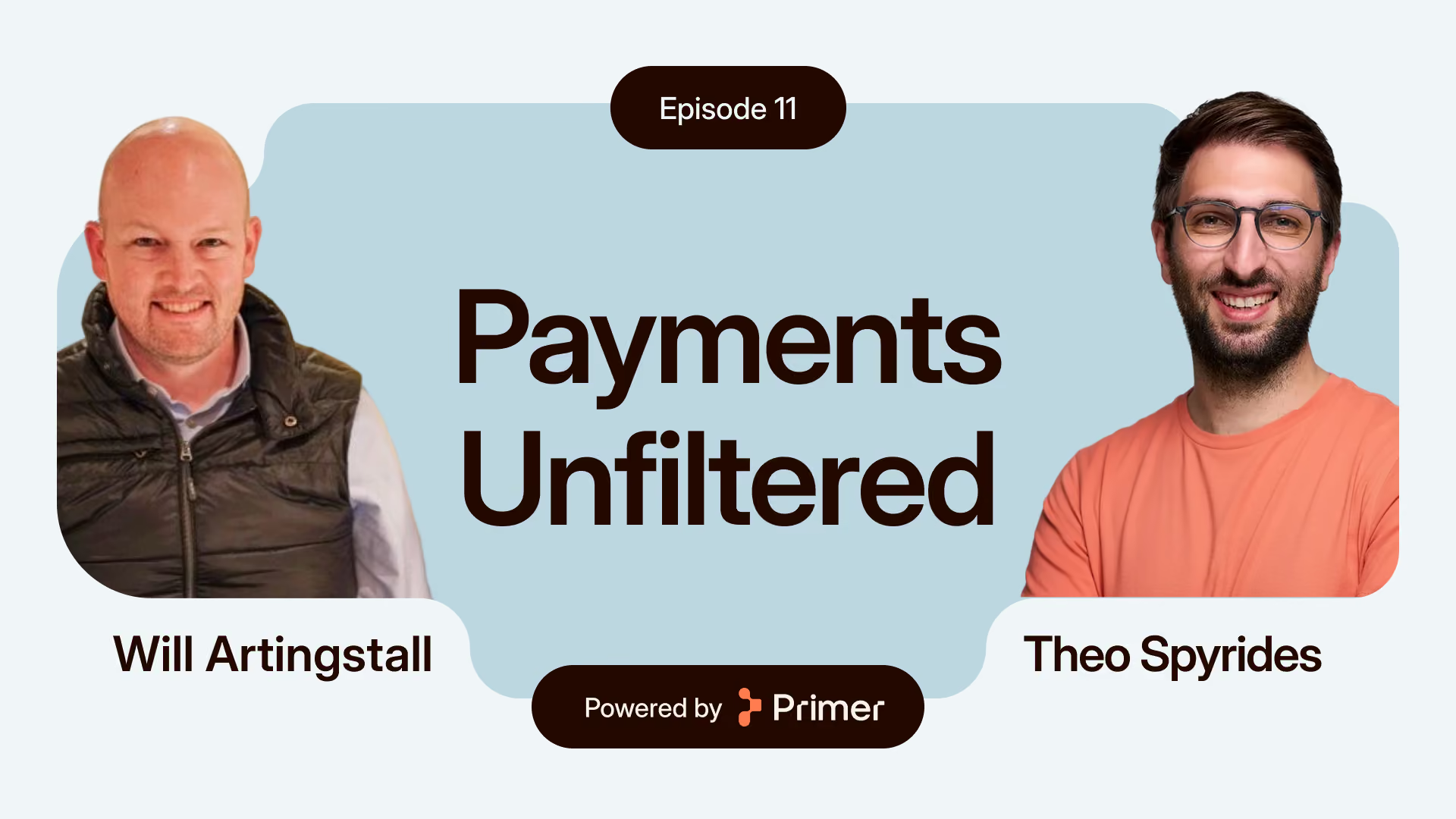
The shifts reshaping enterprise payments with Citi’s Will Artingstall
In this episode of Payments Unfiltered, Theo Spyrides, Head of Product at Primer, is joined by Will Artingstall, Global Head of Digital Asset Payments and ecommerce Services at Citi. Will shares how Citi is working more closely with enterprise merchants as payment flows become more complex and new rails begin to emerge. They discuss how large organizations are approaching these changes in practice, and what it means for how payments are designed and managed.

Theo Spyrides
Host of Payments Unfiltered

Will Artingstall
Global Head of Digital Asset Payments & ecommerce Services @ Citi

Theo Spyrides: Will, thanks so much for joining us today. As a starting point, could you give us a quick introduction to who you are and what your current role is?
Will Artingstall: Thanks very much for having me, Theo. It's great to be part of the conversation. I'm Will Artingstall, and I've been at Citi for a long time. I'm currently part of our Global Payments product organization, where I lead our digital asset payments and e-commerce services globally.
TS: Amazing. And as a starting point, how does Citi work with merchants today?
WA: We work with merchants across several different fronts. From one perspective, we work directly with merchants that are looking for services such as acquiring. They may be using platforms like Spring by Citi for general online payment acceptance. The second way we work with merchants is through several fintechs around the world. We support many of them with both acceptance and settlement. In those cases, we might work directly with the merchant, or we may be serving another participant in the ecosystem that then provides payment or other services to the merchant. So we see merchants from both perspectives.
TS: Amazing. I think the first model you mentioned, where merchants work directly with Citi as their acquirer, is something I'm particularly interested in because it's a topic that's coming up more and more in conversations I'm having with merchants. As a basic starting point, why would a merchant choose to work directly with Citi for an acquiring relationship instead of going through a PSP?
WA: It's a good question. If you think specifically about the acceptance side of the payment flow, there are multiple participants involved in a single payment lifecycle. You could have a gateway, a processor, an acquiring bank, and ultimately the bank account where the funds are settled. Going directly to the acquiring bank can make sense for several reasons, particularly in e-commerce, where every basis point matters. That last 10, 15 or 20 basis points of additional acceptance can make a huge difference when you're processing very large GMVs on relatively small margins. The main theme is reducing the number of intermediaries. Merchants that come directly to us are typically looking for a few different benefits by simplifying that gateway, processor, acquirer and bank relationship. One is cost efficiency. Removing intermediaries can reduce the overall cost of processing. The second is faster settlement. Because funds aren't moving through as many third parties, merchants can often settle faster. Another benefit is enhanced data and reporting. Working directly with the acquiring bank means you have visibility into both the gateway data and the treasury reconciliation associated with the bank account, all within a single participant. That makes reconciliation much more efficient because those data points are already connected. We also see merchants looking to optimize conversion rates. For a large institution like Citi, we're both an acquiring bank and an issuing bank. That means we can fine-tune some of the risk metrics, particularly for Citi-issued cards. When you're trying to improve authorization rates by even a couple of basis points, that additional insight can make a meaningful difference. Finally, there's resilience. Reducing the number of players and the number of handoffs between third parties naturally improves resilience. I remember speaking with a very sophisticated client a couple of years ago. They were looking at the performance of one of our acquiring BINs and noticed a slowdown at a very specific time on a particular day of the week. They asked us about it, and when we investigated internally, we realized they had actually identified one of the BINs we used for testing. It was fascinating to see that level of sophistication. Some merchants are now monitoring acquiring performance at that level of detail, giving them yet another lever to optimize acceptance rates. So there are a number of benefits that can make a direct acquiring relationship attractive.
TS: Got it. The point that stood out most to me, though, is when you're operating on both sides of the transaction as both the acquirer and the issuer. You mentioned being able to optimize the risk rules. If I understand correctly, because Citi is both issuing and acquiring in those scenarios, you're able to make better authorization decisions because you have access to more data than someone who's only acting as the acquirer. Is that correct?
WA: So, there are two ways you would tend to think about this. The one which is maybe the more innovative and less frequently used is looking at potentially redirecting traffic away from the card. Like, maybe there’s an opportunity to do things like an on-us transaction, but actually the real magic is even just in really simple things. So, as an example, you may look at the decline reasons when you’re looking at the actual issuance of the card and find that one of the main decline reasons is happening because the transactions are $5 to $6 over the credit limits of the card. You may decide as the issuing bank that you’re okay allowing those transactions to go at risk because it’s a small addition onto the overall credit line of the card. But by doing those things end to end, you can really dial in those little conversion rates. Again, because to your point, you’ve got access to the data on both sides of the transaction. So it’s allowing things like that to happen that smooth out that acceptance process. It’s really just a little bit of risk tolerance that you’re able to take and make, optimizing that acceptance flow because you see both sides of the transaction.
TS: Yeah, so I think if I play that back to you to make sure I’ve understood correctly, you essentially have access to unique levers to enhance performance because of your access to all the data and because of the tolerances and decisions that you get to make, because you see the entire transaction.
WA: That’s right. Yeah, I mean, essentially, if you think about it in that type of scenario where we are thinking about being on both the issuance side and the acceptance side, in that case the merchant is my client. The cardholder who holds the card is my client. I know both people.
TS: So maybe switching gears slightly, we’ve, in fintech and payments, there’s always lots of trends. And I think one of the ones that stands out at the moment is a lot around stablecoins or cryptocurrencies. Citi has been in the news as well recently with Coinbase, so I’d love to get your take on stablecoins. Maybe as a starting point, you could explain to the audience: what is it, and how do you think this new technology could impact traditional payment rails?
WA: We always like to think about this in terms of the different forms of money that exist today. You have central bank money, which commercial banks use to settle with each other, commercial bank money, which sits on banks’ balance sheets for customers, and e-money, which emerged through the fintech revolution and is typically backed by fiat held in a bank account. Then you had public cryptocurrency emerge from the 2008 Bitcoin whitepaper. That introduced a very different way of thinking about value and transactions, but with significant volatility and no direct connection to traditional fiat currencies. That volatility created demand for a more stable form of digital money, which is where stablecoins came in. Stablecoins are typically pegged to a fiat currency, such as the US dollar, with the most common model today being a one-to-one-backed token held on a blockchain. That’s effectively the fifth form of money we see emerging. The important thing is that all of these forms of money are moving through some form of tokenization and digitization. Whether that’s CBDCs, tokenized deposits, or stablecoins, we’re seeing the broader financial system evolve. In terms of where we’re seeing interest today, there’s definitely growing corporate interest in tokenization, driven by the potential to innovate, reach new customer segments, and create efficiencies. But many of our institutional clients are still in an exploratory phase. One of the biggest challenges is that treasury functions aren’t always set up to operate 24/7, and there are still questions around tax and accounting treatment. Ultimately, we see stablecoins as another tool within the broader digital asset ecosystem. It will become another form of payment within the wider payments landscape. At Citi, we’re inherently client-led, so we want to be where our clients’ needs are developing. That’s why interoperability is so important. Our clients don’t come to us for just one payment method; they need access to multiple forms of payment. We’re already exploring this through initiatives like our collaboration with Coinbase around digital asset payment capabilities, as well as the connectivity between Citi Token Services and our 24/7 clearing platform.
TS: So you mentioned the kind of what you are hearing from merchants is around, mainly from the treasury team and how can I leverage this kind of new form of currency in order to optimize what I’m doing as a treasury function? What are those optimizations? Is it cost, is it speed? Is it both? Do you have a sense of that?
WA: So, a couple of years ago, we realised that if you want to ask the smartest people in the room, you ask your clients. We ran a survey two years ago and repeated it last year, asking what they saw as the biggest competitive levers in an increasingly complex payments landscape. The response was very clear. There were three things clients viewed as mission critical: cost efficiency, speed, and transparency. Those were the key areas they were looking to improve in the transaction process.
TS: And is that gain applicable across all markets, or do you see it being more relevant in certain markets, such as emerging markets?
WA: I think it depends on where the friction exists. Some markets, like Brazil, have already built incredibly fast payment infrastructure through platforms like Pix, where transactions can settle almost instantly. In those cases, it’s difficult to create incremental value purely through speed. The bigger opportunity, especially in emerging markets, is often around removing friction around the payment process. For example, in markets with exchange controls, the delay isn’t necessarily the payment itself. It’s the preparation, documentation, compliance checks, and reporting requirements around that payment. The technology is often already fast. It’s the surrounding processes that create delays. That’s where solutions like Citi Token Services can add value. It’s a 24/7/365 near real-time settlement platform that allows clients to manage treasury positions outside traditional cut-off times. For example, a company could rebalance positions between the UK and US on a Friday evening rather than waiting for the next business day. Looking ahead, I think the most interesting area is programmable payments. Being able to create conditional payments on-chain could unlock new use cases in areas like trade finance, where today you might rely on instruments such as letters of credit or guarantees.
TS: And that 24/7 clearing capability, is that built using stablecoins, or is it leveraging different technology, such as blockchain itself?
WA: Citi Token Services is essentially a tokenised deposit, meaning it’s a token representation of a deposit held in a bank account. The advantage is that you get the benefits of moving tokens on a blockchain, while still having the regulatory clarity of a traditional deposit. It’s treated as cash, it’s easier to account for, and that has made it a practical solution for many corporates. Since the commercial launch in 2024, we’ve already seen billions of dollars of transactions flow through the platform. A lot of the adoption has come from solving practical problems, such as allowing treasuries to move money 24/7 and settle outside traditional banking hours.
TS: We’ve spent quite a bit of time talking about B2B. Do you see growing interest from consumers around using stablecoins for payments, acceptance, or payouts from businesses?
WA: Yes, I think we do, although many of these use cases are still exploratory. One interesting perspective came from a BCG report that looked at potential stablecoin payment flows across different segments. They estimated roughly half a trillion dollars in peer-to-peer payments, around $400 billion in consumer-to-business payments, and around $400 billion in business-to-business payments. The interesting point is that peer-to-peer is currently the largest opportunity. If more consumers gain access to stablecoins through those use cases, businesses may eventually need to support stablecoins as a payment method to serve that customer base. Ultimately, we see stablecoins becoming another part of the broader payments ecosystem. People like choice when it comes to how they pay, and the question is whether stablecoin adoption reaches a point where businesses need to support it as another payment option.
TS: Got it. So stablecoins are a really exciting technology being explored across both B2B and B2C. If I’m a merchant listening to this and I’m interested in exploring stablecoins, what advice would you give them on how to start that journey and think about embedding it into their business?
WA: So, Theo, following the regulatory shifts we’ve seen over the last year, I’d give two pieces of advice. The first is: read. There is so much happening in this space that it’s easy to miss something important because of the sheer volume of announcements. The second is: watch the regulators. The biggest economies have received a lot of attention, but many emerging markets are also starting to introduce frameworks and guidance around stablecoins, issuers, and crypto activity. For any merchant exploring this space, it’s important to understand both what the technology can enable and how the regulatory landscape is evolving.
TS: You mentioned something earlier that I’d love to explore further: this idea of co-creation. As a leader in payments and banking, how do you make sure what you’re building has the maximum impact for customers?
WA: I like this concept of co-creation. It was spearheaded by our Global Head of Payments, Deben, as a way to create deeper client engagement. Historically, product development in payments was often done in a bit of a vacuum because use cases were simpler. You might build a product for something like payroll or vendor payments. But the fintech evolution and the growth of embedded payments have changed that. Today, payments are often part of the product experience itself. Think about one-click checkout, or a gig economy platform enabling instant driver payouts. The payment isn’t just a transaction anymore; it’s part of the customer experience. That means you need to understand exactly what the client is trying to achieve and how they want to use the payment flow. You can’t design effectively without understanding the real-world problem you’re solving. That’s why co-creation is so important. The outcome is that you build something a client is ready to use because they helped shape it, while also creating something that can solve similar problems for other clients. The key is starting with real customer problems. Whether it’s a fintech dealing with compliance requests, a marketplace embedding financial services, or a business looking at cross-border payments, you need to understand the problem first and design the solution around it.
TS: If someone listening wants to introduce co-creation into their business, what pitfalls should they be aware of?
WA: I think the first pitfall is trying to solve too many problems at once. If you ask clients to share every challenge they have, you’ll end up with too much to tackle. You need to prioritise and focus on a small number of problems that are genuinely worth solving. The second is making sure you have the right people involved. You need three groups around the table: business stakeholders who understand the problem, product teams who can shape the solution, and technology teams who understand what is actually possible to build. The final thing is avoiding overly bespoke solutions. A good co-creation opportunity should solve a problem that exists beyond one company. If it’s too specific to one business, it’s unlikely to be prioritised by partners or scaled more broadly. Those are probably the three biggest things to keep in mind.
TS: That’s amazing advice. I’d echo all of those. Thank you so much for sharing your insights and joining us on Payments Unfiltered.
WA: Thank you.
Meeting with the best in the business
Primer puts you in control of how money moves across the business. With our unified infrastructure you can orchestrate every flow, reduce friction, and capture more revenue everywhere.







Latest episodes
July 23, 2026
The next era of payments: AI, data & the end of the “black box”
Featuring:
Theo Spyrides
&
Gabriel Le Roux
In this episode of Payments Unfiltered, Theo Spyrides sits down with our co-founder and CEO Gabriel Le Roux to discuss where payments are heading next, why AI in payments is more about context than prompts, and what payments intelligence actually looks like in practice for merchants.
.avif)
June 15, 2026
Everything merchants need to know about chargebacks with Chargeblast’s Qi Cao
Featuring:
Theo Spyrides
&
Qi Cao
Most merchants think hitting their chargeback target means they're safe. Spoiler alert: they're not. In this episode of Payments Unfiltered, Theo Spyrides speaks with Qi Cao, co-founder and CEO of Chargeblast, to unpack chargebacks, what the Visa Acquiring Monitoring Program (VAMP) actually means for merchants, and why the merchants who manage disputes best are the ones who've already fixed their business model.
April 30, 2026
What is really takes to build and run a PSP at global scale with Worldpay’s James Fry
Featuring:
Theo Spyrides
&
James Fry
This is Part 2 of our conversation with James Fry, Head of Enterprise Product at Worldpay (now part of Global Payments). Most people know what a PSP does. Far fewer know what it actually takes to build and run one. In this episode of Payments Unfiltered, Theo Spyrides, VP of Product at Primer, and James pull back the curtain. James also shares how he thinks about structuring product teams inside a large payments organization and his advice for anyone building payment technology today.
March 19, 2026
From commodity to competitive advantage with James Fry at Worldpay
Featuring:
Theo Spyrides
&
James Fry
In this episode of Payments Unfiltered, Theo Spyrides, Head of Product at Primer, sits down with James Fry, Head of Enterprise Product at Worldpay (now part of Global Payments), to explore how merchants have evolved their approach to payments, and what that means for the payment providers supporting them. James also shares his perspective on two of the biggest trends reshaping the space: stablecoins as an additional payments rail for global merchants, and agentic commerce as a new channel that will require the industry to solve for trusted agents, fragmented protocols, and a whole new model of intent verification.
January 21, 2026
How AI shoppers are forcing merchants to rethink fraud with Riskified’s Jeff Otto
Featuring:
Theo Spyrides
&
Jeff Otto
In this episode of Payments Unfiltered, Theo Spyrides, Head of Product at Primer, sits down with Jeff Otto, CMO at Riskified, to explore what happens when software starts acting on behalf of customers and what that means for risk, fraud, and merchant exposure. They discuss how agentic commerce changes who initiates a transaction, how trust is established, and why introducing an agent into the flow raises new questions around risk ownership and liability.
September 24, 2025
The business of play with Xsolla’s Berkley Egenes
Featuring:
Theo Spyrides
&
Berkley Egenes
Payments aren’t just infrastructure in gaming, they’re critical to the industry’s growth. From local wallets and currencies to mobile browser checkout, the way players pay now decides how studios scale. In this episode of Payments Unfiltered, Berkley Egenes, Chief Marketing & Growth Officer at Xsolla, joins host Theo Spyrides to outline a practical playbook for global game monetization.
July 31, 2025
Why low fraud isn’t always a win, with Galit Shani-Michel of Forter
Featuring:
Theo Spyrides
&
Galit Shani-Michel
Low fraud and chargeback rates? Great. But what if it’s costing you customers? In this episode of Payments Unfiltered, host Theo Spyrides is joined once again by Galit Shani-Michel, VP of Emerging Products at Forter, to explore the hidden risks of a “zero fraud” mindset. From KPI misalignment to false declines and friction-filled 3DS flows, Galit explains how well-meaning fraud strategies can quietly damage conversion, customer experience, and long-term growth.
April 16, 2025
Merchants, money & the mechanics behind the scenes with Natasha de Teran
Featuring:
Theo Spyrides
&
Natasha de Teran
In this episode of Payments Unfiltered, Theo Spyrides speaks with Natasha de Teran, author of The Payoff and former Head of Corporate Affairs at SWIFT, about the hidden complexity behind everyday transactions. Together, they unpack the frictions built into today’s payment rails, the rising role of regulators, and whether CBDCs and account-to-account payments are viable challengers to cards. Natasha brings a rare blend of policy insight and hands-on merchant experience to the conversation, questioning what’s changing in payments and who those changes are actually for.
March 12, 2025
Setting up payments for success with André Moeller (Elli)
Featuring:
Theo Spyrides
&
André Moeller
In this episode of Payments Unfiltered, Theo Spyrides sits down with André Moeller, Payments, Risk, and Fraud Professional Lead at Elli (Volkswagen Group’s energy and charging solutions provider). They explore the key strategies for setting up payments correctly, including defining the optimal payment flow: Understanding the difference between Customer-Initiated Transactions (CIT) and Merchant-Initiated Transactions (MIT); selecting the right payment methods: Aligning payment options with customer preferences, average order values, and regional trends; avoiding misalignment: Why businesses must involve payment experts early to prevent friction, fraud, and failed transactions; optimizing checkout experiences: How too many payment options can create unnecessary complexity and reduce conversion rates; the role of data: Using insights to optimize payments, reduce fraud, and improve business strategy; and building a strong payments team: Why hiring experienced payments professionals is critical for success.