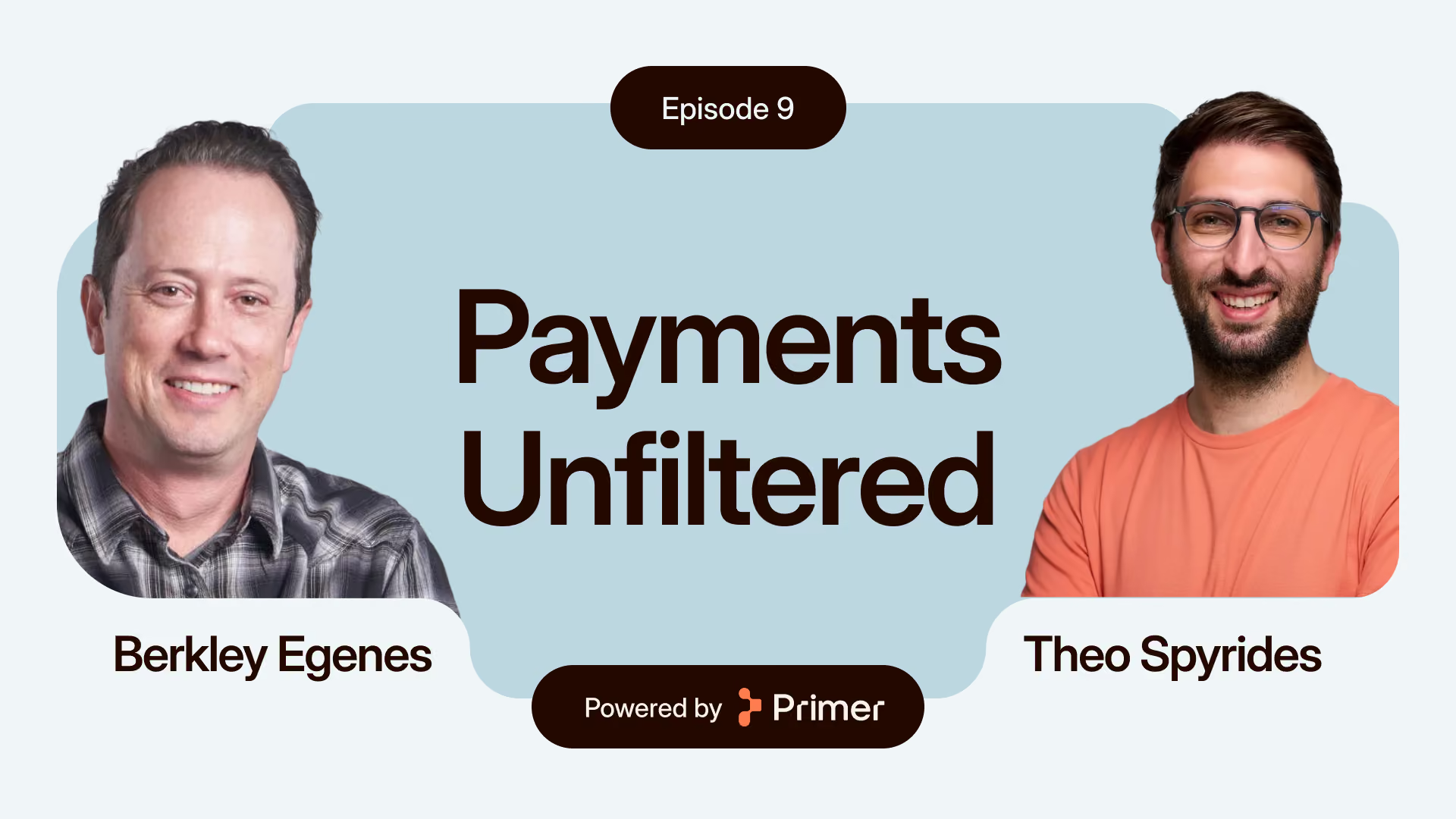
The business of play with Xsolla’s Berkley Egenes
Payments aren’t just infrastructure in gaming, they’re critical to the industry’s growth. From local wallets and currencies to mobile browser checkout, the way players pay now decides how studios scale. In this episode of Payments Unfiltered, Berkley Egenes, Chief Marketing & Growth Officer at Xsolla, joins host Theo Spyrides to outline a practical playbook for global game monetization.

Theo Spyrides
Host of Payments Unfiltered

Berkley Egenes
Chief Marketing & Growth Officer @ Xsolla

Theo Spyrides: Let's dive in — could you tell us about Xsolla, who you are and what you do?
Berkley Egenes: I'm Berkley Egenes, Chief Marketing and Growth Officer at Xsolla. I've been here about five and a half years and loved every bit of it — learning and growing in the industry from a video game commerce perspective. We're the global leader in video game commerce. Think of us as the Shopify of video games: we help developers distribute games to players anywhere in the world, letting them play on their preferred platform and pay with their preferred method — digital wallet, credit card, or other local electronic payment methods. We support over a thousand payment methods, working with PSPs around the world. That could mean anything from paying like you'd pay for groceries on a smartwatch, to serving unbanked players who don't have a bank account. We work with partners like Pix in Brazil to bring a digital wallet experience into the checkout, so no matter where you are, you can play and pay how you want.
TS: If I'm a game developer wanting to monetize my game, what do I need to consider?
BE: First, have an amazing game. Developers should focus on creating something beautiful and immersive — whatever the platform, mobile, PC, or web. Focus on the game and its mechanics. As you build and prepare to launch, you'll need a monetization strategy — that's where we help. Want to go free-to-play? Here are the mechanics you'll need: offers, pre-orders, game keys for demos, and so on. At the end of the day you need a real business — great games are great businesses too, and we help make that possible. Think about the mechanics: subscriptions, "premium" (pay once and you're done), or free-to-play like the Fortnite model — everyone wants to replicate Fortnite because of what Epic built with skins and IP tie-ins. It depends on the journey you're creating, and we support whatever monetization method you choose.
TS: So there are some big early decisions to make, since they shape the game itself. So how do i think of things like subscription versus free-to-play with add-ons?
BE: Exactly, and it happens very early — we'll see storyboards and immediately ask how they want to monetize. For pre-funded games especially, we help with those decisions. A lot of developers already have a model in mind — "I want to do it like Tilting Point with Warhammer or Star Trek," or "I want to replicate Fortnite," or "I want the Roblox model with season passes." If you're doing quarterly content updates, a season pass and subscription probably make sense. If you want constant updates and new IP, free-to-play is the clear choice — and we set up the online distribution and monetization for that. Those are decisions you make pre-launch. Post-launch, some developers come back wanting monthly updates or incentives based on community demand — some partners even release new offers twice a week because fans want more.
TS: As a game developer, I know nothing about payments. What do I need to think about to actually accept funds and receive cash in my account?
BE: That's the core question for what we call "garage games" — a handful of people in a garage, office, or dorm room. You need to be able to accept payments. Accepting payment in the US alone means dealing with taxation in every state. In Europe it's not just "the euro" — every country has its own specifics. So you go to a provider — most people start with PayPal. But as you grow — say an influencer causes a spike in South Korea — you can't just turn that on overnight because of legal, tax, and compliance requirements. That's where we come in as a Merchant of Record: we distribute and sell the game worldwide on the developer's behalf. You could be based in London with a following in South Korea — you don't need a presence there, we operate on your behalf, collecting payments through the channels your players are used to. For a small fee, we collect the transaction and pay you out at the end of the month, so you can forecast revenue and make business decisions. Without proper payments infrastructure, growth stalls — or your game stays a hobby rather than becoming a real business.
TS: So you take on a lot of the "unsexy" but essential work.
BE: Exactly — everyone thinks about merch, cosplay, influencers, the fun stuff. We handle the back end: chargebacks, dispute resolution, and issues developers don't anticipate — like someone accidentally buying two copies of a game, or a kid spending $3,000 on skins. In those cases we help set up parental controls — removing saved credit cards, setting limits — while still giving kids freedom to play. We even see adults spending thousands on mobile games. One partner has $10,000 transactions for digital skins on a mobile game.
TS: Since it's a digital good, I'd imagine fraud and chargebacks are a big issue. What trends are you seeing in gaming payments?
BE: Digital wallets, overwhelmingly, worldwide. In emerging markets especially, many players are unbanked — they're paid in cash and need to convert it into digital currency to pay bills or buy games. You'll see more digital wallets: Apple Pay and Google Pay in the US, and in Asia, things like scanning a QR code or paying via WeChat Pay. The Middle East and Africa are very mobile-first — high-speed internet and PC infrastructure are less common, so everything happens on mobile. Southeast Asia is similar with digital apps. On dispute resolution, we have industry-leading, automated anti-fraud protection built into our payments platform, detecting about 99% of fraud transactions. When a chargeback dispute comes in, we investigate using machine-learning tools: was there two-factor authentication, proper sign-in verification, and so on. Our chargeback win rate is around 60%, versus an industry average of 20-30%, thanks to 20 years of experience working with developers. Developers often don't even know this is happening, since we operate as Merchant of Record. Our support team operates 24/7 in over 25 languages, because players are everywhere. Chargebacks are costly — a real chargeback can cost 2.5x the transaction value. A $10 transaction can cost $25 to reverse once you factor in the payment processing itself.
TS: How much of a value proposition is that Merchant of Record model versus building it in-house?
BE: Huge. Other providers may charge a lower fee, but they don't have our chargeback win rate or fraud protection. They can't cover as many payment methods. That's worth more than our standard 5% transaction fee. Some developers try to do it themselves, and a month later many come back — it's time-consuming, expensive, and painful. Suddenly someone on your small team becomes the de facto CFO instead of focusing on development.
TS: You carry a lot of responsibility navigating the regulatory landscape too. Things like Epic v. Apple and the Digital Markets Act. Can you explain what's changed?
BE: It's a huge topic right now. The rules of the game keep changing. On April 30th, the California court ruling in Epic v. Apple gave mobile developers the ability to link directly to a web shop. Before that, purchases had to happen entirely within the app, using iOS's payment system. We've actually run web shops for mobile games since 2001. More of a traditional e-commerce experience with different offers and bundles unavailable in-app. Now, developers can link directly from the app to that web shop, which wasn't allowed before. A familiar example is Spotify: before April 30th, upgrading your subscription required logging in separately on a PC. Now there's a direct link right in the app. It's the same in gaming — you're low on in-game currency, you get a one-click offer, it opens a mobile browser, you complete the purchase via ApplePay, and you're back in the game instantly.
TS: What's the benefit of doing that in the browser?
BE: Higher conversion and more control over the branded experience. Before, developers could only offer standard in-app pricing. Now they can tailor offers to player behavior — "you're almost out of gems, here's a bundle," or "welcome back, here's an offer." It's fewer clicks, less friction, and developers own the experience end-to-end, instead of being confined to the iOS ecosystem. That said, in the UK you can't do this yet — but you could for players in the US. That's where we help developers navigate these regional differences. Under the EU's Digital Markets Act it's a bit different — fees follow a tiered structure rather than disappearing entirely. A couple weeks ago Google faced a similar ruling in the US. This is the reality — rules change constantly, including things like child privacy laws. Six developers in a room can't be expected to track all of that, and that's fine — we send guidance directly when rules change so developers know what applies to their game and region. We expect this kind of policy shift to keep spreading globally — South Korea, Southeast Asia, South America, Europe, Africa — and our team stays on top of it so developers don't have to.
TS: It sounds exciting that developers now have another lever to pull for conversion and upsell, and it feels like a decoupling of the platform from the payment system. If you had a crystal ball, how do you foresee payments looking like in a games environment?
BE: Decoupling is exactly the right word. A democratization of payments in games. It's about giving developers freedom of choice. In Poland, for example, you can now pay using points. We're bringing on more payment methods, and you'll keep seeing policy shifts that give developers back control over the direct-to-consumer relationship and brand experience. Something that was much harder to navigate even a couple of years ago.
TS: How much of that forecast applies to other digital goods beyond gaming?
BE: Very applicable. Music is a great example, in terms of monetizing and distributing content across geographies. You're going to see more of this cross-industry convergence: entertainment, movies, streaming. More films are moving across platforms like Apple, Netflix, and Hulu. You're even seeing this on airplanes — saving your profile in the seatback screen on a Delta flight, connecting your account, making a purchase mid-flight. There will be a screen in front of you everywhere — airplanes, taxis — recognizing you and enabling instant transactions, even bill payments, connected through your digital wallet or bank.
TS: You mentioned expanding into different countries, how do you determine the right payment methods for a new region?
BE: We look at the game, the brand, and the target market, and offer developers the choice — it's all listed in our publisher account, just a few clicks to turn methods on. Usually we recommend turning most of them on. Going into Japan, for example, LINE Pay and PayPay alone cover over 50% of the market. Paytm does the same in India. Our team is constantly researching and adding new methods — we launched 11 new payment methods across the Middle East and North Africa in March alone, with more coming. We have dedicated teams handling both game partnerships and payment system partnerships, signing PSPs and managing the legal and licensing work. We look beyond the major global brands — sometimes a smaller regional method might cover 20% of a market like South Africa or Egypt, which is significant enough to prioritize.
TS: I assume you have your own internal payment strategy too, managing redundancy and optimizing rates?
BE: Definitely. A big piece is localized pricing. The price point that works in Brazil isn't the one that works in the US. It takes testing, iteration, and accounting for local taxation. We also handle fraud protocols tied to IP and banking location, things developers wouldn't necessarily think about, but we make sure it's handled correctly.
TS: And that probably varies by payment type too – subscriptions, recurring payments like the new Pix Automático in Brazil?
BE: Exactly. We have two business development teams – one signs game developers, the other signs payment systems. And they coordinate closely. If a developer sees a surge of interest from, say, Kenya, we can quickly evaluate and enable the right payment methods there.
TS: What are the hardest problems in managing so many payment integrations?
BE: Communication and scale. We're constantly rolling out new payment methods and need to keep our teams updated so developers know what's available and why it matters. It's a lot to track, but it enables that democratized experience where developers can choose exactly what fits their audience. We also proactively flag opportunities, like if a game is getting strong traffic from Japan but has only one local payment method enabled, we'll recommend turning on others to increase conversion. The worst outcome is a player abandoning a purchase because their preferred payment method isn't available.
TS: Or the local currency isn't offered. If I'm in the US and it says "10 euros," I'm probably not converting.
BE: Right, and currency fluctuations can make that worse. That's why we support over 130 currencies. Most developers, even mid-tier and enterprise, don't want to think about this. They want to focus on game development, merchandise, or even movie adaptations. We saw that with Minecraft and Mario extending their IP into film. We handle the payments infrastructure in the background so developers can focus on their craft.
TS: I spoke to a merchant this morning doing tens of millions in monthly volume in Europe who only offered euros until last week, and now they're unlocking five or six more currencies.
BE: That'll open up new regions and higher conversion. It's fascinating that these entrepreneurs build incredible businesses without being payment experts. And that's fine, as long as they eventually bring in someone to own that function, otherwise it caps their growth. We've seen games go from 5-10% growth to 20-40% just by opening up the right payment systems, real businesses transformed by simply enabling payments in Taiwan, South Korea, and Japan.
TS: So a few clicks can take you from three or four markets to a fundamentally different business.
BE: Exactly, from planning "version two" to suddenly being able to do three, four, or five, just from a backend change.
TS: If there's one thing you're most excited about in gaming, and how payments will enable it, what would it be?
BE: Seeing the digital and physical worlds converge. Imagine buying a cosmetic skin in-game and redeeming the physical item in the same transaction. You're already seeing luxury goods enter games — Jordan shoes in Fortnite, Louis Vuitton around esports trophy cases, starting with League of Legends Worlds and now Formula One. Entertainment is merging with gaming too — buying a music track through a game, or games and movies crossing over, like Uncharted becoming a film or Minecraft's movie boosting the game's IP. Netflix and Amazon are both moving into games — Amazon lets you buy toilet paper, watch a show, and play a game all in one ecosystem. We'll see more consolidation — Netflix, Amazon, telcos like Verizon or Three getting more integrated. And mobile is central to all of it — for Gen Z and Alpha, their first experience with a mobile device is often a game, which is a completely different relationship with technology than previous generations had.
TS: Well, thank you so much for sharing. It's been great having you.
BE: It's been a lot of fun, thanks for having me. Great to be here in London in person.
Meeting with the best in the business
Primer puts you in control of how money moves across the business. With our unified infrastructure you can orchestrate every flow, reduce friction, and capture more revenue everywhere.







Latest episodes
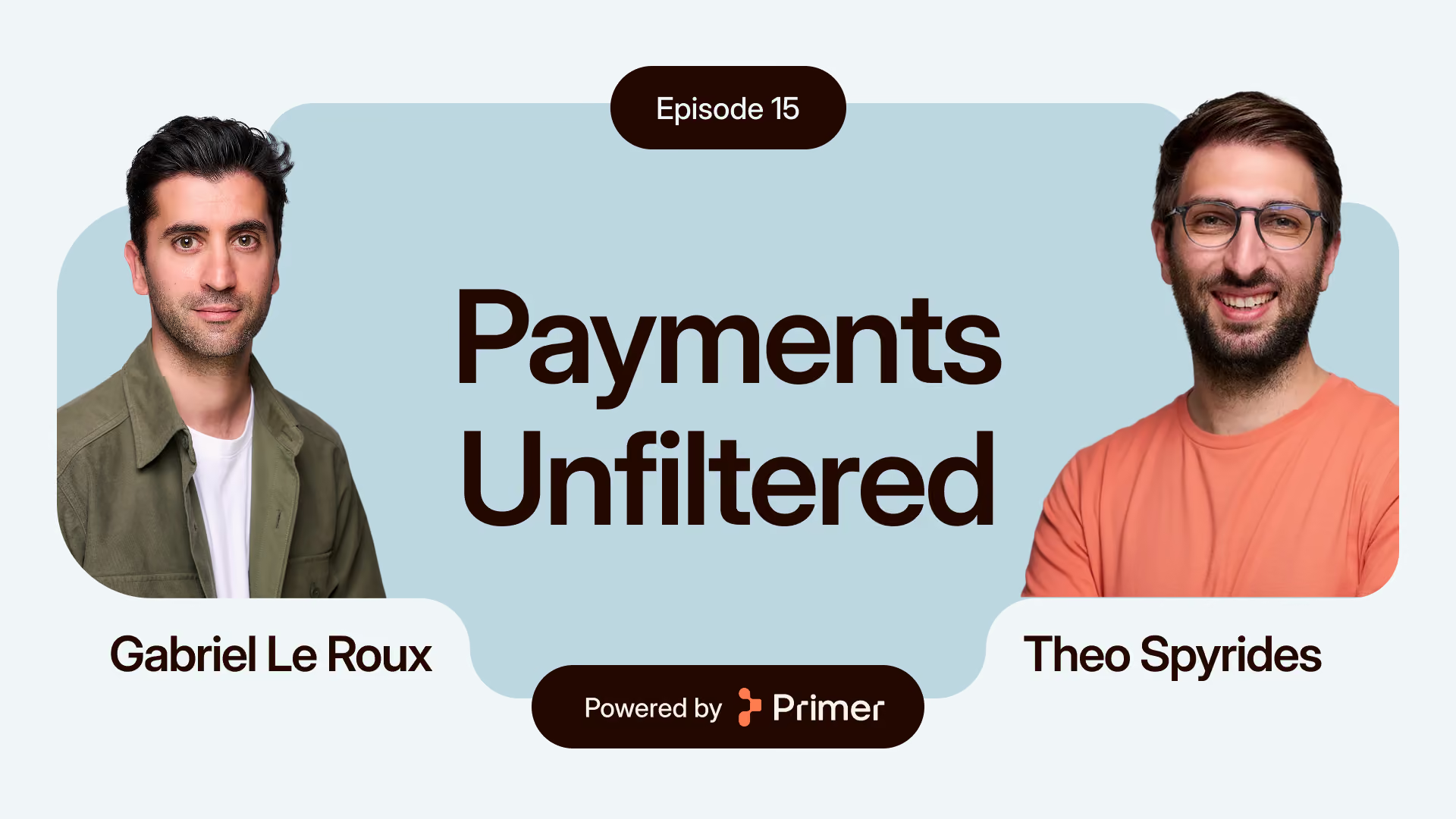
July 23, 2026
The next era of payments: AI, data & the end of the “black box”
Featuring:
Theo Spyrides
&
Gabriel Le Roux
In this episode of Payments Unfiltered, Theo Spyrides sits down with our co-founder and CEO Gabriel Le Roux to discuss where payments are heading next, why AI in payments is more about context than prompts, and what payments intelligence actually looks like in practice for merchants.
.avif)
June 15, 2026
Everything merchants need to know about chargebacks with Chargeblast’s Qi Cao
Featuring:
Theo Spyrides
&
Qi Cao
Most merchants think hitting their chargeback target means they're safe. Spoiler alert: they're not. In this episode of Payments Unfiltered, Theo Spyrides speaks with Qi Cao, co-founder and CEO of Chargeblast, to unpack chargebacks, what the Visa Acquiring Monitoring Program (VAMP) actually means for merchants, and why the merchants who manage disputes best are the ones who've already fixed their business model.
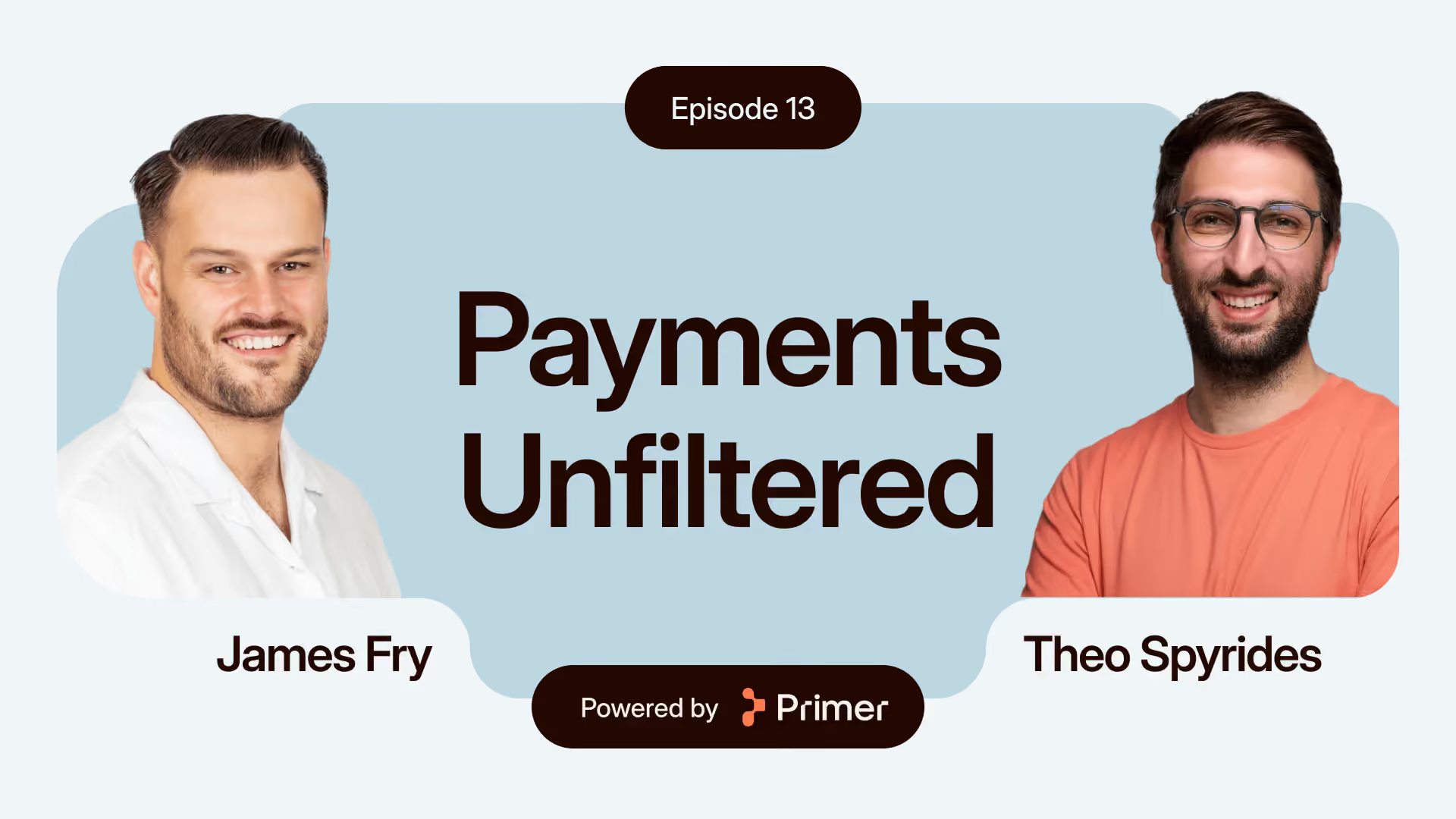
April 30, 2026
What is really takes to build and run a PSP at global scale with Worldpay’s James Fry
Featuring:
Theo Spyrides
&
James Fry
This is Part 2 of our conversation with James Fry, Head of Enterprise Product at Worldpay (now part of Global Payments). Most people know what a PSP does. Far fewer know what it actually takes to build and run one. In this episode of Payments Unfiltered, Theo Spyrides, VP of Product at Primer, and James pull back the curtain. James also shares how he thinks about structuring product teams inside a large payments organization and his advice for anyone building payment technology today.
March 19, 2026
From commodity to competitive advantage with James Fry at Worldpay
Featuring:
Theo Spyrides
&
James Fry
In this episode of Payments Unfiltered, Theo Spyrides, Head of Product at Primer, sits down with James Fry, Head of Enterprise Product at Worldpay (now part of Global Payments), to explore how merchants have evolved their approach to payments, and what that means for the payment providers supporting them. James also shares his perspective on two of the biggest trends reshaping the space: stablecoins as an additional payments rail for global merchants, and agentic commerce as a new channel that will require the industry to solve for trusted agents, fragmented protocols, and a whole new model of intent verification.
February 19, 2026
The shifts reshaping enterprise payments with Citi’s Will Artingstall
Featuring:
Theo Spyrides
&
Will Artingstall
In this episode of Payments Unfiltered, Theo Spyrides, Head of Product at Primer, is joined by Will Artingstall, Global Head of Digital Asset Payments and ecommerce Services at Citi. Will shares how Citi is working more closely with enterprise merchants as payment flows become more complex and new rails begin to emerge. They discuss how large organizations are approaching these changes in practice, and what it means for how payments are designed and managed.
January 21, 2026
How AI shoppers are forcing merchants to rethink fraud with Riskified’s Jeff Otto
Featuring:
Theo Spyrides
&
Jeff Otto
In this episode of Payments Unfiltered, Theo Spyrides, Head of Product at Primer, sits down with Jeff Otto, CMO at Riskified, to explore what happens when software starts acting on behalf of customers and what that means for risk, fraud, and merchant exposure. They discuss how agentic commerce changes who initiates a transaction, how trust is established, and why introducing an agent into the flow raises new questions around risk ownership and liability.
July 31, 2025
Why low fraud isn’t always a win, with Galit Shani-Michel of Forter
Featuring:
Theo Spyrides
&
Galit Shani-Michel
Low fraud and chargeback rates? Great. But what if it’s costing you customers? In this episode of Payments Unfiltered, host Theo Spyrides is joined once again by Galit Shani-Michel, VP of Emerging Products at Forter, to explore the hidden risks of a “zero fraud” mindset. From KPI misalignment to false declines and friction-filled 3DS flows, Galit explains how well-meaning fraud strategies can quietly damage conversion, customer experience, and long-term growth.
April 16, 2025
Merchants, money & the mechanics behind the scenes with Natasha de Teran
Featuring:
Theo Spyrides
&
Natasha de Teran
In this episode of Payments Unfiltered, Theo Spyrides speaks with Natasha de Teran, author of The Payoff and former Head of Corporate Affairs at SWIFT, about the hidden complexity behind everyday transactions. Together, they unpack the frictions built into today’s payment rails, the rising role of regulators, and whether CBDCs and account-to-account payments are viable challengers to cards. Natasha brings a rare blend of policy insight and hands-on merchant experience to the conversation, questioning what’s changing in payments and who those changes are actually for.
March 12, 2025
Setting up payments for success with André Moeller (Elli)
Featuring:
Theo Spyrides
&
André Moeller
In this episode of Payments Unfiltered, Theo Spyrides sits down with André Moeller, Payments, Risk, and Fraud Professional Lead at Elli (Volkswagen Group’s energy and charging solutions provider). They explore the key strategies for setting up payments correctly, including defining the optimal payment flow: Understanding the difference between Customer-Initiated Transactions (CIT) and Merchant-Initiated Transactions (MIT); selecting the right payment methods: Aligning payment options with customer preferences, average order values, and regional trends; avoiding misalignment: Why businesses must involve payment experts early to prevent friction, fraud, and failed transactions; optimizing checkout experiences: How too many payment options can create unnecessary complexity and reduce conversion rates; the role of data: Using insights to optimize payments, reduce fraud, and improve business strategy; and building a strong payments team: Why hiring experienced payments professionals is critical for success.