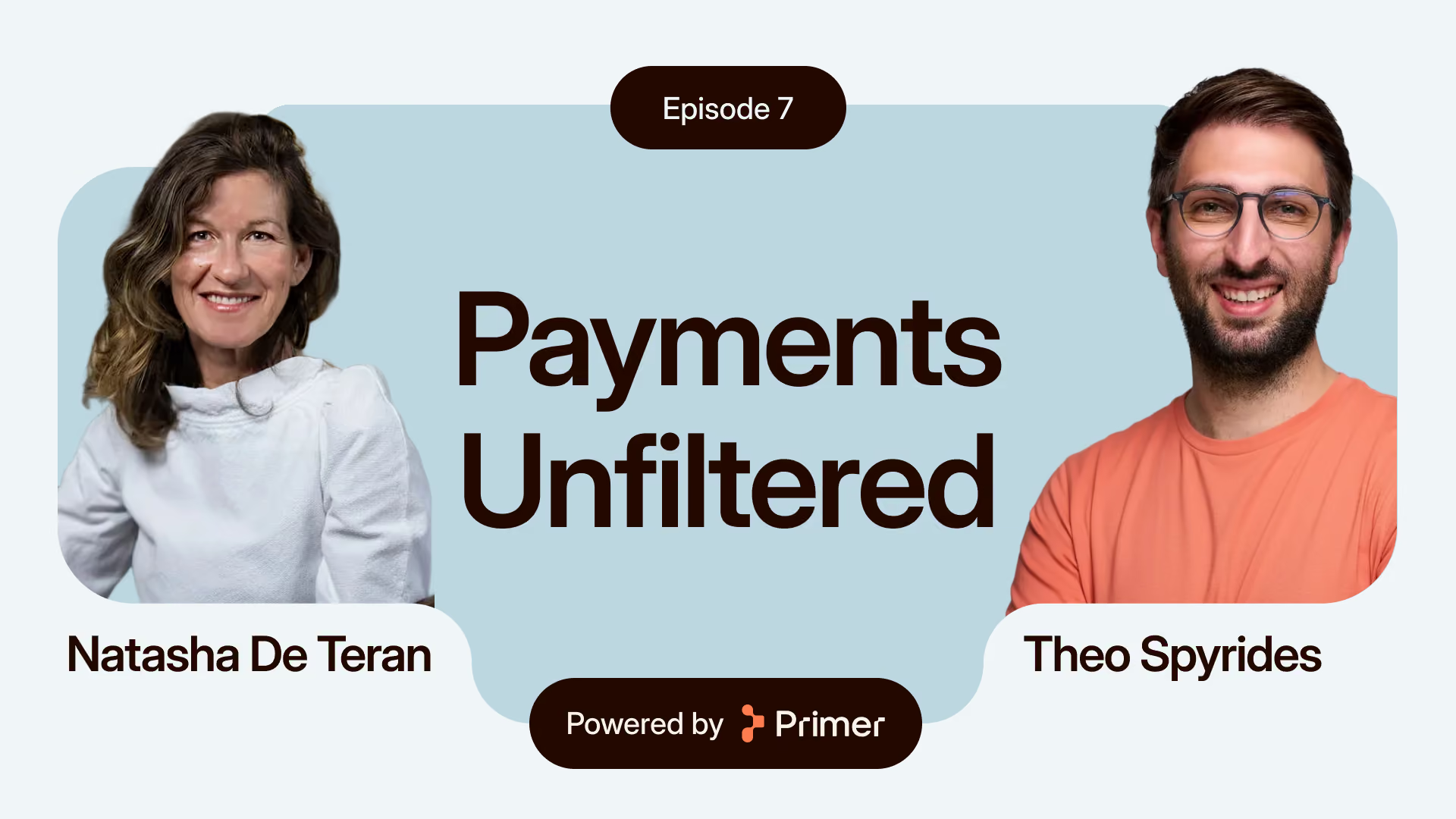
Merchants, money & the mechanics behind the scenes with Natasha de Teran
In this episode of Payments Unfiltered, Theo Spyrides speaks with Natasha de Teran, author of The Payoff and former Head of Corporate Affairs at SWIFT, about the hidden complexity behind everyday transactions. Together, they unpack the frictions built into today’s payment rails, the rising role of regulators, and whether CBDCs and account-to-account payments are viable challengers to cards. Natasha brings a rare blend of policy insight and hands-on merchant experience to the conversation, questioning what’s changing in payments and who those changes are actually for.

Theo Spyrides
Host of Payments Unfiltered

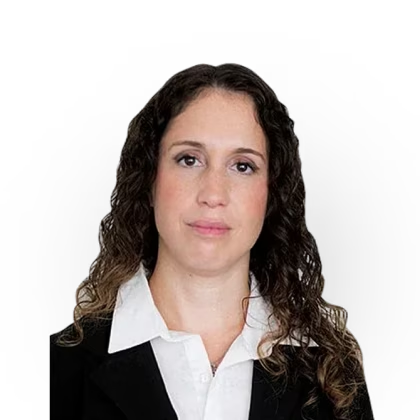
Natasha de Teran
Author of The Payoff & ex-Head of Corporate Affairs @ SWIFT

Theo Spyrides: Natasha, thanks so much for joining us. To kick us off, what do you think are the biggest pain points that merchants face in today's payments system?
Natasha de Teran: That's a really good question, and firstly, thank you very much for inviting me to this podcast. It's particularly difficult to say because one sees it from one's own standpoint, and I'm a smaller merchant. As a smaller merchant, I'd say yes, there's cost, but probably the biggest thing is the settlement delay, that can be really quite extended depending on which provider you're using. I'd also say the lack of flexibility we're seeing from some payment providers. As a small merchant, you want to enable your customers to pay as easily as possible, typically that means they want to use their existing logins.That will mean you're locked into paying higher fees. So if I want to offer PayPal as an option, I automatically have to offer, for instance, Pay in 3 on those goods. I don't have the option not to offer that. So cost is an issue, but it's the delayed settlement above all. It depends on the stage of your growth and what your cash flow looks like, but at the smaller, growing end, cash flow is absolutely king and you really do want that money in fast. You also don't want to be at risk to providers who, frankly, aren't your banks. When your money's in your bank, it's there. You can keep it there and it's protected, or you can spend it. But when it's locked up in someone else's system, it's not entirely clear who you're at risk to, nor how you'd be protected were the worst to happen. So the lack of transparency is tricky, and it's also very tricky when I choose a payment provider. I'm thinking of all the different things I could consider. But when you go payment shopping, you really have to delve to answer those questions. You have to sign up and give away your firstborn in terms of information before you actually find out what your settlement times would look like or what the fees are on non-UK issued cards — all of those problems, which determine which payment provider you should choose.
TS: And you talked about flexibility. There's obviously a big rise in APMs, especially through the rise of innovation and fintech. So how should merchants think about alternative pay, and is there a way these alternatives can overcome some of the problems you just articulated?
NdT: I think there probably are. At the very small merchant end, there are lots of different alternatives, a huge amount. Some are stacked into your web provider if you're an internet/e-commerce merchant. You might build your platform and then find out you haven't got a choice of payment provider. It's the one that comes with your web platform, or you can try to connect something on the back of it, but your inventory will be separated from your payment process, so you've got to manually manage the inventory. There's a lot of innovation, and I think merchants should be looking all the time because everything's changing. Offers can be better, but you can't just retool your website, unless your e-commerce offering is very, very basic. In terms of customers, you want to make it as easy as possible for them to make the payment. You don't want to lose them at checkout because they've lost the will to fill in their postcode for a third time, or because they're reluctant to give over personal information, they'd rather just use their login. I think what consumers are probably unaware of is the impact that has on the merchant, the additional costs the merchant faces depending on which payment method is chosen. And I think that lack of awareness in the consumer's mind spreads across quite a number of things in payments, in terms of protection, for instance. People who've had holiday problems probably know they're better off paying with their credit card, say, a colour television didn't turn up when it was supposed to through an eBay purchase. Given the use of debit cards in this country, and what I see on my own platform in terms of debit card use instead of credit cards for relatively high-value items, a lot of consumers are not using the protected payment method when they probably should be. So going down an innovative payment method is all well and good, but as a merchant you do have a responsibility in terms of what you're offering, does the consumer understand it, and is it the best way for them to pay?
TS: That's a super interesting perspective, I've not heard many merchants consider so much around consumer protection, but I think that's a really important consideration. There are some alternatives in other regions that are really thriving and challenging the legacy payment rails like cards via Mastercard and Visa. Two obvious ones are PIX in Brazil and UPI in India. Why do you think these alternatives are doing so well, and do you think that's a prelude for what's coming globally, or are they exceptions to the rule?
NdT: Well, you said they disrupted cards. I think there's a bit of a challenge there, since cards were widely used by the wealthier parts of those societies and by tourists. But was the majority of the population banked and using cards before? No. So PIX and UPI moved consumers away from cash, and in Brazil, away from reliance on the post office, which was quite interesting. They cut off the entry point that we have in the UK, where cards are the rails, in effect. Those two governments took quite dramatic, decisive steps to shape the future of their payments. There's probably something more complicated in Britain. We have a system that works. There are issues with it, competition issues, cost issues, and a question of who's getting the profit, but we have a different approach in Britain at the moment to public sector intervention in what's seen as a private sector domain. It's a tricky area, because the payment system is a public good, but the payment providers are not necessarily public goods. In Brazil and India, there's been a will to make both the providers and the systems public goods. Do you need that? Do you need public ownership to protect the public interest? Interesting question.
TS: Well, have you ever seen it work without the regulator or the government taking more control over that kind of alternative payment solution?
NdT: Well, you see things in Scandinavia. There's push from the public sector, but you see more positive movement from the private sector there than we necessarily do here. I think it's tricky when you have a very dispersed system like we have in the UK — big old banks, young new banks, card providers, lots of different interests, antique legacy systems alongside snazzy new ones. I think our financial sector has a different relationship with the public sector than it does in Scandinavia — to be frank, they just seem to play nicer with each other there. Have I seen evidence? Yes. Is it transportable evidence — can you say "it's worked in Denmark, Sweden, and Norway, therefore it can work here"? I think there'd have to be quite a significant change for that to happen here. Otherwise we'd have seen more of those things happen already.
TS: That makes sense. So it sounds like in some areas regulators are supporting and driving innovation, and in others they're a bit more standoffish. Do you think these regulations help merchants, and if so, how do you see that manifesting?
NdT: I think a lot of progress in payments happens because it's a team sport, and the financial services industry isn't always a team-playing industry, but in payments there is some team playing, and that's encouraged everywhere by the public sector. It's degrees of success that vary from region to region, and also reflect societal behaviors that differ between countries. We have seen regulation result in lower interchange fees, more competition between acquirers, and mobility on acquirer contracts. We've seen drives from regulators that encouraged adoption of different payment methods; sometimes making retailers' lives easier, sometimes more expensive. In some cases freedoms have been taken away from merchants. For instance, under PSD2 in Europe, merchants were disallowed from giving preferential treatment to one payment method versus another. You could also say, well, whether I pay in cash or by card, it's the same, so I don't use cash. But say I'm paying for a taxi, I'm paying the fees of a credit card even when I didn't need the protection of one. That's built into the price, and the taxi driver is paying for my protection through his interchange fee, when he doesn't need that either. So there's been a kind of base tax imposed right across the system, so that when you and I buy a colour television or go on holiday, we get insured. There've been benefits on one hand and drawbacks on the other. I think everything the regulators and the public sector do is designed for good; whether the outcome is always as beneficial as hoped is another matter. Take SEPA payments: the regulation requiring that cross-border euro payments are charged at the same cost as domestic ones across Europe. Great fanfare, an awful lot of work, and I challenge you to find a bank in Europe that will actually transfer your euros cross-border at the same cost as domestically. As a consumer, or even as a merchant, you generally need to ask, and often quote the law at banks, to get what the European Commission spent an awful lot of time working on.
TS: You're a member of the Bank of England's CBDC Engagement Forum, so I was wondering if you could explain to the audience what a CBDC is, and any thoughts on what the impact could be on the payments landscape.
NdT: I think we don't really know what a CBDC is. It can be a different thing in different places. The impact it could have, if it has one, would presumably be designed by the state to fill a gap — present or future — in the existing payment system. That's the way I think the public sector is approaching it: what won't be working perfectly in the future, for businesses and models of commerce we don't know about yet. Back when I was young, there would have been no purpose for PayPal, but PayPal enabled eBay and a lot of other things since. What sort of payment system do we need for the future, and does that necessitate a public sector digital payment instrument like a CBDC, or doesn't it? That's a really big question, which most countries are still trying to answer. An invidious task as well, I think. It really is, because you're trying to publicly design something for an unclear future — with possibly public money — in the glare of the private sector, conspiracy theorists, and excitable media.
TS: Do you think that without a central bank supporting it, driving it forward, defining it, and monitoring it, that's the only way that kind of digital currency ecosystem could work? Or, given the rise of stablecoins, could the private sector be the answer in itself?
NdT: If we think about what cash is, it's a public-sector-provided public good that allows everybody to move, receive, spend, and store value. If we look at the digital sphere and ask: is the Bank of England ensuring that everybody in the UK — whether in John o' Groats or the Outer Hebrides — can access, store, and receive digital money without charge in the same way they receive cash? I think the answer to that is no. What we need is to make sure the poorest — who are always the least well served — aren't left behind, and I think that's probably where central banks need to worry the most. How can the public sector ensure the poorest, the least digitally able, the least commercially appetizing customers, can access, store, and receive money on a risk-free basis — not at risk to a provider that isn't insured or protected in the way banks are? We have basic bank accounts in the UK that are, in theory, accessible to everybody, but in practice there are instances where people get refused. While there's still cash around, that's less of a problem, but in a society where you need to spend to do anything — to eat — if people, including those newly released from prison, can't store, receive, and hold money, they're going to steal again. You leave them no option. So catering for all of that in a digital world requires the public sector to do something — and it raises the question of who bears the obligation, and whether they have the power to place it on those entities. The people serving that economically "unviable" part of the population — well, there are people doing it, and it is economically viable for them, but the result is that very vulnerable individuals pay the most per pound to spend a pound, which isn't fair and isn't in the national interest either. So how does the PSR, the FCA, the Bank — how do they reach beyond their immediate purviews to address that? And alongside that tricky, non-trivial part of the population — which could grow at any time — you also have unappetizing businesses, from a risk or reputational standpoint. Risk gets priced, and that can lead to quite punitive charges, especially mixed with reputational risk. If you don't have obligations throughout the payment stack for providers to serve all kinds of people and professions. Then those people within the British pounds payment system, create a layered system, which I think would be detrimental to the movement of value, and therefore the economy. I don't think the question of whether we do it or don't is being answered. But I don't know that the three regulators, as things stand, have the existing powers to solve all the problems that could be solved by a digital pound.
TS: People talk a lot about concerns around fraud and privacy, and how digital currencies get lumped in as a "Wild West.” People call it crypto and assume it's all the same thing. How do you think that plays into this as a project for the public sector to reason through and tackle?
NdT: I think it's very difficult. Money's always had issues when it comes to privacy. I don't think it's helped that some nations have moved faster than others on digital currency — China in particular, which has a reputation for surveillance, and is represented as something of a bogeyman by parts of the media. That's helpful fuel for conspiracy theorists — fear-mongers will always play louder than enthusiasts, especially when the enthusiasts are seen as business interests. Personally, I think it's a bit of nonsense. You need to worry about your democracy, your judicial system, and your legislature all the time — not because a digital pound is or isn't going to exist. If those institutions are working properly, there's nothing to worry about. And given that American giants already have all of our data — through Apple Pay, Google Pay, Mastercard, and so on — that data is already accessible, likely even to the US government, should they wish to look at it. So I think it's a great story, but I think it's nonsense. For those who are fearful about privacy issues, I'd say: you could end up with the most private instrument being one provided by the state, and one could sacrifice privacy as one chose after that. In this country, given we're on CCTV all the time and wandering around with our phones, I do wonder why people would be particularly worried about a digital pound specifically. The disappearance of cash is frightening from a different angle — certainly if you're engaged in illicit activities, or worried about the direction of the state and its control over your activities, freedom of speech, or freedom of religion. That's a big issue, but again, I'd say let's worry about the state, the legislature, and the judiciary. That's where you can really move the needle. It doesn't matter what you do in payments if the state is wrong.
TS: Absolutely. It sounds like there's a lot of change being explored in fintech and payments over the last decade or so. Looking ahead to the next decade, what emerging trends do you think are most likely to redefine the global financial landscape?
NdT: I think this public-private discussion — not a battle, but a discussion — will continue. We've moved from a system that was just banks and cash, to one where the UK economy is hugely dependent on card networks and the digital movement of money. Individual banks matter — some more than others — because if one bank's payment system stops, parts of the UK would start grinding to a halt pretty soon after. So they're central, but not equally central. I think there'll be much more thinking around the "plumbing" layers that are fundamental to everything — whether that means parallel systems and deep redundancy. I'm not sure the telecoms providers are all that different — you can build as many data centers and pipes as you like, but if underneath it all is the same telecoms provider or grid, we are where we are. I think it'll be fascinating and competitive — we might see more differentiation in how we use different payment instruments. And if relations between the US and Europe continue to deteriorate at this pace, I think the move toward strategic independence in Europe will gather steam.
TS: And I imagine the impact on a merchant would be that they now need to reason about differences in every country, and the trade-off would be complexity that the merchant needs to navigate, but that would be interesting.
NdT: They already need to navigate quite a lot of complexity. I don't know that this would necessarily make it worse for them. We're all very keen on exports but not very keen on dependencies, and the problem with exports is that they create dependencies. If we want to export, someone's got to do a currency conversion. There's going to be money flowing from A to B and back again. For larger merchants, it could make things more complex; for smaller ones, it already is. It's costly, time-consuming, and cross-border payments are never made for free.
TS: And I think you touched on something really interesting, the infrastructure layer needs to be part of how we think about payments in the future. If a bank goes down, Barclays went down a couple of weeks ago for 48 hours, which is pretty crazy, and the economy kept running, if a little less smoothly for Barclays customers. But if AWS went down for 48 hours, what would that impact be on the economy? Maybe that's actually where the focus needs to be.
NdT: Yeah, I think looking deeper into what the strategic layers are that we have big dependencies on, and what you can do about that. Can you eradicate them, or do you put all your eggs in one basket and sit on them? Do you require more from those layers in terms of how they behave, who they serve, what they charge, who they interoperate with, and what they're building in terms of redundancy and resilience?
TS: Amazing, and I'm conscious of time, so one last question. You're obviously an expert in payments, you wrote The Payoff a few years ago, a great book delving into all aspects of the payments ecosystem. You're also a business owner. So I think you have a unique perspective to share: what guidance would you offer businesses looking to navigate this rapidly evolving payment space?
NdT: I don't think it's five minutes on Google. It really is a labor of love, it takes quite a long time to disentangle who's offering what, and think about the flexibility you want to build in. Are you going to sell in person as well as online? How does your payment provider sit with your web platform? How many of your customers are going to be foreign? Should you be looking at non-UK card payment fees? You're probably not going to have much negotiating power, or anyone to speak to along your journey. Really think about what flexibility you need. You might know what your business looks like on day one, but very few businesses look the same on day fifty. So try to understand that, and focus on what matters to you. Is it making it as easy as possible for all customers, even at the cost of a higher interchange fee? Is it faster payouts versus slower ones? There's been huge innovation and great developments, but a lot of providers have built their systems with a particular kind of business in mind, and unless your business looks exactly like that, you might have to shoehorn yourself in a bit. So there's all of that to think about, plus the payout terms and settlement lag, who are you at risk to, and are you comfortable being at risk to them in the interim? It's not a trivial decision which payment provider you go with, and you might be stuck with them for a while. If you're e-commerce, find out what you can do with the web platform before you build your website.
TS: Amazing. Well, Natasha, thank you so much for your time. It's been great speaking with you.
NdT: Not at all, thank you. It's been fun.
Meeting with the best in the business
Primer puts you in control of how money moves across the business. With our unified infrastructure you can orchestrate every flow, reduce friction, and capture more revenue everywhere.







Latest episodes
July 23, 2026
The next era of payments: AI, data & the end of the “black box”
Featuring:
Theo Spyrides
&
Gabriel Le Roux
In this episode of Payments Unfiltered, Theo Spyrides sits down with our co-founder and CEO Gabriel Le Roux to discuss where payments are heading next, why AI in payments is more about context than prompts, and what payments intelligence actually looks like in practice for merchants.
.avif)
June 15, 2026
Everything merchants need to know about chargebacks with Chargeblast’s Qi Cao
Featuring:
Theo Spyrides
&
Qi Cao
Most merchants think hitting their chargeback target means they're safe. Spoiler alert: they're not. In this episode of Payments Unfiltered, Theo Spyrides speaks with Qi Cao, co-founder and CEO of Chargeblast, to unpack chargebacks, what the Visa Acquiring Monitoring Program (VAMP) actually means for merchants, and why the merchants who manage disputes best are the ones who've already fixed their business model.
April 30, 2026
What is really takes to build and run a PSP at global scale with Worldpay’s James Fry
Featuring:
Theo Spyrides
&
James Fry
This is Part 2 of our conversation with James Fry, Head of Enterprise Product at Worldpay (now part of Global Payments). Most people know what a PSP does. Far fewer know what it actually takes to build and run one. In this episode of Payments Unfiltered, Theo Spyrides, VP of Product at Primer, and James pull back the curtain. James also shares how he thinks about structuring product teams inside a large payments organization and his advice for anyone building payment technology today.
March 19, 2026
From commodity to competitive advantage with James Fry at Worldpay
Featuring:
Theo Spyrides
&
James Fry
In this episode of Payments Unfiltered, Theo Spyrides, Head of Product at Primer, sits down with James Fry, Head of Enterprise Product at Worldpay (now part of Global Payments), to explore how merchants have evolved their approach to payments, and what that means for the payment providers supporting them. James also shares his perspective on two of the biggest trends reshaping the space: stablecoins as an additional payments rail for global merchants, and agentic commerce as a new channel that will require the industry to solve for trusted agents, fragmented protocols, and a whole new model of intent verification.
February 19, 2026
The shifts reshaping enterprise payments with Citi’s Will Artingstall
Featuring:
Theo Spyrides
&
Will Artingstall
In this episode of Payments Unfiltered, Theo Spyrides, Head of Product at Primer, is joined by Will Artingstall, Global Head of Digital Asset Payments and ecommerce Services at Citi. Will shares how Citi is working more closely with enterprise merchants as payment flows become more complex and new rails begin to emerge. They discuss how large organizations are approaching these changes in practice, and what it means for how payments are designed and managed.
January 21, 2026
How AI shoppers are forcing merchants to rethink fraud with Riskified’s Jeff Otto
Featuring:
Theo Spyrides
&
Jeff Otto
In this episode of Payments Unfiltered, Theo Spyrides, Head of Product at Primer, sits down with Jeff Otto, CMO at Riskified, to explore what happens when software starts acting on behalf of customers and what that means for risk, fraud, and merchant exposure. They discuss how agentic commerce changes who initiates a transaction, how trust is established, and why introducing an agent into the flow raises new questions around risk ownership and liability.
September 24, 2025
The business of play with Xsolla’s Berkley Egenes
Featuring:
Theo Spyrides
&
Berkley Egenes
Payments aren’t just infrastructure in gaming, they’re critical to the industry’s growth. From local wallets and currencies to mobile browser checkout, the way players pay now decides how studios scale. In this episode of Payments Unfiltered, Berkley Egenes, Chief Marketing & Growth Officer at Xsolla, joins host Theo Spyrides to outline a practical playbook for global game monetization.
July 31, 2025
Why low fraud isn’t always a win, with Galit Shani-Michel of Forter
Featuring:
Theo Spyrides
&
Galit Shani-Michel
Low fraud and chargeback rates? Great. But what if it’s costing you customers? In this episode of Payments Unfiltered, host Theo Spyrides is joined once again by Galit Shani-Michel, VP of Emerging Products at Forter, to explore the hidden risks of a “zero fraud” mindset. From KPI misalignment to false declines and friction-filled 3DS flows, Galit explains how well-meaning fraud strategies can quietly damage conversion, customer experience, and long-term growth.
March 12, 2025
Setting up payments for success with André Moeller (Elli)
Featuring:
Theo Spyrides
&
André Moeller
In this episode of Payments Unfiltered, Theo Spyrides sits down with André Moeller, Payments, Risk, and Fraud Professional Lead at Elli (Volkswagen Group’s energy and charging solutions provider). They explore the key strategies for setting up payments correctly, including defining the optimal payment flow: Understanding the difference between Customer-Initiated Transactions (CIT) and Merchant-Initiated Transactions (MIT); selecting the right payment methods: Aligning payment options with customer preferences, average order values, and regional trends; avoiding misalignment: Why businesses must involve payment experts early to prevent friction, fraud, and failed transactions; optimizing checkout experiences: How too many payment options can create unnecessary complexity and reduce conversion rates; the role of data: Using insights to optimize payments, reduce fraud, and improve business strategy; and building a strong payments team: Why hiring experienced payments professionals is critical for success.