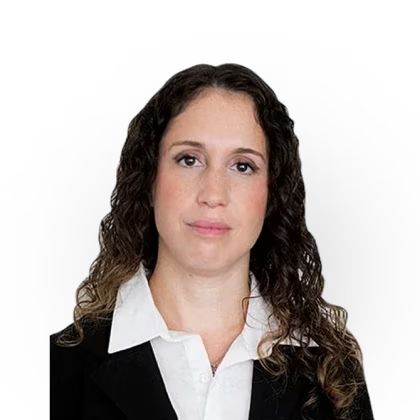
How partnerships power payments with Michaela Weber
Join host Theo Spyrides as he dives deep with Michaela Weber, SVP & GM of Payments & Global Business Development at BigCommerce, to reveal how partnerships are reshaping the payment ecosystem. Discover how these alliances are fueling innovation and unlocking massive value for merchants. Theo and Michaela also discuss the breakthrough ecommerce trends and cutting-edge tactics merchants use to redefine their customers' checkout and payment experience.

Theo Spyrides
Host of Payments Unfiltered

Michaela Weber
SVP & GM, Payments & Global Business Development @ BigCommerce

Theo Spyrides: Your first day of your professional career was on Wall Street on September 15, 2008, which was also the same day that Lehman Brothers filed for bankruptcy. That's a pretty intense first day in your professional career. What was that like? And is there a memory that sticks out?
Michaela Weber: It’s a great question, Theo. I had joined Bank of America, which at the time had acquired Merrill Lynch, as part of the summer analyst class. My first fully licensed day on the trading desk was that Monday. I remember waking up, getting ready for work, and seeing all the news from Sunday night and Monday morning. It was chaos. I was working on the trading floor, and we had to be in early, around 6:30 or 7 a.m. A lot of the experienced professionals felt it was some of the highest volatility they had seen since Black Monday. I was so new that I didn’t really understand what was happening. You’re just hoping to make a good impression, get everyone’s coffee orders right, and learn. But I remember the feeling on the trading floor. People were genuinely concerned, and it ended up being a defining period because I had no idea what was going on for the first few weeks.
TS: I find that really interesting because I wasn’t working then, but you started your career in a bear market. Since then, we’ve generally been in a bull market, aside from the disruption around COVID. Do you think starting in such a difficult environment gave you a different perspective or an edge compared to people who entered the workforce later?
MW: I think so. I was laid off in March 2009. My whole analyst class was let go. At the time, everyone said analysts were the cheapest labour and that companies never cut junior talent because the pipeline was important. So I had this assumption that, while things were changing, I’d probably be okay. Then suddenly I was unemployed less than a year after graduating university, having had this great job on paper, but realistically with very few transferable skills. It was tough, but it taught me resilience. It also taught me that circumstances change and that a lot of things are outside your control. I was lucky to then join a small firm that sent me to Hong Kong, which led me to JP Morgan, and that moment really started the career journey that took me around the world and into different industries. Starting at a time when things weren’t easy was really helpful.
TS: You mentioned J.P. Morgan, Goldman Sachs and Bain. How and why did you transition from global banks and consulting firms into payments?
MW: Payments is fascinating because it touches everything. I studied government and German at university, which doesn’t necessarily give your parents confidence that you’re going to have a traditional career. I ended up on Wall Street but felt I needed stronger financial analysis and strategy foundations. While at JP Morgan, I decided to step away from sales and trading and do my MBA at Dartmouth. I wanted to build those skills and also take a step back and think about what I wanted long term. I loved JP Morgan and had incredible support there, but I didn’t think sales and trading was a lifelong career for me. One of my managers joked that I was deciding to “pay money not to work” by doing an MBA. But it was the right decision, and after Tuck I joined Goldman.
TS: And what took you from Goldman to Bain and then into Worldpay?
MW: I loved Goldman. But my husband was transferred from New York to London, and that gave me the opportunity to build more strategy experience. At Goldman, I had developed strong financial analytical skills, but I hadn’t really done strategy. I was analysing companies through financial tables and analyst decks without understanding how the strategic work happened. At Bain, I worked on an oil and gas project initially, then moved into their private equity group, where I ended up doing a lot of fintech and payments work. That led to the opportunity at Worldpay to run their global partnerships team.
TS: So you kind of fell into payments. It wasn’t a deliberate move?
MW: Exactly. Payments is such an interesting space because it touches everything. If you’re interested in retail, financial systems, money movement, or how society operates, payments sits at the centre of all of it. There are so many directions you can take your career in payments, which makes it such an interesting industry to spend time in.
TS: What learnings did you take from your time at J.P. Morgan, Goldman and Bain when you moved into a completely different environment at Worldpay? I imagine the pace and ways of working were very different.
MW: It was a big shift. When you work in consulting or at somewhere like Goldman, especially in client-facing roles, the work happens incredibly quickly. You throw people at a problem, work long hours, and focus on delivering outcomes. But when you join a company like Worldpay, you see the complexity of making real change. The company had grown through acquisitions, so there were different platforms, teams and areas of expertise that needed to work together. It’s much harder in the real world than it is creating a presentation about what should happen. I think it was very humbling because there are so many implications to changing processes at a large company. You have to understand the knock-on effects, bring people along, and recognise that a small change in one area can impact someone elsewhere in the organisation.
TS: Why did you end up in partnerships? Looking at your previous roles, it doesn’t seem like an obvious path.
MW: My background actually aligned quite well with partnerships. On the trading floor, I was in equity sales, so I had experience in sales and building client relationships. I felt partnerships was a great way to combine relationship building, commercial outcomes, and bringing people together. Naturally, I enjoy introducing people, making connections and creating opportunities, so it was a good fit. I don’t think partnerships was something I knew existed as a career path when I started. It’s not one of the options someone gives you when you’re graduating. But it’s such an interesting mix of skills. People in partnerships can become strong relationship managers and salespeople. It’s a real utility-player role.
TS: And it found you.
MW: Exactly. I think as you find success in a role and see where you can make an impact, you naturally gravitate towards opportunities where you can do more of that. I also like the variety. One month you might be focused on a major contract negotiation, and the next you’re working on events or go-to-market activity. No two days are really the same.
TS: In your experience, what’s the key to forming a successful partnership, especially in an industry as competitive as payments?
MW: The biggest thing is understanding what success looks like for both parties. One of the best ways to start a partnership is with transparency around why you want to work together. I had a call recently with a long-standing BigCommerce partner where they said: “One of our strategic goals is to grow our US business. We want to increase volume in the US. That’s how we define success.” That was incredibly helpful because then we could focus the conversation. We could look at where we are today, what growth could look like, and what investments in marketing or events might help us get there. That’s much more productive than saying, “Let’s deepen our partnership,” because there are a million things two global companies could do together. The second piece is understanding how your counterpart is measured. Are they focused on product adoption? Net-new merchants? Volume? Leads generated? Everyone has specific KPIs, and understanding those helps you build a partnership that benefits both sides.
TS: So almost a “you scratch my back, I scratch yours” approach?
MW: It’s really about joint success. The best partnerships work because both parties are achieving business goals. Those goals might be different, but you find the overlap. For example, if your goal is to grow US merchant volume and my goal is to acquire net-new merchants, how do we combine forces so we both achieve what we need? The challenge is that sometimes people are uncomfortable sharing what they’re being measured on or what their priorities are. But if I don’t understand what you want out of the partnership, it’s very difficult to make it successful.
TS: Do you think that approach applies across industries, or is there something specific about payments? Payments feels especially dependent on partnerships because the ecosystem is so fragmented. A single payment can involve six, seven or eight different parties.
MW: Successful partnerships in any industry are built on mutual value, but payments makes it especially important because we have so many “frenemies”. Take Visa. There are different parts of the Visa ecosystem that work together, but companies can also compete in other areas. Or PayPal. They have the wallet, BNPL, and processing through Braintree, but merchants using Stripe or Adyen may also need PayPal Wallet to work seamlessly. So companies need to collaborate even when they compete in other areas. Getting everyone to work together is critical in payments, and that’s why partnerships is such an important function.
TS: And when you reflect on your career, is there one strategic partnership that stands out to you as a game changer and why? It doesn’t necessarily have to be one that you were involved in, but one partnership where you can clearly see the mutual success and how both sides compounded each other’s growth.
MW: When I was at Worldpay, Worldpay was, and still is, building and evolving its omnichannel strategy. At the time, we were looking at competitors like Adyen, which had a strong omnichannel offering across in-store and online payments. I worked on the early stages of Worldpay’s partnership with FreedomPay, which facilitates in-store payments and works with a number of global hospitality groups. I think that was a great example of a large company working with a smaller, highly innovative company that brought something unique to the table. For Worldpay, it created an opportunity to unlock a market where building a native solution would have been very difficult. For FreedomPay, continuing to work with large global organisations helped broaden their reach and expand their customer base. I still see them exhibiting alongside each other at retail technology events, and I always feel proud to have played a small part in the early stages of that relationship because it genuinely made sense for both sides.
TS: That’s a great example because it also shows that partnerships don’t have to be between companies of the same size or at the same stage. We’re a 4.5-year-old company, and we work with companies much older than us. I think both sides can bring something valuable to each other at different stages. I actually think that’s one of the reasons fintech has grown so quickly over the last decade. Partnerships are just intrinsic to fintech now.
MW: Definitely. This summer, one of my big projects has been working with a large North American bank that’s launching as a reseller of BigCommerce. That’s a really interesting example of a large organisation working with a smaller fintech. We can move like a speedboat alongside their aircraft carrier and help bring them a capability they needed to offer through an external partner. Of course, there can be friction. We might send over a short contract and receive something that feels more like War and Peace in return because large, regulated organisations have their own processes. But it’s incredibly rewarding when you see those relationships come together because they combine the strengths of both organisations.
TS: Okay, it’s time to get to know Michaela better with a round of quick-fire questions. Michaela, are you ready?
MW: I’m ready.
TS: Early bird or night owl?
MW: Early bird.
TS: Tea or coffee?
MW: Coffee.
TS: Favourite payment method?
MW: Apple Pay.
TS: Half marathon or triathlon?
MW: Triathlon.
TS: In-store or online?
MW: In-store.
TS: Restaurant or takeaway?
MW: Restaurant.
TS: Favourite holiday destination?
MW: Bhutan.
TS: Best advice you’ve received?
MW: Show up early.
TS: US or UK?
MW: Don’t make me choose.
TS: And one thing you would change about payments?
MW: More senior women, or more women in general. Payments is such an interesting industry, and it’s disappointing that we still don’t see the diversity of our customer base and the wider professional world reflected in payments, especially in senior leadership roles. I really hope we continue to make progress there.
TS: So, pivoting slightly, you touched on sales and partnerships earlier. If you think about a Venn diagram, there’s definitely overlap between the two roles. What would you say is the biggest similarity, but also the biggest difference, between sales and partnerships?
MW: I think the biggest difference is that you’re not just completing a transaction. When I think about a sales team, they’re selling a product or service to a customer. Once the contract is signed, that customer moves into implementation, customer success, and ongoing support. The salesperson may still be involved, but they’re often moving on to the next opportunity. Partnerships are different because you’re building something that needs to last. It’s not about a single transaction or a single quarter. The strongest partnerships create strategic value for both organisations over multiple years, through product launches, joint initiatives, and ongoing collaboration. The similarity is that partnerships still need to be commercially valuable. Sometimes partner teams can lose sight of that, but ultimately what keeps a partnership alive is that both organisations are getting something meaningful from it. That could be revenue, pipeline generation, merchant retention, cross-sell opportunities, or something else. There needs to be a thread connecting both sides beyond just having a similar customer base.
TS: Do you think a good salesperson can become a good partnerships person, and vice versa? It feels like a good partnerships person could probably become a good salesperson, but maybe a salesperson doesn’t always have the longer-term view needed for partnerships.
MW: I think if you have a customer lifecycle account executive who is used to closing deals and staying involved with a customer relationship, that can be a really good foundation for becoming a partnerships person. Some salespeople can become excellent partner managers. Equally, partnerships people can move into sales, but they need to understand what that role requires. Managing a traditional sales cycle, working towards a quota, and operating in that more direct commercial environment can be a very different experience depending on the product you’re selling. I’m actually interviewing quite a lot at the moment, and I’ve seen salespeople trying to move into partnerships and partnerships people wanting to move into account executive roles. You need to have an awareness of the skills and mindset each role requires.
TS: And we touched on this earlier, but partnerships also feels like a much more cross-functional role. I don’t think sales teams are necessarily working across as many different functions.
MW: That’s a really good point. One of the key relationships for me, and I’m biased because I work closely with product, is the product function. There are a couple of ways partnerships and product work together. One is at a strategic level: looking at our product roadmap and deciding whether a new capability should be built internally or whether it’s something we should offer through a partner. BigCommerce is a very partner-led organisation. We have over a thousand technology partners and hundreds of payment and payment-adjacent partners. So we often ask: is this something we should build ourselves because it’s core functionality we want to own, or is there already a company doing this exceptionally well that we can partner with? The second piece is creating feedback loops. We work closely with partners on the features they’re offering on our platform, and we take that feedback back into BigCommerce so we can continue improving the experience for merchants.
TS: Are you trying to get your product team in the same room as your partners’ product teams and get them working together?
MW: Yes, often. For example, with some of our payment partners, we work extremely closely together. With PayPal, we recently worked on their Fastlane beta accelerated checkout launch. We were part of the alpha and beta programmes, so the product teams were essentially working together day-to-day, looking at data, supporting merchants, and improving the experience. Stripe is another example where our product teams have a really strong relationship. There are mutual Slack channels, ongoing conversations, and a lot of collaboration around merchant support, customer needs, and product improvements. That connection is critical, especially in payments, because platforms and payment providers have to work hand-in-hand. Neither side really works without the other.
TS: And maybe the last question on this: how do you think about partnering to solve merchant problems versus building or even acquiring those capabilities yourself? For example, you mentioned Fastlane with PayPal. If BigCommerce decided to build its own equivalent solution, how do you navigate that complexity? I imagine you’d have partners coming to you saying, “Why are you building this when you could use our solution?”
MW: It’s a great question. From a BigCommerce perspective, we’ve always been partner-first. Unlike some other platforms, we haven’t tried to force merchants into using white-labelled solutions or penalised them for choosing other providers. We have made some acquisitions where we felt there was native functionality we wanted to add to the platform. Earlier this year, we acquired Makeswift, which was a partner of ours and a really strong graphics editing tool that fit into our broader product strategy around headless commerce. A few years ago, we also acquired Feedonomics, which was a channel management solution that had previously been a partner. So we do make acquisitions where we believe there’s functionality we want to bring in-house. But it’s always a balance because there may still be partners in the ecosystem offering similar capabilities. Ultimately, if merchants have choice, everyone has to compete on value, features, usability, and experience. I think that healthy tension between what partners offer and what platforms build natively is important.
TS: Hence the “frenemies” idea.
MW: Exactly. Hence the frenemies.
TS: So I’d love to pivot a little more into your experience in e-commerce. What role does payments play for an e-commerce platform?
MW: I think there are two parts to that question. The first is what role payments plays generally, and the answer is that it’s incredibly important because, unless you have some kind of non-transactional store where you’re just creating a website, payments is how your business runs. Without payments, you can’t accept revenue, and you don’t have a business. The second part is how customers view payments as part of their e-commerce store. Some customers understand the strategic importance of payments, while others still see it as a bit of an afterthought. I still speak to customers who have the most beautiful websites: modern designs, incredible branding, great user experiences. Then you get to the payment experience and the checkout is clunky, or you’re asked to select Visa or debit card manually. My personal pet peeve is being asked to select a card type when the checkout should already know that from your card number. Checkout is part of your customer experience. If I have a seamless checkout, I see the payment methods I want, and that contributes directly to how I view the brand overall. The companies that are really successful today understand that building a brand isn’t just about the website. It has to carry through checkout, shipping, and all the post-purchase experiences that build customer loyalty. It’s especially important in competitive markets. If I’m buying a pair of Adidas sneakers, for example, and I can find the same product somewhere else, why would I come back? It has to be because I like the brand, I trust the experience, and everything feels easy. You rarely feel connected to a brand if the checkout experience is frustrating or your payment fails for no clear reason.
TS: Payments has clearly changed how the checkout experience works, but merchants might not always have the expertise to understand the importance of payments because historically it was treated as a commodity. How do you navigate those conversations with merchants and brands?
MW: It can be really difficult. One of the things we’ve started to understand more deeply is that there are often two different stakeholders involved: the e-commerce team and the finance team. The e-commerce team is usually focused on running the website and improving the customer experience. Finance may look at a proposal and say, “You can’t switch payment providers unless you’re getting a better rate than what we have today.” But the payment rate is only one part of the overall value you can get from payments. If you improve your conversion rate, that can outweigh an increase in processing costs. Adding new payment methods can unlock new customers. Using specialised fraud tools can help reduce false declines, provide better protection, and improve the customer experience. So the conversation with finance teams shouldn’t just be about whether one provider charges slightly more or less. It should be about the overall impact on the business. We recently saw this with one of our home and garden customers. They moved from a legacy UK bank to Stripe and saw a huge uplift in conversion. They were able to offer Apple Pay, and surprisingly, more than 50% of their transactions are now through Apple Pay. Before that conversation, they had no idea how significant that would be. If you only looked at payment rates, you may never have made that change. But when you look at the full picture, including conversion, customer behaviour, and revenue impact, the value becomes much clearer.
TS: I think what you said about Apple Pay is so true. We actually had the exact same experience with one of our retail merchants. They thought they should probably add Apple Pay, and within six weeks it became their most popular payment method. What people don’t always realise is that payment method performance varies depending on the device someone is using, the browser, and the country they’re in. Unless you’re exposed to it, you assume the way you pay is the way everyone else pays. I had no idea how important digital wallets were until I spent time in APAC. In some places, people rarely pay with cards. In Germany, invoicing is common. In the Netherlands, iDEAL is everywhere.
MW: Exactly. We see this all the time. We sometimes work with Dutch merchants who only want to offer iDEAL because it’s low-cost and widely used locally. But if you’re trying to expand internationally, that can limit your audience. You need to understand where your customers are, how they prefer to pay, and what payment methods will help you convert them. When you enter new markets, you have to make those adjustments.
TS: With payment methods, there’s also an interesting trade-off between optionality, speed, and security. How should brands think about those trade-offs? It can sometimes feel like a zero-sum game. If you want something faster, you might be sacrificing security. If you make something extremely secure, you might introduce more friction.
MW: I’d probably push back slightly on the idea that speed and security always have to be a trade-off. There are a lot of solutions emerging that make payments faster without compromising security. Visa and Mastercard have Click to Pay, and we’re seeing more adoption through PSPs. We’re also seeing customers use solutions like PayPal Fastlane, Skip, Stripe Link, and Bolt to make checkout faster. The bigger consideration is localisation. You need to work with a platform and payment providers that can surface the right payment methods for the shopper, based on where they are, how they shop, and what they’re likely to use. You don’t want a NASCAR-style checkout with 30 different payment buttons. We’ve all seen those examples online. It’s especially challenging in emerging markets where there can be so many alternative payment methods. We worked on an RFP for a customer with a large APAC business, and in Indonesia alone they had eight or ten payment methods listed. The question becomes: how much volume can realistically go through the tenth option on the list? The goal isn’t to offer every possible payment method. It’s to offer the right payment methods for your customers.
TS: So it sounds like payments is very much a strategic priority, or at least it should be a strategic priority. I know you own payments at BigCommerce. Was that a strategic priority before you joined, or is that something you helped bring to the table?
MW: I would love to take credit for payments being a strategic priority at BigCommerce, but I think that through our open SaaS, partner-led strategy, payments has always been recognised as incredibly important. PayPal and Braintree were early, foundational partners for BigCommerce. The idea of giving merchants choice has always been a priority, especially for mid-market and enterprise merchants who don’t want to be locked into a single payment solution. These businesses have complex needs and operate across different regions, so having flexibility in their payments stack is really important. I see my role as helping steward that strategy and continue pushing it forward. On my team, we’ve expanded our payments growth consultants, who work directly with merchants to help them understand and optimise their payments stack and connect them with the right partners. Payments has always been a critical part of helping our merchants succeed.
TS: That’s awesome. I think we need more and more people to care about payments because it’s not going away. It’s only going to become more important. Looking at the future of e-commerce, what’s one innovation or change that excites you the most, and what’s one that keeps you up at night?
MW: The thing keeping me up at night would probably be crypto. Partly because of the constant LinkedIn messages I receive from people wanting BigCommerce to add crypto as a payment method. There are a lot of companies out there trying to make that happen, and I’m not always sure how all of them still exist. More seriously, the question is whether crypto is going to achieve widespread consumer adoption for everyday use cases. Coming from a regulated financial services background, I still have questions around areas like compliance, KYC, and how it fits into the broader payments ecosystem. I know there are many people who are very positive about crypto, but I’m personally still a bit of a skeptic. As for what excites me, I would say more frictionless commerce experiences. I’m a huge fan of technologies like Amazon’s Just Walk Out. There’s an Amazon store near our office in Liverpool Street that uses it, and I think it’s really interesting. What’s fascinating is that they eventually added payments back into the experience because people didn’t always want to simply walk out.
TS: Why do you think that happened? I thought that was an interesting pivot.
MW: I think there’s a consumer behaviour element. It’s a learning process. Even with contactless payments, people initially felt uncomfortable. I remember when contactless first launched, it felt strange compared with chip and PIN. Every market has its own habits. In the US, for example, I still find it strange that people hand over their credit card at restaurants. In Europe, that feels much less normal. So I think frictionless commerce will continue to evolve, but it may not always mean removing every single step. Whether it’s checking out quickly in-store, saving your payment details online, or using accelerated checkout solutions, anything that makes commerce easier and faster is exciting. I also think biometric payment methods could become more interesting. We’ll see whether consumers adopt them.
TS: I’ve heard WeChat are exploring technology where you can pay with a hand scan. I’ve even seen examples of people getting chips inserted into their nails to pay. Maybe that’s something for Money20/20.
MW: I have seen some examples of people getting chips implanted, but honestly, if you can just tap with Apple Pay, I’m not sure why you would need a chip in your body. But I do think it’s interesting that people are pushing the boundaries. That’s how innovation happens. You experiment, see what works, and eventually some of those ideas become normal.
TS: When you think about frictionless commerce, does that also include meeting consumers where they are? Social commerce feels like something that probably deserves more attention than it gets. I know BigCommerce has done work with TikTok in the past.
MW: Yes, we do quite a lot around social commerce. We make it easier for brands to integrate with TikTok Shop, and many of our merchants advertise and sell through TikTok and other social platforms. We also work with partners like Random Retail on things like buy online, pick up in-store and same-day delivery. Brands are increasingly looking at how they can fulfil orders from stores rather than only warehouses. Ultimately, consumers don’t care where the product comes from. They just want it quickly, and they want it to arrive in good condition. That flexibility gives brands more options and fits into the broader idea of unified commerce, where the customer experience works seamlessly regardless of where the transaction happens.
TS: Do you think there’s a possible world where people only buy things through social platforms? Where you never have to leave Instagram or TikTok? Almost like the super-app model?
MW: I think it’s possible, but consumer preferences are still very diverse. As an Instagram user, I find the recommendation algorithm incredibly accurate. I see products that are very relevant to me, and I’ve definitely purchased things through those kinds of recommendations. Sometimes that’s exciting, and sometimes it’s a little concerning. I’m not sure we’ll end up with one universal super app, but I do think we’ll continue seeing more integrated shopping experiences embedded into people’s everyday lives, whether that’s through social commerce or other channels.
TS: Thanks, Michaela, and thanks everyone for listening.
Meeting with the best in the business
Primer puts you in control of how money moves across the business. With our unified infrastructure you can orchestrate every flow, reduce friction, and capture more revenue everywhere.







Latest episodes
July 23, 2026
The next era of payments: AI, data & the end of the “black box”
Featuring:
Theo Spyrides
&
Gabriel Le Roux
In this episode of Payments Unfiltered, Theo Spyrides sits down with our co-founder and CEO Gabriel Le Roux to discuss where payments are heading next, why AI in payments is more about context than prompts, and what payments intelligence actually looks like in practice for merchants.
.avif)
June 15, 2026
Everything merchants need to know about chargebacks with Chargeblast’s Qi Cao
Featuring:
Theo Spyrides
&
Qi Cao
Most merchants think hitting their chargeback target means they're safe. Spoiler alert: they're not. In this episode of Payments Unfiltered, Theo Spyrides speaks with Qi Cao, co-founder and CEO of Chargeblast, to unpack chargebacks, what the Visa Acquiring Monitoring Program (VAMP) actually means for merchants, and why the merchants who manage disputes best are the ones who've already fixed their business model.
April 30, 2026
What is really takes to build and run a PSP at global scale with Worldpay’s James Fry
Featuring:
Theo Spyrides
&
James Fry
This is Part 2 of our conversation with James Fry, Head of Enterprise Product at Worldpay (now part of Global Payments). Most people know what a PSP does. Far fewer know what it actually takes to build and run one. In this episode of Payments Unfiltered, Theo Spyrides, VP of Product at Primer, and James pull back the curtain. James also shares how he thinks about structuring product teams inside a large payments organization and his advice for anyone building payment technology today.
March 19, 2026
From commodity to competitive advantage with James Fry at Worldpay
Featuring:
Theo Spyrides
&
James Fry
In this episode of Payments Unfiltered, Theo Spyrides, Head of Product at Primer, sits down with James Fry, Head of Enterprise Product at Worldpay (now part of Global Payments), to explore how merchants have evolved their approach to payments, and what that means for the payment providers supporting them. James also shares his perspective on two of the biggest trends reshaping the space: stablecoins as an additional payments rail for global merchants, and agentic commerce as a new channel that will require the industry to solve for trusted agents, fragmented protocols, and a whole new model of intent verification.
February 19, 2026
The shifts reshaping enterprise payments with Citi’s Will Artingstall
Featuring:
Theo Spyrides
&
Will Artingstall
In this episode of Payments Unfiltered, Theo Spyrides, Head of Product at Primer, is joined by Will Artingstall, Global Head of Digital Asset Payments and ecommerce Services at Citi. Will shares how Citi is working more closely with enterprise merchants as payment flows become more complex and new rails begin to emerge. They discuss how large organizations are approaching these changes in practice, and what it means for how payments are designed and managed.
January 21, 2026
How AI shoppers are forcing merchants to rethink fraud with Riskified’s Jeff Otto
Featuring:
Theo Spyrides
&
Jeff Otto
In this episode of Payments Unfiltered, Theo Spyrides, Head of Product at Primer, sits down with Jeff Otto, CMO at Riskified, to explore what happens when software starts acting on behalf of customers and what that means for risk, fraud, and merchant exposure. They discuss how agentic commerce changes who initiates a transaction, how trust is established, and why introducing an agent into the flow raises new questions around risk ownership and liability.
September 24, 2025
The business of play with Xsolla’s Berkley Egenes
Featuring:
Theo Spyrides
&
Berkley Egenes
Payments aren’t just infrastructure in gaming, they’re critical to the industry’s growth. From local wallets and currencies to mobile browser checkout, the way players pay now decides how studios scale. In this episode of Payments Unfiltered, Berkley Egenes, Chief Marketing & Growth Officer at Xsolla, joins host Theo Spyrides to outline a practical playbook for global game monetization.
July 31, 2025
Why low fraud isn’t always a win, with Galit Shani-Michel of Forter
Featuring:
Theo Spyrides
&
Galit Shani-Michel
Low fraud and chargeback rates? Great. But what if it’s costing you customers? In this episode of Payments Unfiltered, host Theo Spyrides is joined once again by Galit Shani-Michel, VP of Emerging Products at Forter, to explore the hidden risks of a “zero fraud” mindset. From KPI misalignment to false declines and friction-filled 3DS flows, Galit explains how well-meaning fraud strategies can quietly damage conversion, customer experience, and long-term growth.
April 16, 2025
Merchants, money & the mechanics behind the scenes with Natasha de Teran
Featuring:
Theo Spyrides
&
Natasha de Teran
In this episode of Payments Unfiltered, Theo Spyrides speaks with Natasha de Teran, author of The Payoff and former Head of Corporate Affairs at SWIFT, about the hidden complexity behind everyday transactions. Together, they unpack the frictions built into today’s payment rails, the rising role of regulators, and whether CBDCs and account-to-account payments are viable challengers to cards. Natasha brings a rare blend of policy insight and hands-on merchant experience to the conversation, questioning what’s changing in payments and who those changes are actually for.