
Showing the right payment methods: the checkout optimization lever most merchants underuse
A shopper reaches your checkout, scans the payment options, and doesn't see the method they actually use day to day. Instead they find a wall of card fields, or a list of options built for a different market entirely. Neither of them files a complaint. They just leave, and in your analytics, they're indistinguishable from someone who got distracted and wandered off.
This is what makes payment method selection such an underused conversion lever. Abandonment caused by the wrong methods looks exactly like abandonment caused by anything else, so it rarely gets diagnosed. But unlike pricing or shipping speed, it's a problem you can fix at the checkout layer, often without touching your margins at all.
Localization is a conversion lever, not a compliance chore
Payment preferences are stubbornly local. In some markets, bank-transfer schemes dominate. In others, real-time mobile wallets are the default and cards are an afterthought. Elsewhere, invoice and direct-debit habits run deep. Across large parts of the world, wallets dominate on mobile in a way card-first Western checkouts never anticipated. A checkout that ignores this doesn't look "global" to the customer, it looks foreign, and foreign at the payment step reads as risky.
The mechanics matter here. A customer who sees a familiar, trusted method completes payment on rails they already use daily: stored credentials, biometric confirmation, no card-number typing on a phone keyboard. A customer forced onto an unfamiliar method faces friction (find the card, type the digits, survive an authentication step) and a trust question (do I want to give this site my card?) simultaneously. The right local method removes both barriers at once, which is why method relevance is one of the strongest predictors of checkout completion.
Ordering: the decision after "which methods"
Once the right methods are available, the next lever is sequence. Checkout is a moment of low patience; most customers pick from the first options they see rather than exploring a long list. That gives method ordering real weight:
- Lead with what converts, not what's alphabetical. If a wallet completes at a higher rate than manual card entry for mobile traffic in a given market, it should sit first for that segment.
- Order by context. The right first option differs by market, device, basket size, and whether the customer is new or returning (a returning customer's vaulted card is hard to beat).
- Prune as well as rank. More methods isn't better; more relevant methods is. A dozen options a customer doesn't recognize adds scanning cost and dilutes trust. Fewer, well-chosen, well-ordered options outperform the everything-menu.
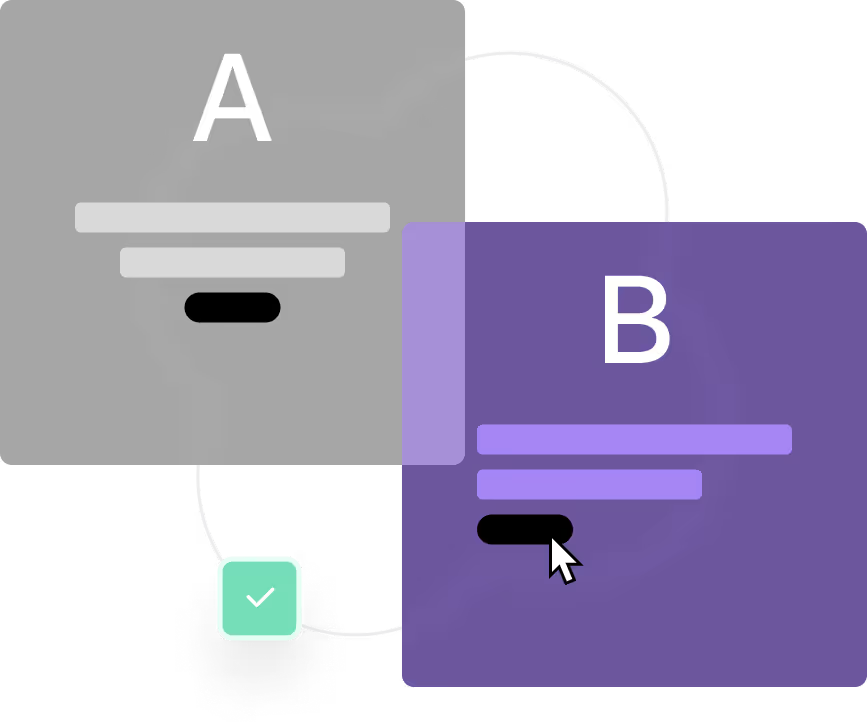
- Test ordering decisions, don't debate them. Split traffic, compare completion rates, keep the winner, the same discipline that applies to any other conversion lever.
Why this is usually an engineering problem, and shouldn't be
Most merchants don't disagree with any of the above. The blocker is operational: in a conventional setup, every new payment method is an integration project, and every display or ordering change is a code change competing for engineering time. So the checkout ossifies. Markets launch with whatever methods the original integration happened to support, and "we should add the local option" sits in the backlog for quarters.
The fix is structural rather than tactical: a checkout where payment methods are added through one integration rather than one integration per method, and where display logic is dynamic, meaning which methods appear, and in what order, can be conditioned on market, currency, device, and other transaction attributes, configured by the payments team rather than engineered per change. The checkout adapts to the customer instead of showing everyone the same list.
Measure it like the conversion work it is
Method optimization without measurement is guesswork. Three practices keep it honest:
- Segment completion rates by method, market, and device. An aggregate checkout conversion number hides exactly the differences you need to see.
- Watch the payment-selection step specifically. Drop-off between reaching payment options and selecting a method is the clearest signal that the display is wrong for that segment.
- Re-test periodically. Method preferences shift as wallets and account-to-account schemes grow. Last year's optimal ordering is this year's hypothesis.
A working checklist
- For each market you serve, can you name the top three local payment methods, and do you offer them?
- Does your mobile checkout lead with wallet or account-to-account options where those dominate?
- Is method display conditioned on market, currency, and device, or does everyone see the same list?
- Are returning customers shown their vaulted method first?
- Can your payments team change method display without an engineering ticket?
- Have you A/B tested method ordering in your top three markets in the last six months?
- Can you report checkout completion by method and market from a single source?
If several of those answers are "no," the gap between your checkout and a localized, dynamically ordered one is measurable revenue.
Why merchants pick Primer for checkout method optimization
Primer's Checkout is built to remove the operational blocker above. Payment methods are added through one integration rather than one integration per method, and display logic (which methods appear, and in what order) is conditioned on market, currency, device, and other transaction attributes, configured by the payments team, not engineered per change.
Testing built into the flow. Gaming marketplace Eldorado runs A/B tests through Primer's Workflows to validate checkout and routing changes on live traffic before rolling them out, the same discipline that applies to method display: split traffic, compare completion rates, keep the winner.
Measurement across every provider. Primer's Observability provides a cross-provider view of completion rates by method, market, and device in one place, rather than one dashboard per PSP.
See what a localized checkout could do for your conversion rate. Book a demo and we'll walk through method display for your top markets.

%20(1).png)