
Smart routing improves authorization rates by dynamically selecting the payment route most likely to succeed for each transaction. Instead of sending all payments through a single provider or static path, smart routing uses performance data, configurable rules, and retries to maximize approvals without adding friction at checkout.
Why authorization rates suffer without smart routing
Authorization declines are rarely random.
Approval rates vary by provider, region, card scheme, issuer behavior, and even time of day. A provider that performs well in one market may underperform in another, and issuer behavior can shift without warning. Your authorization rate is not one number. It is a blended average that hides enormous variance: one PSP approving 94% of UK Visa debit transactions while another approves 88%; a route that performs well for domestic cards but loses several points on cross-border traffic; an issuer that quietly starts declining more of your volume on a Tuesday. Merchants on a single provider, or on static routing, never see that variance, let alone act on it. They simply lose the difference, transaction by transaction, as declined payments from customers who were ready to pay.
Smart routing exists to capture that difference. The best solutions share one core mechanic: for every transaction, route to the provider with the best measured authorization rate for that specific segment, and recover the failures that still happen.
Why authorization rates vary by route
Declines are rarely random. Approval odds shift with the relationship between the issuing bank and the acquiring path a transaction takes:
- Domestic vs. cross-border acquiring. Issuers tend to approve transactions acquired in their own market at higher rates. A German-issued card processed through a European acquirer generally outperforms the same card routed through a US entity, which can also trigger higher fees and stricter fraud screening.
- Scheme and card-type differences. Providers perform differently on Visa vs. Mastercard vs. Amex, and on debit vs. credit vs. commercial cards. A PSP that is excellent for consumer debit in one region may be mediocre for corporate cards in another.
- Issuer behavior shifts. Issuers update risk models without notice. A route that performed well last quarter can degrade this week, and if routing logic is hard-coded, traffic keeps flowing down the degraded path until engineering can intervene.
This is why "which solution is best" is really a question about granularity and speed: how precisely can a platform measure performance per segment, and how quickly can it move traffic in response?
The mechanic: route each segment to its best-performing provider
A smart routing engine evaluates each payment at authorization time and applies rules built on performance data. In practice that looks like:
- Routing UK-issued Visa cards to the acquirer with the highest measured approval rate for UK Visa, and doing the equivalent for every other card-type-and-region segment where you have provider overlap.
- Falling back automatically when an authorization fails with a retryable decline code, so a soft decline at one processor becomes an approval at another rather than a lost sale.
- Preserving authentication across those retries. This detail is easy to miss and material: if a completed 3DS result doesn't carry over when a payment is retried on a different processor, recovery attempts either fail outright or force the customer through a second challenge.
- Shifting traffic when performance changes, without a code deployment, so a degrading route stops costing you within hours rather than sprint cycles.
What separates the best solutions
Measurement you can trust. Routing on bad data is worse than not routing. A platform needs unified, normalized authorization data across all providers: one view of approval rates by processor, market, method, and card type, with alerting when a metric moves outside its expected range, so routing decisions are grounded in evidence rather than PSP-by-PSP report stitching.
A rule layer your payments team controls. Routing rules, retries, and fallbacks need to be configurable in a visual builder, without code. Because the logic sits outside the checkout, iterating on approval optimization shouldn't require engineering for every change.
The ability to test, not guess. Routing strategies involve trade-offs, and the honest way to resolve them is experimentation. If a processor is better at blocking fraud but approves fewer legitimate payments, the merchant needs to be able to decide whether that outcome fits their risk appetite, which means splitting traffic between routes and measuring results directly rather than taking a vendor's word for it.
Complementary auth-rate levers. Routing is the biggest lever but not the only one. Network tokenization replaces raw card numbers with network-issued tokens that issuers approve at higher rates and that survive card reissues. The best solutions let you stack this on top of routing rather than sourcing it from a separate vendor.
Where the options land
PSP-native routing tools can lift approvals within a single provider's acquiring network, and for merchants committed to one PSP they are a reasonable start, though the provider is effectively grading its own homework, since you cannot route around it when it underperforms. Dedicated orchestration platforms add provider-neutral routing and failover, but many stop there, leaving the measurement layer fragmented across the underlying PSPs' dashboards.
The practical evaluation is straightforward: pull your approval rates by card type and region from each provider, find the spread, and ask each vendor to show you, in their product, how a rule would move that specific segment to the better route, and what happens when the first attempt fails.
Why merchants pick Primer for authorization rate optimization
Primer's approach is to combine the three things authorization optimization actually requires in one system, rather than leaving them fragmented across separate tools.
- Unified performance data. Observability gives one view of approval rates by processor, market, method, and card type, with Monitors alerting the team when a metric moves outside its expected range.
- No-code rule building. Routing lives in Workflows, a visual builder where rules, retries, and fallbacks are configured without code, so iterating on approval optimization doesn't require engineering for every change.
- Authentication that survives a retry. With Primer 3DS, a completed 3DS result carries over when a payment is retried on a different processor, so recovery attempts don't force the customer through a second challenge or fail because the authentication was lost.
- Built-in experimentation. As Aladin Taleb, Product Manager at Primer, puts it: A/B testing helps merchants weigh trade-offs, since a processor that blocks more fraud but approves fewer legitimate payments forces a real decision about risk appetite.
- Results in production. Australian sports betting operator Dabble runs its multi-processor setup on Primer and sustains a 96% authorization rate, with automated fallbacks recovering roughly $70,000 AUD in payments that initially failed. That's the pattern to expect from routing done well: a strong headline approval rate, plus a recovery layer quietly converting soft declines into completed payments underneath it.
See where your own approval rate spread is hiding. Book a demo and we'll walk through your routing setup with you.
routing logic is fixed or embedded in code, merchants have limited ability to respond quickly.
As a result, traffic continues to flow through underperforming routes until the issue is detected and engineering can intervene. By the time changes are made, approval rates and conversion may already have dropped.
Read more: A complete guide to payment authorization: what it is and how it works
How smart routing improves authorization rates
Smart routing improves authorization rates by enabling merchants to adapt how transactions are processed based on what is working best at any given time.
Instead of relying on a single route, merchants can set up routing logic based on:
- Historical approval rates by provider and region
- Card type or payment method performance
- Issuer or scheme-specific behavior
- Transaction value or currency
- Retry and fallback conditions after a decline
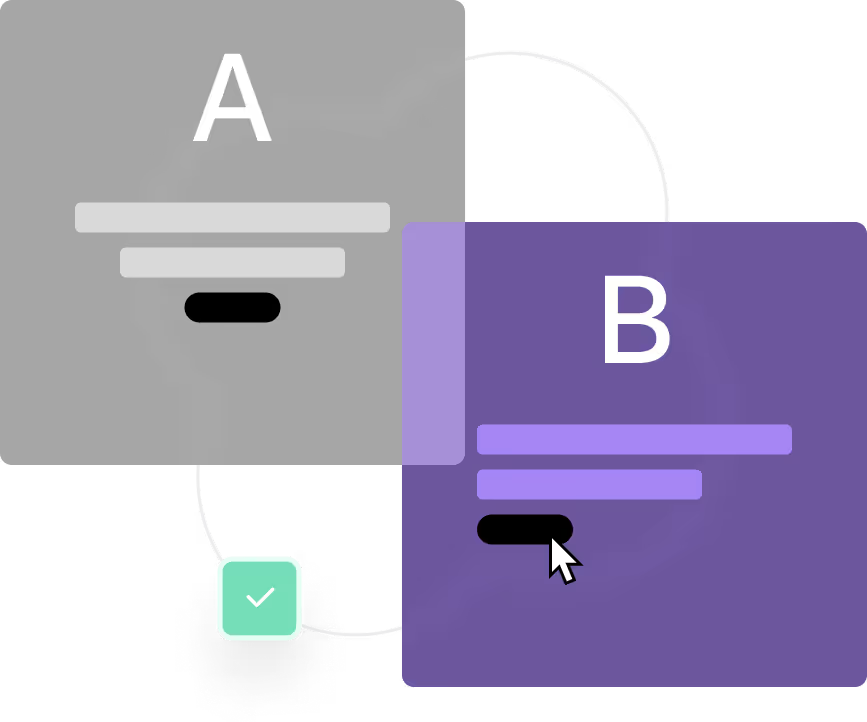
In order to find the set up that works the best for your business, it’s important to continuously A/B test.
As Aladin Taleb, Product Manager at Primer puts it: “A/B testing makes it easier to weigh trade-offs. If a processor is better at blocking fraud but approves fewer legitimate payments, the merchant can decide whether that outcome aligns with their risk appetite.”
How Primer enables smart routing
Primer is a payment platform with orchestration abilities designed to help merchants improve authorization rates at scale.
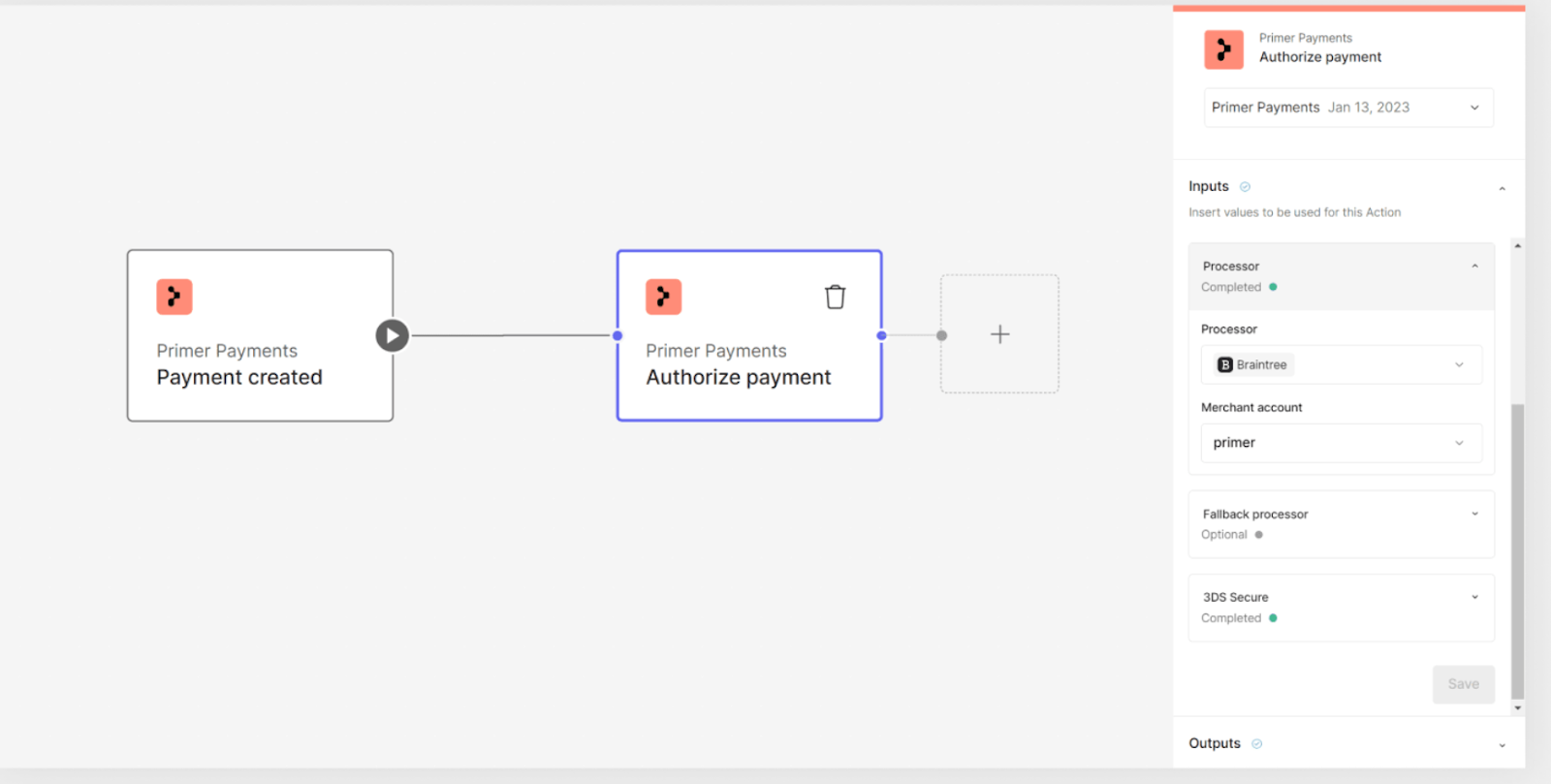
With Primer, smart routing logic is defined using Workflows, a visual tool that allows payments teams to configure routing rules, retries, and fallbacks without writing code. Because routing logic lives outside the checkout, teams can optimize approvals without deploying changes or relying on engineering for every iteration.
Workflows make it possible to prioritize higher-performing providers, route traffic differently by region or payment method, and introduce fallback logic when authorizations fail. Teams can also test routing strategies by splitting traffic and measuring results over time.
Using data to guide smarter routing decisions
Smart routing only works if teams can see how routing decisions affect outcomes.
Primer provides built-in observability across transactions, providers, and markets. This unified view allows teams to identify where authorization rates are dropping and which routes are performing best, without stitching together multiple provider dashboards.

AI Companion builds on this visibility by helping teams understand why performance is changing. It highlights patterns and anomalies across authorization data, allowing teams to adjust routing strategies before declines escalate.
Together, these capabilities support ongoing optimization rather than reactive troubleshooting.
Frequently asked questions (FAQ): Using smart routing solutions to improve authorization rates
How is smart routing different from basic payment routing?
Basic payment routing sends transactions through a predefined path, often a single provider or fixed priority order. Smart routing continuously adjusts routing decisions based on performance data, approval trends, and predefined conditions.
What data does smart routing use to improve authorization rates?
Smart routing uses authorization data such as provider approval rates, card scheme performance, regional trends, issuer behavior, and the outcome of previous attempts to determine which route is most likely to succeed.
Can smart routing reduce false declines?
Yes. By retrying transactions through alternative routes or prioritizing providers that perform better with certain issuers or card types, smart routing can recover transactions that would otherwise be declined.
How quickly can routing strategies be adjusted?
With a payment platform that has orchestration abilities, routing strategies can be adjusted immediately through configuration, without code deployments or checkout changes.
Who benefits most from smart routing?
Smart routing is most valuable for merchants processing high volumes, operating across multiple regions, or using multiple payment providers where authorization performance varies by market.
What can go wrong with smart routing if it’s poorly configured
Smart routing can improve authorization rates, but if it is poorly configured it can create new problems. Common issues include retry loops that generate extra declines and fees, rules that accidentally send traffic down the wrong route (because of small condition errors), and routing decisions that chase short-term variance instead of real performance trends.
It can also cause trade-offs teams do not expect, like optimizing approvals at the expense of fraud outcomes, or creating operational headaches around settlement, reconciliation, and reporting as traffic shifts across providers.
To avoid this, use a platform like Primer to manage routing in one place with guardrails, controlled testing, and clear monitoring. Workflows lets teams adjust logic without code, and Primer’s unified observability (plus AI Companion) helps catch performance shifts or misconfigurations early so you can iterate safely.

%20(1).png)