
What is the best payment orchestration platform for reducing cart abandonment?
The most expensive customer in ecommerce is the one who decided to buy and still didn't. They found the product, added it to the cart, entered their details, and then something at the payment layer lost them: their preferred payment method wasn't there, their card was declined for a reason that had nothing to do with their funds, or a clunky 3DS challenge asked one question too many. Marketing paid full price to get that customer to checkout; payments dropped them at the finish line.
Cart abandonment is usually discussed as a UX problem: shipping-cost surprises, long forms, forced account creation. Those matter, but they're only half the story.
A meaningful share of abandonment happens after the customer commits to paying, in the machinery most merchants can't see: declines, failovers that never fire, authentication friction, and missing local payment methods. Fixing that layer is what payment orchestration is for. Here's what actually moves the number, and how to judge which platform can deliver it.
The three levers that reduce payment-driven abandonment
Lever 1: Payment method coverage, letting customers pay the way they already pay
Shoppers don't adapt their payment habits to your checkout; they abandon it. When the right payment method isn't there, the sale often isn't either. Method coverage is the bluntest abandonment lever, and the constraint is rarely willingness; it's integration cost. Each new method built natively is weeks of engineering, so coverage chronically lags expansion.
This is the core promise of orchestration generally: pre-built connections to dozens of local methods mean a merchant can add a market's preferred payment options in days rather than running a fresh integration project per method. Presentation matters as much as availability, too. A checkout that surfaces the right methods by country, currency, and device beats one that buries local options under a generic card form.
Lever 2: Fallbacks, recovering the decline before the customer sees it
Not all declines are real. Soft declines (issuer timeouts, over-tight risk rules, temporary technical failures) are recoverable, but only if something retries them instantly on a different route. Customers don't retry; studies of checkout behavior consistently show that a failed payment is, for most shoppers, the end of the session.
The mechanism that fixes this is automatic failover: intercepting a decline and re-routing the transaction to a secondary processor in real time, ideally reusing the existing 3DS authentication so the customer isn't challenged twice. Merchants running this kind of fallback logic routinely recover transactions that would otherwise be silent losses: money that never shows up as "abandonment" in analytics because the customer never saw an error, they just didn't buy.
Lever 3: Checkout personalization and experimentation, treating checkout as a product, not a form
Between coverage and declines sits the experience itself: the order methods appear in, the number of fields, how errors are worded, how the flow behaves on mobile. These details move conversion, but on most stacks they're frozen; every change is a frontend release, so nobody experiments.
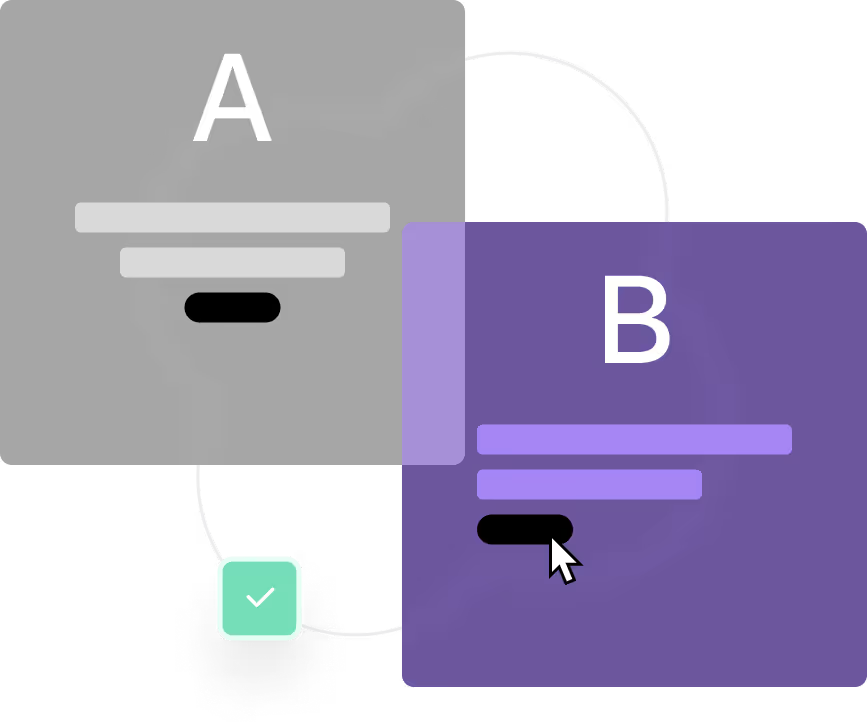
The merchants who reduce abandonment durably aren't the ones who found one perfect configuration; they're the ones who can iterate weekly. That requires a checkout layer that's modular enough to change layout, method ordering, and flows without an engineering release, and ideally extends to routing too, so teams can A/B test which processor to send traffic to based on live approval-rate data rather than a fixed rule set decided once and never revisited.
Two supporting levers: 3DS friction and funnel visibility
- Smarter authentication. In regulated markets 3DS is mandatory, but indiscriminate 3DS is an abandonment machine: challenges on low-risk transactions add friction exactly where none is needed. SCA rules include exemptions for low-risk transactions, and the platforms that handle this well centralize authentication logic across every processor, triggering challenges only when required and reusing authentication data during fallback retries so a recovered payment never challenges the customer twice.
- Seeing where the funnel leaks. Abandonment is rarely one problem; it's several small ones distributed across markets, methods, and providers. The difference between guessing and knowing is observability: which methods underperform in which markets, which provider is declining which card types, plus alerting when a metric moves, so a quiet provider degradation gets caught in minutes rather than discovered in a monthly report.
So what's the "best" payment orchestration platform for reducing cart abandonment?
Any orchestration platform, including Primer, Gr4vy, Spreedly, and IXOPAY, will give you multi-processor connectivity and routing, which addresses part of the problem. If cart abandonment is specifically the metric you're trying to move, evaluate platforms against the full set of levers rather than routing alone:
- Method coverage and dynamic presentation: are the local methods on your roadmap pre-built, and does the checkout localize automatically?
- Real-time fallbacks with 3DS reuse: are failed payments recovered before the customer sees an error, without re-authentication?
- No-code experimentation: can a payments team test checkout and routing changes without engineering releases?
- Unified funnel visibility: can you see abandonment drivers across every provider and market in one place?
The right way to validate any vendor's claims here, Primer included, is to ask them to walk through exactly where your customers drop off today and which specific mechanism addresses each leak.
Why merchants pick Primer to reduce payment-driven abandonment
Primer's case is that of these levers (coverage, fallbacks, experimentation, and visibility) live in one platform, operable by the team that owns the conversion number, rather than split across a payments engineering backlog. A few examples of what that looks like in production:
- Customizable checkout. Primer's Checkout automatically shows the right methods by country, currency, and device. Every checkout element from form fields to buttons can be added, removed, styled, and arranged independently: no heavy lifting required. Use only what you need, adapt to any frontend stack, and match your brand without templates or overrides.
- Fallbacks that actually recover revenue. Australian sports betting platform Dabble, where deposits are the product and a failed payment means a customer heading to a competitor mid-game, runs on Primer and maintains a 96% authorization rate. In one month, automated fallbacks recovered roughly $70,000 AUD in transactions that would otherwise have failed, each one a customer who never saw an error screen.
- 3DS and visibility, centralized. Primer 3DS centralizes authentication logic across all processors, triggers challenges only when required, and reuses authentication data during fallback retries. Observability and Monitors surface drop-off and approval trends across the whole stack, so a quiet provider degradation gets caught in minutes.
See where your own checkout is leaking revenue. Book a demo and we'll walk through your funnel with you.
FAQs
1. What causes most payment-stage abandonment?
Missing preferred payment methods, soft declines that never get retried, unnecessary 3DS challenges, and slow or confusing error handling. Most are payment-infrastructure issues rather than page-design issues.
2. How do fallbacks reduce abandonment?
They retry recoverable declines with a secondary processor in real time, reusing the original 3DS authentication, so the customer never sees a failure.
3. Do more payment methods always mean less abandonment?
Coverage of the right methods matters more than raw count. The goal is that each market's preferred ways to pay are present and prominent, which is what dynamic, localized checkout presentation handles.
4. Can 3DS be reduced without breaking compliance?
Yes. SCA rules include exemptions for low-risk transactions; centralized 3DS logic applies challenges only where required, cutting friction without leaving the rules.
5. How quickly can checkout changes be tested?
On a modular, no-code checkout like Primer's, changes to layout, method ordering, and flows can be made and measured in days, without a frontend release cycle.

%20(1).png)