
Reconciliation is a grind.
You open your dashboards, only to find the numbers don’t quite line up. Payments are scattered across multiple PSPs. Refunds and chargebacks trickle in at different times. Payouts arrive in batches, sometimes days apart. Each provider reports data in its own format, and reconciling it all means hours spent sifting through spreadsheets.
And as your transaction volume grows, that manual process quickly becomes unmanageable.
But it doesn’t have to be this way. With the right tools, reconciliation can move from a compliance burden to a genuine source of insight: helping you identify trends, reduce errors, and optimize performance.
That’s exactly what this guide will help you to do. We’ll break down how ecommerce payment reconciliation works and highlight the six biggest challenges merchants face today. Then we’ll explain how Primer Reconciliation helps automate the process to save time, reduce errors, and bring clarity to your payment operations.
Primer is a unified payments infrastructure platform that helps streamline ecommerce payment reconciliation and turn a compliance responsibility into a strategic tool. Reach out to Primer to find out how we can help you.
How does payment reconciliation work in ecommerce?
Payment reconciliation involves matching order data from the sales platform (including what was sold, when, and for how much) with payout data from the merchant’s bank account or payment provider. The goal is to ensure that all received funds align with recorded transactions.
Here’s what that looks like in ecommerce:
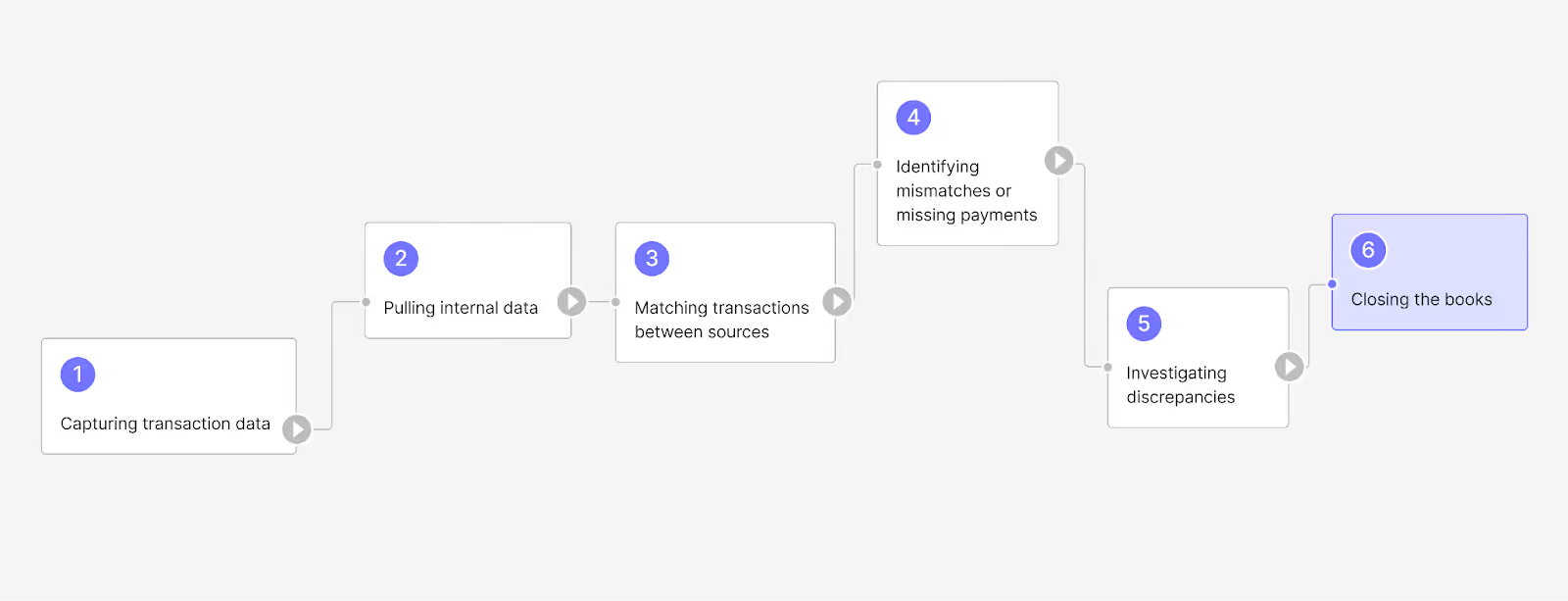
- Merchant, accountant, or payment manager pulls payout and settlement reports from every PSP they use. The goal is to capture details like order IDs, payment IDs, gross and net amounts, fees, and refunds.
- PSPs often group multiple transactions into a single payout. Each payout (“a batch”) covers a specific period of time, depending on the PSP’s schedule. For example, one PSP might aggregate transactions into a daily batch, while another one might issue weekly payouts.
- The merchant must find individual transactions within these varied payouts and match them to the corresponding payments from internal records, for instance from systems like Shopify or QuickBooks.
- When discrepancies are found (for example, if an order is marked as “paid” internally but has no matching PSP transaction), finance teams need to investigate and resolve the issue.
- Once all transactions have been reconciled, the books are closed, leaving behind clean, audit-ready records.
Why is payment reconciliation so challenging for ecommerce merchants?
As an ecommerce merchant, you might have run into the following reconciliation challenges before:
- High transaction volumes make matching records time-consuming. Each sale creates multiple records across payments, settlements, refunds, and fees, and as volumes rise across regions or peak seasons, a once-manageable task turns into days of manual work that slow down close cycles.
Instead of focusing on your core business goals, you’re now pouring resources into what should be a background administrative task. What’s more, human errors are inevitable, be it missed transactions, duplicate matches, or incorrect currency entries. This can lead to serious financial discrepancies and fines if you’re audited.
- Using multiple PSPs and payment methods leads to fragmented data. 62% of merchants use two or three PSPs and a variety of payment methods to support different geographies, currencies, and customer preferences.
But each PSP has its own reporting structures and data formats. While one PSP might provide a CSV report and refer to a particular field name as “gross amount”, another one could use XML files and call the same field name “total amount”. Dates and currencies could also be formatted differently.
This means your finance teams have to translate different payments structures and languages into a unified framework, which adds unnecessary friction to daily operations.
- Batched payouts make it hard to tie deposits to individual orders. Because PSPs pay out in batches, a single transfer can represent hundreds of transactions. Combined with differing payout schedules, tracing each payment to its source isn’t easy.
This lack of granular visibility also delays the identification of errors, which complicates cash flow management, as merchants might not immediately spot whether they’ve been over or underpaid.
- Refunds, chargebacks, and fees add further complexity. The net amount a merchant receives from a sale is constantly in flux. Processing fees, interchange fees, refunds, and chargebacks all affect the final payout.
Interchange fees, for example, can fluctuate by card type or region, and chargebacks are especially disruptive because they can take weeks or months to resolve, distorting cash flow.
- Currency conversions and cross-border payments complicate reconciliation further. Once you scale internationally, you now have to deal with exchange rates, FX conversion fees, and settlement delays. And the larger the scale, the more important accuracy is. Even small FX discrepancies can accumulate over time, causing merchants to leave money on the table.
- Delays or errors in processor reports can cause mismatches. PSP reporting delays are common, especially while transactions are still settling or refunds are in transit. What’s more, differences in time zones and data cut-offs can make it tricky to align PSP reports with ecommerce order logs, and occasional missing or duplicate transactions only add to the mismatch. As a result, it’s harder to close the month on time, and overall financial visibility is reduced.
For many merchants, issues like revenue leakage, distorted cash flow forecasts, refund mismanagement, audit complications, and the prospect of potential fines are nothing new due to the above issues.
But there’s a way to build a better payments strategy: automate what can be streamlined and free up finance teams to focus on cases where human intervention is critical.
The power of automation in ecommerce reconciliation
As you scale, your time and resources should ideally be spent on forecasting and optimization, not manual routine checks. Automation makes that goal possible.
By handling transaction matching, currency conversion, and discrepancy detection automatically, automation eliminates human error and ensures nothing slips through the cracks. Finance teams get real-time visibility into cash flow and settlement status, while compliance becomes simpler thanks to clear, traceable records for every transaction.
But automation alone isn’t enough if your data is fragmented across multiple payment providers.
As a unified payments infrastructure, Primer abstracts away the complexity of multi-PSP reconciliation. Every transaction processed through Primer is standardized and tracked from the moment it’s created, giving merchants a single source of truth across providers, currencies, and payment methods.
Take Eldorado, a global gaming marketplace. Before partnering with Primer, their payments setup relied on multiple one-off PSP integrations: a fragmented system with little visibility or optimization. With Primer, they simplified their architecture, reduced operational complexity, and gained complete oversight of every transaction across their global stack.
When your payment data is unified from the source, reconciliation stops being a manual chore and becomes a strategic advantage: faster, cleaner, and more accurate at every scale.
How to get started with Primer reconciliation
So, you’ve signed up with Primer. You’re now adding new payment methods in just a few clicks, managing your whole payment stack in one place, and setting up payment routing code-free.
Here’s how Primer Reconciliation can help save you even more time by turning a compliance burden into strategic insights:
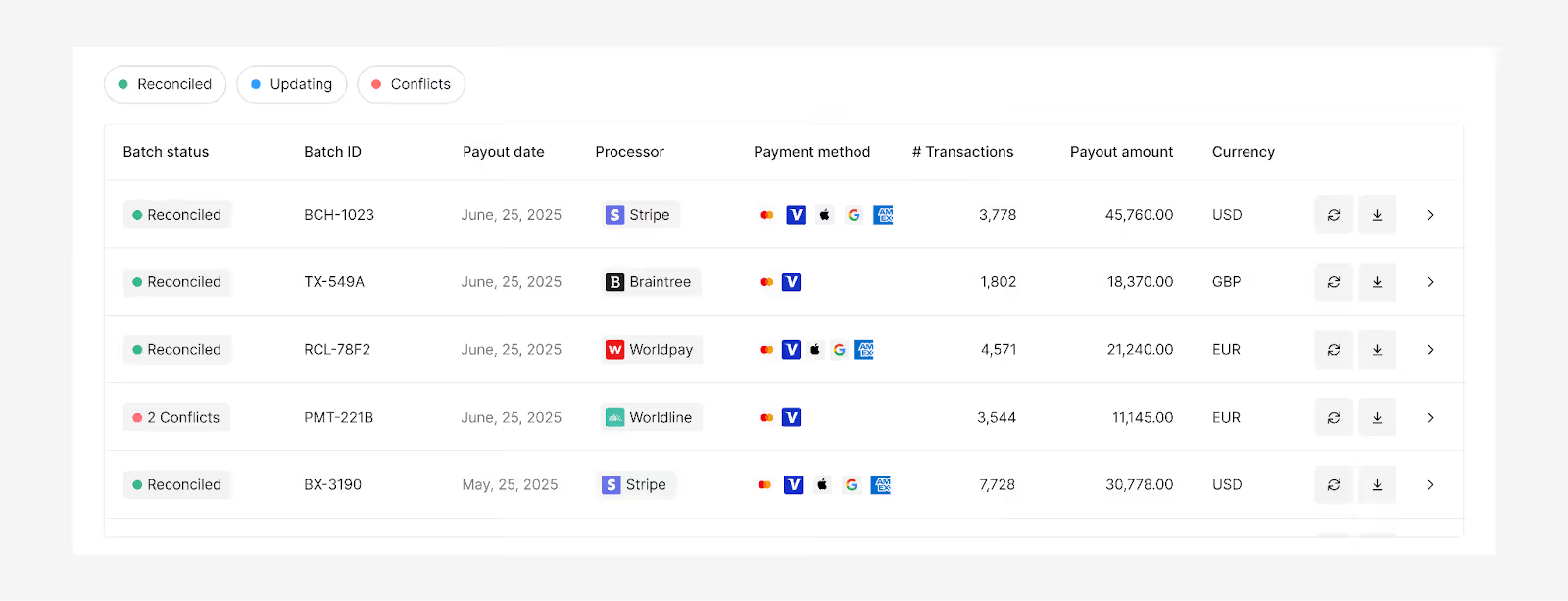
- A unified view across PSPs: See batch status and ID, payout date, processor, payment methods, number of transactions, payout amount, and currency in a single dashboard.
- Standardized data formats: Order IDs, amounts, currencies, and fees all line up automatically – there’s no need to manually map formats and terms across providers.
- Real-time insights and powerful analytics: Track discrepancies, identify trends with over 100 charts and 30+ ways to slice data, and gain a better understanding of where money is being lost to fees, FX conversions, or delays.
- Audit-ready reports: Produce clean and accurate data that support compliance and increase stakeholder confidence.
Turn reconciliation from an operational bottleneck into a growth lever
Ecommerce payment reconciliation doesn’t have to be a time-consuming back-office chore. With Primer, it becomes a critical tool for understanding and optimizing your payments.
Primer Reconciliation automatically matches transactions, accounts for fees, refunds, and chargebacks, and gives you a complete view of what you’ve actually earned. No more guesswork or manual spreadsheets; just reliable, actionable data that lets you make smarter financial decisions.
Ready to reconcile faster and smarter? Find out more or book a call with one of our team.
FAQs: Ecommerce payment reconciliation
1. What is ecommerce payment reconciliation?
Ecommerce payment reconciliation is the process of matching ecommerce transactions from your e-commerce platform or sales channels with deposits received in your bank statements or from your payment gateways such as Stripe, PayPal, or Amazon Pay.
A well-structured reconciliation process ensures every order and payment aligns correctly, giving your e-commerce business accurate financial records, clean audit trails, and more reliable financial reporting.
2. Why is ecommerce payment reconciliation so difficult?
Reconciliation becomes complex when e-commerce businesses rely on manual reconciliation through spreadsheets or basic accounting software. The challenge increases with high volume or multi-channel sales, where transaction data is fragmented across multiple payment gateways, currencies, and payout schedules.
Factors like delayed bank deposits, chargebacks, refunds, and exchange-rate fluctuations all make it harder to maintain financial accuracy and slow down month-end close cycles. This adds unnecessary manual effort for finance and operations teams.
3. How does automation help merchants reconcile faster?
Automated reconciliation tools streamline repetitive work within the payment reconciliation process. They automatically match transaction data with bank deposits and payout records from providers like Stripe, PayPal, and Amazon.
This reduces errors, saves time, and provides real-time data visibility. Finance teams can monitor exceptions immediately and focus on higher-value financial management tasks, improving both accuracy and profitability.
4. Can reconciliation be used to optimize my payments strategy?
Yes. Modern reconciliation software and reconciliation solutions do more than maintain compliance — they strengthen your overall financial operations.
By unifying your data across multiple payment gateways and e-commerce platforms, you can identify trends like high decline rates, refund spikes, or excessive processing fees. This insight helps merchants make smarter decisions around PSP routing, workflows, and cost optimization. Integrated data also supports better financial reporting and scalability as your volume of transactions grows.
5. How hard is it to automate payment reconciliation?
It depends on your current setup and the ERP or accounting software you use, such as Xero or NetSuite. In general, tools like Primer Reconciliation make automation simple by connecting directly with your existing payment gateways and e-commerce platforms.
Once configured, transactions are matched automatically across your systems with minimal engineering input. The result is faster, more accurate reconciliation and a smoother user experience for your finance team.

%20(1).png)