Inside the mind of the modern payment leader
We surveyed 500 industry insiders to reveal the unique stories of the people shaping the future of the industry. Here’s their untold story.


Head of Payments, Remote

Global Payments Director, Burberry

Head of Payments, Conforama

Head of Payments & Partnerships, Zip

Strategic Payments Partnerships, Vinted

Senior Product Manager, Printify

Head of Payments, loveholidays
Director of Product, Agoda











The untold story of payment pioneers
Payments are crucial to the success of organizations, playing a more critical role than ever before. Yet, the role of the payment leader is often enigmatic and undefined. While every business designates someone responsible for payments, their responsibilities, experiences, reporting lines, and influence can vary greatly from one company to another.
So we set out to understand who is the modern payments leader? What motivates them? What are their passions and challenges? What are their goals and concerns? And where do they see their profession heading?
We’ve surveyed 500 payments leaders across five markets and interviewed prominent figures from brands such as Agoda, Burberry, loveholidays, Printify, Vinted, and more. The result is the most comprehensive analysis of the modern payments leader to date.
Enjoy.
The untold story of payment pioneers
We surveyed 500 industry insiders to reveal the unique stories of the people shaping the future of the industry. Here’s their untold story.
Get the full story
Learn more about the inside story of payment leaders by taking a look at our in-depth report.
Our payment leaders
Explore the stories of payment pioneers blazing a trail around the world.

Alistair Chaytor
Alistair Chaytor is the Global Payments Director at the fashion brand Burberry. With over a decade of experience in payments from his time at the iconic travel platform Tripadvisor, Alistair now applies his strategic financial expertise to Burberry, overseeing the luxury brand’s global payment operations. Alistair provides exclusive insights into his journey in a payments-focused role, the development of the payments function on a global scale, and the strategic use of payments to drive revenue growth in a multi-billion-pound business.
Alistair, you’ve come from a traditional finance background. How did you first get involved in payments? What prompted this shift?
At Tripadvisor, I initially held a finance-based role focusing primarily on financial reporting. I then transitioned to working with some of the marketplace business units, where I began to focus on the payments coming in and going out.
Part of my responsibilities included operational finance, collaborating with Product and Engineering teams to design accounting systems for those marketplace businesses. These accounting systems were driven by various event types in the lifecycle of a booking—such as a payment from a customer, booking confirmation, and subsequent payment out, which was usually a disbursement to a supplier.
As payments were central to these accounting events, I became increasingly involved in the payment space. I gained an understanding of how payments work, the different components involved, and the various routes they take. This ignited my interest in payments, and I found myself at the forefront of managing Tripadvisor’s payment service providers (PSPs).
Did anything surprise you when you transitioned into payments?
Up to this point, most of my finance roles had been consolidated reporting for quarter-end and year-end deliverables, for example.
Of course, at the core of any business is the delivery of a service or the production of goods, but closely followed to that is taking payments for those services and goods.
Shifting my focus to payments revealed how multi-faceted this space really is. At Tripadvisor, in particular, which operates on a global scale, I saw firsthand how varied the payments landscape is between countries, including differences in consumer behavior and payment methods. I was surprised at how detailed and nuanced the payments space is.
You’ve continued working in payments. What made you stay?
Part of moving into payments was me fancying a change, but I’ve stayed for a mix of reasons.
I quickly realized that working in payments afforded a lot more flexibility. Traditional finance roles live and die by strict reporting standards, as they’re highly cyclical in nature. Payments, on the other hand, aren’t driven by the same reporting measures.
It’s also been refreshing to work with different teams, such as Product and Engineering, rather than working solely within Finance. I’m really enjoying the wider variety of work and collaboration that payments offer.
Payments are 24/7. Has this impacted you from a work-life balance perspective?
At Tripadvisor, it was all e-commerce-led, with no brick-and-mortar payments. Now at Burberry, the focus is much more on retail, and payments are restricted to store hours. However, given the global nature of the business, there’s considerable overlap as regions open for business.
Even so, there are very few emergencies, and most of these can be mitigated by building redundancy into the technology and operational aspects of payments. In six months, I haven’t been called in the middle of the night, which is a testament to the strength of our IT systems.
For the engineering and product side of payments, there is a need to have people on call, but there isn’t that type of pressure for a more relationship management role, which is how I see mine.
Can you expand on how you’d define your role? And how is the payments function evolving?
Primarily, I manage Burberry’s commercial relationships with various parties across the payment lifecycle, including card schemes, acquirers, and issuers. This involves both day-to-day interactions and key events like contract negotiations.
Secondarily, I focus on driving operational excellence, which is grounded in data. We aim to make payments more efficient and improve the customer experience by benchmarking authorization rates, cost of payments, chargebacks, and other metrics.
The third and most exciting pillar of my role is being an enabler in payments. This involves engaging with all parts of the business, understanding their needs, and initiating discussions on how payments can support them.
There’s a shift happening here: payments have traditionally been seen as a commoditized utility, but now they’re getting greater attention due to their business-wide impact.
This is evident in the newly-created payments function and the increased engagement from other teams. We’re getting a seat at the table, which is great for brand awareness and showcasing the value of payments.
Our goal is to elevate the payments brand internally, demonstrating that they’re not just a utility but a value-added function that can drive and enable the business’s goals. This involves a level of education, as payments should be cross-functional. The collaborative aspect of my role is something I really enjoy.
You mentioned involving the business—how are you achieving this?
It can be difficult.
Some of the time it's about involving those more senior to me in the business and ensuring they advocate for looping payments in the conversation. Often, people in the organization overlook the need to involve payments in their initiatives from the get-go.
The rest of the time is about increasing knowledge around payments through these initiatives and by explaining and showing people how we can add value.
The payment space touches so many aspects of the business that it’s up to us, as payment leaders, to identify where we can add value. Instead of waiting to be invited, we have to initiate those conversations. We need to be bold and approach people who may not know who we are and what we do.
What’s your current reporting line?
At Trip Advisor, it was within finance. At Burberry, payments sit within Business Services, but the person I report to is still a member of the Finance team.
How would you define the role of a modern payment leader? How do you see this evolving in the next 5 to 10 years?
Enabling revenue generation is my number one goal. So the modern payment leader needs to think of themselves as an enabler. Specifically, they need to strategize with other business leaders on how payments can enhance the customer experience and drive the organization forward.
This involves taking both a strategic and an operational or tactical approach depending on the goal. Payment leaders should understand the full end-to-end process, including finance and reconciliations. When working with product teams on the frontend, it’s about enhancing the customer experience. On the backend, it’s about optimizing integrations with engineering. Additionally, there’s the regulatory element, involving managing risk and compliance. Finally, optimizing performance means driving down costs and boosting acceptance rates.
In the future, the focus will become more on the strategic value of payments rather than the operational side. Technology will lead the way in localization and personalization of payments to give consumers what they really want.
Would you recommend a career in payments to someone starting out? What advice would you offer them?
100% yes! In my experience, the last six years of my career have been more exciting and rewarding than the previous six.
In terms of advice, I’d say jump in with both feet! There’s no defined route into the payments space, and nobody knows everything since it’s constantly evolving.
As payments become a bigger part of every business, there will be increasing opportunities and roles driven by payments. There is definitely a lot of value to add.

Andrea Feinberg
Andrea Feinberg is the Head of Payments at loveholidays, the UK’s fastest-growing travel agent. She discusses her reasons for transitioning to the merchant side of the industry, highlights the importance of context-switching in her role, and shares her ambition to build a dedicated payments team.
Andrea, you’ve worked for some big names in payments, including Gemalto, Visa, and Verifone. How did you get involved in the payment space?
I grew up with payments—my mother worked for 20 years in Visa’s commercial team in Argentina. However, I didn’t always envision following the same path. As a child, I dreamed of a career in architecture or design.My journey into the payments industry began after completing my master’s degree when I secured a job with Axalto in France, which has since been rebranded as Gemalto and later acquired by Thales. I entered the industry at a dynamic time in 2006, working in a company focused on POS terminals when mobile point-of-sale devices were just emerging. It was an exciting time.
How hard was it to learn about payments?
Given my family’s payment experience, I understood the industry's complexity. It’s not just the technical aspects but also the challenge of aligning all the stakeholders in the ecosystem. The tricky part for me was learning about the European landscape.Gemalto provided me with valuable experience in bringing new products and concepts to market. However, it was when I joined Visa that I began to understand the broader payments industry. Payments are constantly evolving, and each role offers new opportunities for learning and growth. After spending over a decade working for payment providers, I was ready for a new challenge and decided to move to the merchant side of the industry.
What made you want to experience payments working for a merchant?
I’ve always been interested in how payments affect customers’ experiences and buying behavior. During my last few years at Visa, I worked in the Merchants and Acquirer Value Proposition team. After that, I joined a payment solutions and gateway provider, where I developed products for Europe and serviced merchants again.While offering merchants various cost, price, and competitive options, I often thought, “I’d love to make these decisions myself.” That desire to directly impact the decision-making process ultimately drove me to move to the other side of the fence.
You have a solid analytical background? Is this necessary for a career in payments?
It’s not a prerequisite, but it certainly helps. Over the years, I’ve developed an instinct for spotting trends quickly and, when incidents occur, the ability to swiftly identify the source by asking the right questions. This skill comes from being deeply immersed in the details and performing analytical tasks over time.Working in payments requires analyzing, understanding, and communicating a wide range of information to different stakeholders. It takes a particular mindset to do this effectively. You must also have the technical and financial acumen necessary to balance cost control, compliance, and infrastructure needs.
Which internal teams do you collaborate with the most, and why?
Payments is a horizontal function that impacts every aspect of the business, from the back end to the front end. My role sits within the finance team, but collaboration is a key aspect of my job, as payments touch many different parts of the business. I frequently engage with multiple teams: tech, product, and engineering teams who help implement my projects; customer service teams who handle customer inquiries and issues, marketing and brand teams who optimize our website; and legal teams to sign new agreements. You must collaborate constantly to ensure that payments are seamlessly integrated into all business areas.

Andreea-Diana Jegermane
Andreea-Diana Jegermane is a Principal Product Manager at Printify, a technology platform that enables people to sell customized merchandise on an on-demand basis. She is a seasoned marketing and payments specialist committed to transforming payment systems, strengthening fraud prevention, and improving the shopping experience. Here, she traces her career over the last 15 years and shares what she has learned about optimizing payments and working with different stakeholders.
Where did you begin your career, and how did you move into payments?
My first passion was marketing. At the start of my career, I worked as head of marketing and marketing manager before becoming a business analyst and contributing to developing digital products.
My payments career started when I was asked to tackle a chargeback problem. I knew nothing about payments then but was eager to take on the challenge.
I started by analyzing data to identify fraud patterns and creating rules to address these issues globally. After that, I became more heavily involved in payments, negotiating big deals and rates with payment processors. We had a large portfolio of payment partners and needed to consolidate, so we began building our own orchestration platform.
Following this initial experience, I joined Mastercard, working in its payment gateway services. I was there for two years, experimenting with open banking, learning about 3DS, and working with big banks and merchants.
When Printify approached me, I loved the idea of working in a start-up and having more flexibility. Printify was growing fast and needed a strategy to diversify its payment partnerships and respond to global customer needs.
Since then, I’ve been working on optimally routing transactions, enriching the payment portfolio, and strengthening our payment relationships.
Are you happy that you moved from marketing to payments? Was it the right career decision?
I have no regrets. There’s so much to explore in payments and so much innovation and opportunity. Although I had plenty of other career opportunities, including with Mastercard, I really liked the challenge of working in payments, so that’s where I’ve placed my energy and focus.
How has your background in marketing helped the way you approach payments?
My marketing experience has proved valuable in two ways. On the communication side, I can explain the technicalities of payments in simple terms to someone with zero background and knowledge. I can cut through the jargon and adjust the message to any audience, which has been very useful at Printify. For example, it helped to get buy-in from the leadership for the initiatives I was proposing. This skill is a great advantage because payments can be complex and challenging to understand.
The second benefit is this: I’m a product person, so I always care about the user and spend time understanding their challenges and needs. I watch how users behave, understand all the relevant data, and see where the bottlenecks are. In particular, I always think about localization and splitting users into smaller buckets so that we can understand the specific needs of different groups and how the product I’m working on should reflect their needs.
Working in payments involves balancing both technology and people. It’s essential to accommodate the needs of everyone, including end users and internal stakeholders.
What are some of the common misconceptions about payments?
There are always misunderstandings and competing viewpoints. That’s because people come from different disciplines, and their payment priorities vary.
For example, finance people care about money in the bank. That’s their primary focus. It’s my job to educate them on how they can have more money in the bank by optimizing the approval rate or by lowering costs using more effective payment methods. This knowledge can help a chief financial officer view payments more strategically.
In contrast, with a chief technology officer, the blind spot may be building a monolithic application with huge engineering costs. In other words, over-complicating things. So, depending on who you are talking to, you must adapt the message and look at the problem from different angles.
What changes do you foresee in the payments industry over the next decade, and what skills must payment leaders develop?
Being a payments leader is a combination of art and science—in fact, you have to be a bit of a wizard. There is so much complexity, so many moving parts, and very little transparency around efficiency and cost. So, you need to experiment and find the right formulas for payment success. There’s no single and simple winning strategy: you need to understand different business models, customer needs, and buying preferences.
The payment landscape is changing rapidly, and it will evolve even more in the future. Fintechs are transforming traditional relationships and competing with established brands, and to remain competitive, you need to understand your customers and innovate.
Do you see yourself staying in payments, and would you recommend it as a career?
Payments will always be one of my passions, but I may eventually apply my experience to another area. However, I can confidently say that payments are a great career choice for anyone. It’s a versatile and innovative field, offering endless opportunities for exploration and development.
Dipa Dubhashi
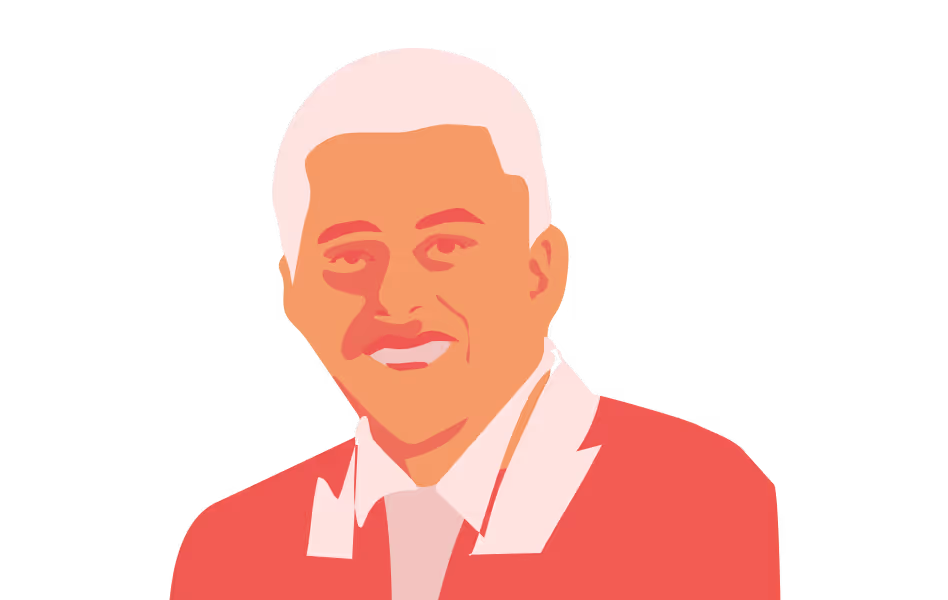
Dipa Dubhashi is the Director of Product at Agoda, a global digital travel platform with millions of customers that offers affordable deals on various travel services, including hotels, flights, activities, and more. With over ten years of product management experience across e-commerce, SaaS, payments and fintech products, Dipa currently heads Agoda’s payment and fraud prevention product teams - driving the product vision and strategy for this pillar.
How did you become involved in payments?
I began my career as a data/business analyst at a management consultancy firm before launching my own company. Within a couple of years, we were acqui-hired by another data solutions startup called Sigmoid Analytics where I took on the role of Head of Product. The next four years were incredibly rewarding and we were able to build a fantastic team and product that grew from 0 to $10s of millions in ARR, securing multiple rounds of funding from Tier-1 VCs like Sequoia Capital along the way.
At that point, I decided to move on and explore the world of B2C product management. Being an avid traveller and Agoda fan even back then, it was a no-brainer for me to join Agoda’s product team where I started off as a product manager responsible for a couple of our marketing products. After about a year, an exciting opportunity in the fintech product team arose, specifically around a new payment-related product. Despite my lack of experience in the world of fintech and payments back then, I was intrigued by the innovative product we were developing and decided to make the switch.
My role at Agoda has evolved significantly since then, from product manager of a single payment product to senior PM driving a couple of related payment products, to lead PM spanning the entire consumer payments area, to now director of product, overseeing our entire payment and fraud prevention domains.
What sparked your interest in payments?
Having optimized a mature product for about a year, I was keen to work on something more 0 -> 1. An opportunity sprung up in the fintech product team, where we were looking for a product manager to help drive an innovative, new payment product that was greenlighted. I spoke to a few people to learn more about it and despite having limited knowledge around payments, was blown away - both by how interesting and complicated the area was but also the innovativeness of our own envisioned product. That sparked my interest and convinced me to make the move.
Did anything surprise you when you started looking at payments?
The most surprising aspect was the number of different layers beneath the surface that customers and even most merchants are unaware of. There are countless ways to optimize the payment experience, adding value for customers and merchants.
Although I anticipated some complexity and nuance, I was amazed by how intricate the payments ecosystem is and its many challenges, including things like regulatory compliance. Operating within such a controlled environment and finding new models that add value for businesses and customers is both an opportunity and a challenge.
Why have you decided to continue working in payments?
Being a product manager is all about solving consumer and business problems, and in payments, there is no dearth of problems to solve. Finding innovative solutions to existing pain points enables people to do things better and faster unlocking value for the business.
Payments have intrigued me since I joined that team about six years ago. Our payment setup was relatively nascent then, but the potential was evident. Ensuring that all our customers, with diverse payment preferences and backgrounds, can make seamless payments on our platform is no easy feat and while we have made great progress, there is still a long way to go.
I learn something new every day, a rarity in many other roles. Payments is a field where even multi-decade veterans can continue to expand their knowledge and skills, making it a continually exciting and evolving area to work in.
Tell me about the setup at Agoda. What are your responsibilities, and how is the payment strategy developed and executed?
The product, commercial, and engineering teams work hand-in-hand to craft Agoda’s payment strategy, informed by data, evolving consumer needs, business goals, and market dynamic
Our goal is to ensure we enable any customer who wants to make a payment on Agoda to be able to do so successfully with a delightful experience. That implies offering relevant choice and flexibility around how and when someone wants to make a payment, eliminating friction in their payment journey, and ensuring robust security & fraud prevention mechanisms... At the same time, we cater to business goals around minimizing cost and driving efficiency.
That then translates to specific tactics around adding new payment methods, offering flexible options like BNPL, optimizing conversion/acceptance rates, improving our fraud detection models, security and platform modernization, etc. , all of which go through a rigorous prioritization process to determine our eventual strategy and roadmap.
Selecting the right third-party partners is also a critical aspect and a lot of thinking goes behind selecting the ones that can provide the right technology, experience, insights, etc. to help us realise our goals.
How do you bridge the knowledge gap between teams and ensure a joined-up approach?
We foster a knowledge-sharing culture across the business. Different product teams regularly discuss their current initiatives, experiment results, and the corresponding lessons learned. This shared learning helps everyone understand the overall product and business more deeply and enables them to consider a wider variety of factors when developing new features or products.
Continuous education is crucial to ensure product managers evaluate their experiments holistically and avoid rolling out products or features that may have unintended, negative downstream consequences. A PM could run an experiment that skips the fraud check step entirely in order to improve conversions and see positive results, however, this will likely result in a flood of chargebacks coming our way a few days or weeks, or even months later and the result in a net poorer outcome, both for consumers and the business.
Educating our teams helps us consider different customer personas and potential risks, ensuring we build the most effective and secure products.
What are the satisfactions and frustrations of working in payments?
Inefficiency in payment workflows is one aspect that often creates frustration but that also means there’s a lot of opportunity and value in eliminating it. Often, processes are followed simply because “that’s the way they’ve always been done.” This can be frustrating, but it also presents a chance to break the mold and create something innovative and better.
Finding and implementing solutions to these inefficiencies is highly satisfying. Transforming outdated systems into streamlined, efficient processes improves the customer's payment experience and drives business growth.
What are the most critical skills or attributes for someone working in payments?
The skills needed for payment product management are similar to those required in any product role. You must think like a scientist, applying a first principles approach and viewing things from the customer’s perspective. It’s essential to be open-minded and dig deep to find the truth rather than take everything at face value.
I’ve often been surprised by how much is taken for granted. People make false assumptions, so it’s essential to always challenge conventional wisdom, especially when it doesn’t feel logical. Questioning and challenging assumptions is almost always the path to discovering newer and better ways of doing things.
How will the payment product management approach evolve?
While new technologies will undoubtedly influence payment strategies, it’s important to proceed with caution. Understanding the limitations and risks of innovations like blockchain or generative AI is essential. Before hastily adopting the latest digital advancements, we must thoroughly explore their design, limitations and assess fit.
Would you recommend a career in payments to someone just starting out? What advice would you offer?
Absolutely, I highly recommend a career in payments, and more broadly in fintech. The industry is filled with inefficiencies, ripe for disruption and offers numerous opportunities for creative individuals who enjoy tackling challenges and developing new business models. I advise staying curious, continuously learning about new trends and technologies, and being ready to innovate. As Steve Jobs famously said - Stay Hungry, Stay Foolish.
Lucas Quinio
Lucas Quinio is Head of Payments at Conforama Europe's second-largest home furnishings retail chain. We talked to him about his entry into payments, what it takes to be a successful payments leader, and the challenge of working across functions.
Did you always want a career in payments?
Payments is a role you typically fall into. It’s not typically a role one considers when growing up or entering the workplace, as it’s not taught in schools nor discussed when making career choices. However, once you discover this field, it can be a rewarding path to follow.
This was my experience. I had the opportunity to join Carrefour, where I worked for a new FinTech division focused on payments. I enjoyed working in the middle ground, at the intersection of IT and business, something that’s quite unique to a career in payments.
What do you enjoy about your role?
As Head of Payments, you always have one foot on the technical side—being innovative and solutions-focused—and the other in the business side—improving the customer journey and achieving business goals. It’s essential to understand and enjoy both aspects.
Balancing these two paths inspires me. I get to be creative and curious while also being strategic. Working in payments allows me to interact across multiple functions, from the tech team to marketers to the Board. Intellectually, it’s gratifying, and I’ve never regretted finding my way into this field.
Who do you report to within the organization?
Payments touch every aspect of the business, so I report to various departments. It’s a challenge, but it’s also fun.
My direct report is to the finance team, where we discuss numbers, cost, and investment alongside key performance KPIs.
I regularly liaise with the IT director and CTO to explain the tools we deploy and trends such as decline and error rates. Additionally, I frequently report to the security and audit team, as fraud management is a significant part of payments and often the first place issues are detected.
I also partner with the marketing team, whose primary KPI is driving sales. Together, we work on projects such as identifying and introducing new payment methods that boost conversion.
Since payment is a strategic priority at Conforama, I also spend a lot of time with the C-suite. For instance, I recently shared our long-term vision for payments with the company president.
How does this sphere of activity impact your skillset?
Working in payments is often about problem-solving; you must find solutions to meet everyone’s needs.
You must also be flexible and able to adjust your mindset and conversations depending on which team you’re speaking with. Additionally, you need to excel at generating reports!
What common misconceptions do you encounter about having a payment function?
Attitudes towards payments depend on the nature of the business. In large companies, a common misconception is that payments are a siloed, one-dimensional function. In smaller organizations, it’s often thought that payments don’t need to exist as a separate function at all.
In my view, a Head of Payments must sit above everything. I regularly work across different teams that are not explicitly focused on payments. To do this job effectively, you must be open to collaborating with other functions and maintaining oversight of everything happening across the business.
How do you know if a business is ready for a payments lead?
It’s hard to pinpoint when a business needs to hire someone full-time for payments, but it happens in every company. Often, companies transition from knowing nothing about payments to having an expert with no in-between. This is why first-time payment leaders can have a challenging job initially but can also make a significant impact quickly.
I speak with many people at events, and when I tell them what I do, they’re often shocked because they didn’t realize payments is a dedicated role or that their own companies might need it too. On the other hand, some people are surprised that I’m the only one doing this job at Conforama.
Overall, payments is still a very new role for most businesses. Everyone is looking for the right setup, and finding one isn’t easy. I’m the first Head of Payments at Conforama, and it’s one of the reasons I enjoy the role—I get to be strategic while also being hands-on.
Can payments be a springboard to leadership roles in an organization?
It depends on the individual and the business, but ultimately, there’s no reason why payments shouldn’t be a C-level or at least a Head-of-function position, even if it isn’t represented on the Board.
Why? Because to manage payments effectively, you need a degree of autonomy and decision-making power. Without this, you’ll spend your time negotiating with everyone and going in circles rather than getting things done.
In the absence of a dedicated payments lead, you need a powerful sponsor—someone at the board level who understands the importance of payments, can vouch for your work, and can help you progress.
Payments is constantly changing. How do you stay updated on the latest developments?
I’m based in France, where we have a close and collaborative payments community. My best source of information is a WhatsApp group, and I regularly interact with other payment leaders. We communicate daily, swap links, ask questions, and exchange experiences.
I also spend a lot of time with our solutions partners, sharing ideas and discussing new technologies. I’m also part of a government group that focuses on new payment regulations.
Do you plan to expand your team? If so, what roles would you fill first?
Recruitment is always complicated. People are a significant investment, but having the right skills is essential to drive the business forward. My first priority is to hire a dedicated fraud expert to strengthen our team.
Many companies have a Head of Payments who works closely with both a payments manager and a fraud manager, who are more technical. Large companies should at least have these three roles, and I anticipate we will grow this way.
There may also be a future where specific product and engineering teams are built around payments—a very exciting prospect that I’d be eager to champion.

Greta Atminaitė
Greta Atminaitė looks after Strategic Payments Partnerships at Vinted, where she can combine her passion for payments, with sustainability and making second-hand first choice. Find out how she went from building relationships to building a team that’s helping the world buy and sell second-hand items.
Greta, before you joined Vinted, you worked at TransferGo. How did you enter the payments industry?
It was completely unplanned. I studied management, economics, and business strategy, then spent seven years in various sales and commercial roles before securing a job with TransferGo in Lithuania. At that time, I knew very little about payments. Working in a fintech company became my “payments school,” teaching me everything I now know about the industry I love.
Interestingly, my accidental entry into the payments industry is not unique. Recently, I participated in a PSP advisory panel, and all 15 experts on the panel had also stumbled into payments by chance rather than by design.
What surprised you when you first entered the payments industry?
At first, I was amazed that an entire industry is built around payments. As a consumer, paying is something you do automatically, without being aware of how it all works, who is involved, or how they make money. Once on the other side, you’re suddenly exposed to new terms like KYC, optimizations, orchestration, tokenization, chargebacks, and refunds. There’s a lot of complexity and a vast ecosystem running it.
How have your sales background and the skills you have as a salesperson helped you in your current role?
Being able to interact with external parties is a key part of both sales and payments. Having a commercial understanding to negotiate, structure deals, and develop strategies is crucial. My sales experience gives me a better perspective; it helps me “read the room,” especially during contract negotiations. It also provides me with a lot to draw on, from knowledge of different markets and topics to a great network of contacts I can leverage for Vinted.
What prompted the switch from TransferGo to the merchant side with Vinted?
I really enjoyed my time at TransferGo, so I was in no rush to move. However, I was always an active member and a big fan of Vinted and its mission to make second-hand first choice. A few years ago, I saw that Vinted was hiring a payments relationship manager It was an opportunity I couldn’t miss.
When I joined Vinted, I was the first in the payments team to manage external partnerships, allowing me to create and shape my own role. It’s a move that has worked out great for both me and the company.
What made Vinted realize it needed more payments roles?
As the business scaled, payments became more complex. It’s not simply about launching a regular Euro country and making it run smoothly. We needed people who could create opportunities for cost and performance optimization and liaise with the many third parties involved.
Vinted also recognized that PSP (Payment Service Provider) relationships had become critical. Customer acquisition is very expensive, but the last step—the payment—is out of our hands. Losing customers at this stage is extremely costly. My role is crucial in preventing this by managing the PSP relationship and performance more closely and acting as a connector between internal and external teams.
What is the reporting line for payments at Vinted?
Payments are an important part of the strategy of the company. I report directly to the VP of Payments, who is part of the marketplace leadership team and reports directly to the Group CEO. This structure ensures that payments have good visibility and representation in the C-suite.
Our payments domain consists of around 90 people and growing. It’s a large team, especially considering that when I joined, there was only one product team with a product manager, an engineering manager, a couple of engineers, and a QA team. Now, we have six full-stack product teams and a sophisticated payments function.
Tell us about your hiring strategy.
We have expanded from one to six product teams so we are usually on a look out for payments’ talents in all areas: product, data science, engineering, and QA.
I’m also pleased to say we’ve recruited someone to work alongside my role. This will give me the space to focus on more strategic projects and ensure that daily and urgent work doesn’t eat up time time from strategic and long-term thinking.
How do the different teams work together?
Our approach is highly collaborative. Payments initiatives are brought to the product director and product managers, who incorporate them into the roadmap. These initiatives are evaluated based on their ROI, costs, potential earnings, compliance, platform stability, and direct conversion to revenue. We also conduct extensive testing, including A/B testing, before deciding whether to scale an initiative.
We have a high-level marketplace strategy and plan, with payments serving as a support function. If the marketplace decides to launch in a new country, it becomes part of our roadmap. We have six teams: some support the immediate needs of the marketplace, while others focus on our future strategy and growth. We work according to quarterly plans, with two quarters mapped out at a high level and one quarter in detailed planning at any given time.
What do you like most and least about working in payments?
Constant change – it’s both the best and worst aspect of working in payments. No two days are the same, and you never know where challenges will come from. It could be a new requirement from the scheme, a new initiative, regulation, feature, or a new fraud pattern that needs addressing. This makes the work really interesting, but at the same time, there is no such thing as ‘business as usual’.
Would you recommend a career in payments? And do you have any advice for someone starting out?
It’s a great choice for anyone looking for a career in a fast-moving function with lots of opportunities to make a significant impact on a business. The industry itself is both welcoming and interesting. If you can find a role that fits your skills, needs, and future career goals, it’s an excellent accelerator for whatever you want to achieve.
My advice would be: “Be agile, don’t be afraid of change, and enjoy the ride.” If you do happen to get a week or two when things are calm, embrace it, because there’s likely to be another adrenaline rush right around the corner.

Nikos Theodorou
Nikos Theodorou is Head of Payments at Remote, a company that helps organizations access and hire global talent remotely. Nikos’s story is one of continuous learning and adaptation, navigating the intricacies of global payments and sharing his passion for innovation in this ever-evolving field. Here, he shares his story, highlighting his fascination with payments and why he left eBay for a start-up that is redefining how people work.
Nikos, from engineering to eBay, you took an unconventional path to payments. Tell us more.
I began with an undergraduate degree in engineering, majoring in EE&CS. Following my studies, I served in the Greek Hellenic Navy before moving to the U.S. for graduate school. Afterward, I transitioned into consulting, a field I stayed in for nearly four years.
My first exposure to payments came through a project involving card networks and banks. I was captivated by the complexity and the ongoing discovery process at the intersection of global compliance, regulation, and innovation. After managing several projects in this area, I decided to join eBay, where my payments career truly began.
What was it like working at eBay?
I joined eBay in 2019, right after its split from PayPal. This timing provided a unique opportunity to build a new payment infrastructure from the ground up, supported by a well-funded global brand. It was a novel and challenging experience—like changing a plane's engines while it was still in the air.
At that time, the team was enormous. About 400 engineers were dedicated solely to payments, along with 100 people on the business and operational side.
You were Director of Payments Strategy at eBay when you switched to Remote. What prompted this?
While I enjoyed the deep experiences and unique challenges at eBay, there were some downsides typical of large companies. Though necessary, the numerous constraints, approvals, and internal processes could be cumbersome and frustrating.
I wanted to move to a smaller company where I had more autonomy and payments could be built more quickly. At Remote, decision-making is fast: you present a solid case with data, and if everyone agrees, you can act immediately. That’s what I love about working here—we’re creating a new way of working, and that means making change happen fast.
What is the payment function like at Remote?
When I joined Remote, I was one of the first payment specialists, working alongside the current Head of Payment Operations. Initially, I reported to the VP of Finance, but now I report to the COO. As a payments leader, I oversee operations, partnerships, strategy, and the licensing operations team, and working closely with our product and engineering teams on their quarterly and annual roadmaps...
Our function handles payroll payments to over 80 countries and contractor payments to more than 150 countries. We aim to deliver an industry-leading experience to everyone involved.
Our team consists of roughly 10-11 operations and partnership specialists, five product managers, and around 15 engineers.
Although it’s a relatively small team for a global organization, everyone here is an expert in their field, and we are very agile. We automate routine tasks, focus manual operations on edge cases, and have adopted an API-first approach to our infrastructure.
Describe a typical day in your working life.
My job involves a bit of everything, depending on current priorities. I might handle incidents such as double payments or an increase in chargebacks or manage a key payment partner essential for our cross-border payment flows. Other times, I’m focused on building out our core infrastructure, preparing for our payment licenses, dealing with regulators, and working with sponsor banks in the U.S.
Education is also a crucial part of my role. I ensure our product teams have sufficient guidance on what they’re building and why while also communicating various complexities to other functions and decision-makers.
How do you bridge that education gap?
There isn’t a one-size-fits-all approach. In our context, we optimize for customer experience, speed of payments, and economics. I explain that one of these aspects will suffer unless we take specific actions. Starting from the North Star, or the end goal, helps bring people along on the journey and makes it easier for them to see why specific steps are essential. This approach ensures everyone understands the reasoning behind our decisions and the impact on our overall objectives.
What’s the best thing and worst thing about working in payments?
The best thing is the constant novelty. Every day, there’s a new challenge or learning opportunity that keeps me engaged. Building tangible systems and seeing the actual movement of money—from customer payment to recipient receipt—is incredibly rewarding.
On the flip side, there are some frustrations, especially when navigating global regulations. There can be many grey areas, so having a business-minded legal team that can bridge the gap between law and business objectives is crucial. Another tricky aspect is managing expectations. People who don’t work in payments often expect things to happen quickly, which isn’t always feasible. That’s why education is so important.
Are there any critical skills or attributes for a career in payments? Do you see this changing in the years to come?
I always look for two key attributes: ownership and a willingness to learn. I’ve hired many people without a payment background simply because they’ve demonstrated these abilities.
Ownership involves not waiting for direction and being able to push things forward. Payments are such a niche and time-sensitive field that when things go wrong, you need people who can respond and react quickly, even before issues arise. This quality will always be vital, regardless of technological advancements like AI.
A willingness to learn is equally important. The payment landscape constantly evolves with new regulations, technologies, and market dynamics. Having a team that can quickly adapt and grow with these changes is crucial. These attributes will remain essential as the field continues to advance.
Would you recommend a career in payments to others, and what advice would you give to a newbie?
Absolutely—it’s a fascinating field for anyone who loves to learn. There are countless details to master, so you’ll never be bored. FinTech and payments are also part of a tight-knit community where people generally know each other, creating a great environment full of opportunities.
I advise newbies to be patient with the steep learning curve and not be afraid to lean on others for their experience. Even today, there are some nuanced rules for certain transactions (e.g., ACH) that I may not fully know, but I’ll rely on my Head of Operations who is a true expert in that field... Collaboration is crucial because, in this industry, no single person can know everything. Embrace the learning process and make use of the expertise around you.

Nitin Kashid
Nitin Kashid is the Head of Payments and Partnerships at Zip, a global digital financial services company founded in Australia in 2013. Zip aims to simplify and streamline payments worldwide, offering consumers and merchants fair, transparent, and flexible credit options. With extensive experience in senior roles at leading brands such as Mastercard and Citi, Nitin brings a wealth of payment expertise to Zip. He is now leveraging this experience to enhance and manage Zip’s global payments strategy.
Where did you start your career, and how did you get into payments?
I’ve always been in financial services, beginning my career as a software developer. Throughout my journey, I’ve held various technology-related roles in India, Singapore, and Australia.
My path shifted slightly when I joined Citi, where I launched a commercial card program for the Australian government. This transition led me to product management and a move to New York, where I oversaw global credit products and managed payment partnerships—marking my entry into the payments industry.
I’m glad I made the career switch and built solid payment experience with Citi and Mastercard. Today, as the Head of Payments & Partnerships at Zip, I’m consolidating that experience in a senior leadership role.
What have you learned about payments?
I’ve been fortunate with some of my project roles. While managing partnerships at Citi, I was exposed to innovative payment solutions and various forward-thinking initiatives. At Mastercard, I consulted with the major banks and merchants, analyzing their strategies, assessing performance, suggesting improvements, and exploring the future of payments.
Working in such environments with big names requires a deep level of expertise, so I dedicated a significant amount of time to research. Even now, given our rapid pace and continuous innovation at Zip, I am always learning about optimizing payments.
Besides the fast-paced nature of the industry, I am constantly aware of the transparency and openness in the payments world. I recall a discussion with a major bank seeking advice on a go-to-market strategy. We ended up shifting focus entirely, and the bank appreciated the new perspective. That’s the beauty of the payment industry: there are hardly any secrets, and we all work towards the same goal—making payments better for everyone involved in the value chain.
What skill sets do payment leaders need?
When hiring for a leadership role, finding someone with broad experience who can add value across various internal functions is crucial. They need to create and execute payment strategies effectively, which is impossible if they’re working in silos.
Based on my experience, changing roles, whether small or significant, is incredibly beneficial. Diversity in roles expands your knowledge and enhances your perspective on payments. Throughout my career, I’ve held technology roles, built software, managed marketing and sales teams, and led partnership teams. This diverse experience allows me to understand and empathize with most stakeholders and a wide range of customers.
You report directly to Zip's US CEO. Does this indicate the importance of payments within the business?
Reporting lines reflect business priorities and the support required by executive stakeholders. When I started at Zip, I reported to the finance function, primarily focusing on optimizing costs across payment systems and partners. Now, reporting to the US CEO, my role still involves financial focus within the US, but it also includes driving growth through our US payment partners.
Regardless of reporting lines, the leadership team at Zip always prioritizes our most important objective—keeping the bottom line healthy. Optimizing payments is crucial to our efficiency and success, necessitating the right setup and resources. Given the significance of payment strategy and partnerships and the need to interact with various stakeholders and maintain flexibility, my reporting lines could change again in the future.
How big is the payments team at Zip?
The payment partnership team is small—just four people. However, we collaborate closely with larger teams, including payment product, engineering, and risk and fraud teams operating in the United Kingdom, Australia, and New Zealand. Collectively, we form a substantial group.
Despite the size of my immediate team, we don’t create strategy in silos. Strategy planning and budgeting are collaborative efforts requiring input from all stakeholders. As long as we stay aligned and share common goals, we avoid conflicts.
Payment is a unique function involving more internal stakeholders than any other area. We have daily conversations with finance, sales, operations, marketing, product, and engineering teams, ensuring seamless coordination and alignment.
Do conversations about payments vary according to different stakeholders?
Absolutely, and this characteristic is changing the view of payments. Most people used to think of payments as an operational function, a cost center. Now, my team supports sales with merchant acquisitions, and we help marketing boost customer spending and acquisition.
Finance remains fundamental for cost and revenue optimization. We work with our Chief Risk Officer to tackle risks, disputes, chargebacks, and fraud and improve these metrics. Additionally, we address uptime, reliability, and other challenges, exploring how our payment partnerships can assist. These diverse conversations highlight the wide-ranging business impact of payments.
How do you stay up to date with payments?
Newsletters and LinkedIn feeds are invaluable resources. I spend a few hours weekly on LinkedIn to stay updated on industry trends and insights from payment experts. Additionally, I meet with various partners and attend industry events, ensuring a constant flow of information.
Given the field's complexity and ever-evolving nature, the learning curve in payments is continual. While learning everything is impossible, staying informed enough to excel in your day-to-day role is crucial.
What advice would you give to anyone starting in payments?
Engage with various people with varied payment experiences and absorb their knowledge. Payments aren’t just about desk research; it’s about connecting with others, attending industry events, and learning from different parts of the business. Above all, observe how your payment activities impact various stakeholders across the organization. These insights and a broad perspective are essential for effective payment strategies.