
In just a few years, Pix has become Brazil’s most used payment method, adopted by over three-quarters of the country’s population. It’s fast, cheaper for merchants compared to traditional card processing, and integrated into all major Brazilian banking apps.
In Brazil, Pix has become an essential part of the checkout experience. Customers increasingly expect to see it, and without it, you could miss out on conversions in a highly competitive ecommerce market.
In this piece, we’ll cover how Pix works, why it’s essential for doing business in Brazil, and how to integrate it seamlessly into your global payment stack.
Add Pix and optimize your payment routing in minutes with Primer. Book a call with Primer to get started.
What is Pix?
Pix is Brazil’s instant payments system, built and run by the Central Bank of Brazil. Launched in 2020, Pix enables real-time bank transfers 24/7 (including weekends and holidays), with transactions settling in seconds.
Developed to modernize Brazil’s payments infrastructure and reduce reliance on cash, Pix is integrated directly into banking apps across major financial institutions. On the customer’s end, there’s no setup friction and no transaction fees, making Pix a fast, simple, and accessible payment option.
The adoption rates have been remarkable. With 76.4% of the country’s 211 million population using Pix in 2025, it became Brazil’s top transaction method, with debit cards and cash both at a little under 70%.
In 2024 alone, around 64 billion transactions were processed via Pix. And as the fastest-growing Pix use case, person-to-business transaction volume grew by 94% in 2024 compared to the previous year.
All this to say, Pix isn’t a nice-to-have payment method in Brazil. It’s expected. If a customer can’t see Pix at checkout, they might abandon the cart, and you might lose the sale.
How does Pix work?
Here’s what paying with Pix looks like:
- The customer chooses Pix at checkout.
- The merchant’s processor generates a unique QR code, as well as a “copy and paste” Pix code.
- The customer opens their bank app on their phone.
- They have two options:
- Scan the QR code with their phone (if they’re using a laptop or a tablet to view the merchant’s website).
- Copy the Pix code and paste it into their bank app (if they’re on the same device or find this option easier).
- The bank app instantly processes the payment.
- The merchant receives real-time confirmation, and the order is marked as paid.
Behind the scenes, each payment is routed via a Pix key (“chave Pix”), a unique identifier that links a specific bank account to the Pix network. This can be an email, a phone number, a CNPJ, or a randomly generated code.
Pix keys are used directly in peer-to-peer or service-based transactions: for example, freelancers can share their Pix key with customers, who then enter the key in their banking app, enter the amount, and confirm the payment.
In ecommerce, the merchant’s Pix key is embedded within the QR code or Pix code.
The benefits of offering Pix
With adoption exceeding 76%, Pix is now a must-have for merchants in Brazil.But its value goes beyond meeting customer expectations:
- Pix is cheaper than card transactions. Since Pix is a direct account-to-account payment method, it bypasses card networks and the associated fees. If you add Pix to your checkout, you might drive more payments through it and significantly reduce transaction costs as a result.
- Pix payments eliminate the cost of chargebacks. This is because they’re initiated and authorized by the payer directly from their bank account, and they settle in real time. This makes a Pix payment irrevocable because customers can’t dispute the purchase as fraudulent or unsatisfactory. For you, this equals less administrative burden and risk exposure, as well as more predictable revenue.
- Pix transactions settle nearly instantly. This allows you better cash flow control than card payments, which take 1-3 days to settle. For example, you can immediately access your funds if you quickly want to make a large payment.
- Because Pix is operated by the Central Bank of Brazil and because payments take place inside customers’ banking apps, this payment method is highly secure and trusted. Offering it in your online store offers you more credibility. What’s more, Pix enables merchants to receive verified sender information, reducing fraud risk.
How to integrate with Pix
Unless you’re a financial institution or a licensed payment institution authorized by the Central Bank of Brazil, it’s not possible to integrate directly with Pix.
You can either:
- Connect through your bank. If you hold a business account with a major bank, you can receive Pix payments directly into your bank account. This option is more common for small businesses or freelancers who don’t need a checkout for multiple payment methods or automated reconciliation systems.
- Connect through a PSP. This is a popular option among online merchants because PSPs let you simply add Pix to your existing payment stack instead of fragmenting your payment methods. You also get to benefit from ecommerce plugins and consolidated dashboards, which simplify payments management overall.
The challenge of adding multiple payment methods
If your existing PSP supports Pix, integration is easy enough. However, processing payments with a single provider introduces some significant drawbacks:
- You have a single point of failure for your Pix payments. If your PSP goes down due to a technical outage, for example, you’re losing revenue by the second because you can’t reroute your payments to a backup processor.
- You’re limited to what your current provider offers in terms of fees and scalability. You might pay unnecessarily expensive rates and may struggle to expand into markets that your current PSP doesn’t support as well.
This is why 62% of merchants work with two or three PSPs. Using multiple providers adds resilience to your payments stack by reducing dependency on a single processor. It ensures better coverage across payment methods and regions, and allows you to reroute transactions if one PSP goes down. It can also improve scalability and give you more flexibility when negotiating fees.
However, a multi-PSP strategy introduces an avalanche of other challenges: for one, you’ll need to go through a lengthy integration process several times. Secondly, you’ll have to manage multiple dashboards, data formats, payout schedules, and fee structures, all of which adds operational overhead.
Instead of juggling multiple integrations, route payments intelligently across your PSPs through one unified system.
How to easily add Pix and unify your payments operations with Primer
As Pix adoption accelerates across Brazil, many merchants are turning to payment orchestration to add it quickly. Orchestration platforms sit between merchants and multiple PSPs, allowing you to connect once and route transactions to the most suitable processor based on factors like geography, card type, or cost.
It’s a smart way to simplify global payments. But orchestration alone rarely solves the full problem. You still end up juggling separate tools for fraud, reconciliation, and analytics, and your data remains fragmented across dashboards and systems.
Primer goes a step further.
As a unified payments infrastructure, Primer offers all the benefits of orchestration, plus everything you need to manage, analyze, and optimize payments in one place. You can add Pix and over 100 other payment methods through a single API, while unifying routing, reconciliation, and fraud protection under a single, connected platform.
Here’s what you can do with Primer:
- Add Pix (and other APMs) instantly: Select Pix from Primer’s supported payment methods and connect it in just a few clicks. If you need to add new PSPs, the process is the same. You can do all of this from the Primer dashboard: no engineering required.
- Tailor your checkout: Offer Pix to Brazilian customers while keeping your global checkout consistent and localized. Configure which payment options customers will see based on conditions like country or currency, code-free.
- Set up intelligent routing: Use drag-and-drop Workflows to send transactions to whichever PSP you want, based on certain conditions (such as the best real-time performance or lowest fees).
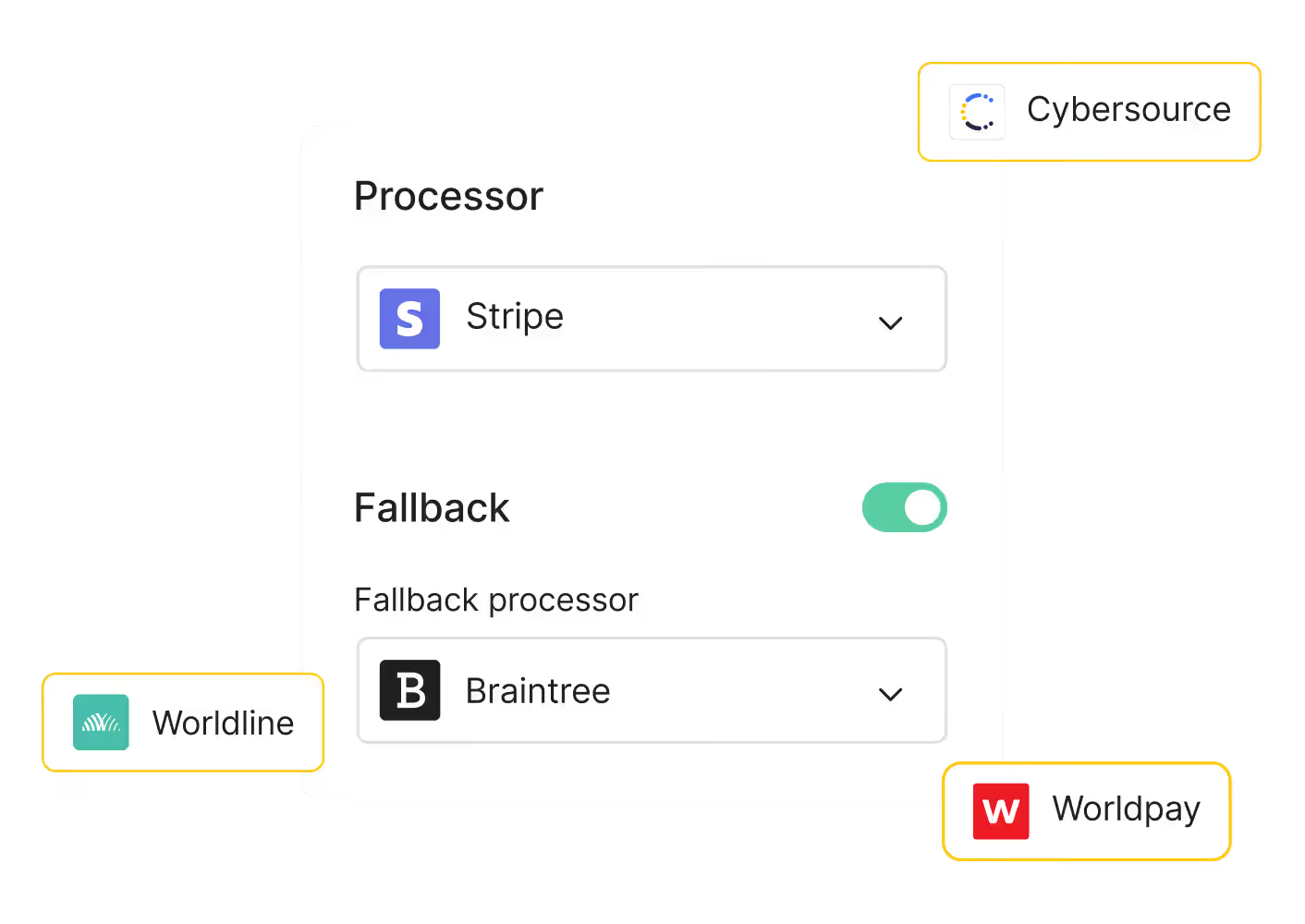
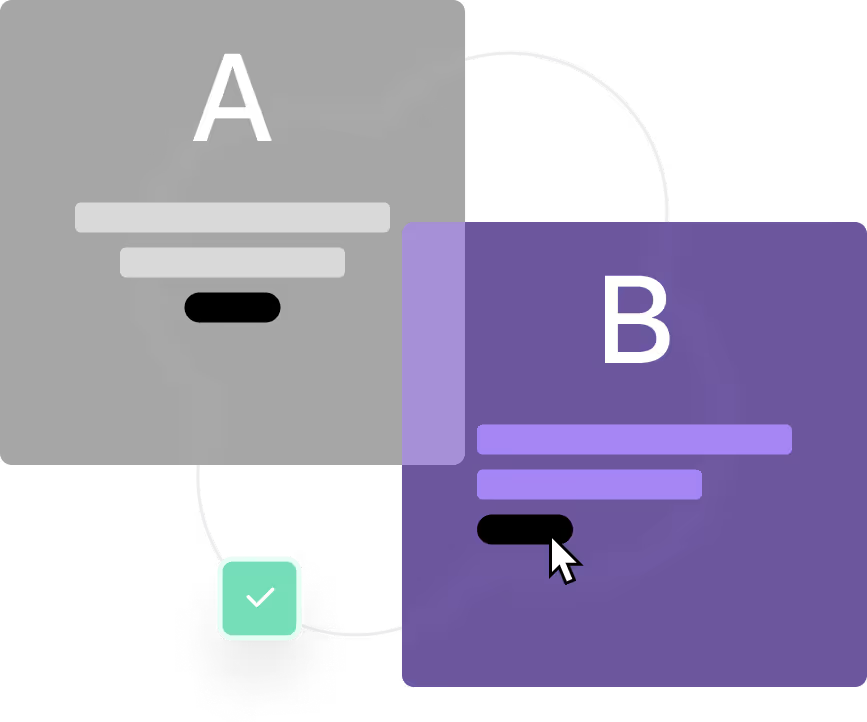
- Analyze and optimize performance: With Observability, compare Pix transactions to cards and other payment methods in real time to spot trends and run A/B tests.
- Monitor everything in real time: Set Monitors to alert your team instantly if Pix performance drops or settlement delays occur.
With Primer, adding Pix is just the beginning. You’re not only enabling a popular local payment method: you’re building a unified infrastructure that connects every part of your payment stack, helping you expand faster, optimize smarter, and run global payments with complete control.
How Primer helped Eldorado expand local payment options
Eldorado is a global online marketplace where gamers buy and sell in-game currencies, items, and services. With millions of players worldwide, payments are one of the most critical parts of the experience.
“If a customer finds the item they want but can’t complete the payment, we lose them,” says Arminas Šimkus, Payments Product Owner at Eldorado. “That’s why payments are one of the most essential parts of our business.”
As Eldorado expanded internationally, its payment setup became fragmented. Players in one region preferred cards, while others used digital wallets or instant bank transfers. PSPs performed differently across markets, and maintaining multiple integrations slowed down progress.
To overcome this, Eldorado chose Primer to unify and optimize its global payment stack.
Brazil quickly became a key focus. Around 42% of the country’s population are gamers, but many don’t use cards online. “We saw huge demand from Brazil, but conversions were low because most players didn’t have access to cards,” says Arminas.
The team decided to add Pix, Brazil’s most popular payment method. “Without Primer, that would’ve been a six-month project and a huge distraction for our team,” Arminas explains. “Instead, we launched Pix in just a week.”
The results were immediate. Conversions and revenue from Brazil surged as players who couldn’t pay before could finally complete their purchases.
“It was a clear return on investment,” says Arminas. “Primer didn’t just speed up deployment. It turned what would’ve been months of lost opportunity into immediate growth.”
Add the Pix payment method and unify your payment operations with Primer
Add Pix to your payments stack with minimal code, expand across Brazil, and intelligently route transactions to the most optimal PSP in real-time through Primer’s unified payments infrastructure.
With a single platform to manage your payments, you can get actionable insights from comprehensive data across all payment methods, craft your own strategies as you see fit, and turn payments from a blocker for growth into the very thing that powers it.
Book a call with Primer to find out more.
FAQs: Pix payment method
1. How popular is Pix in Brazil?
Pix is now Brazil’s top transaction method. This makes it a more popular payment option than debit cards and cash.
2. Why should merchants offer the Pix payment method?
Brazilian customers expect to see Pix as a payment option at checkout. This means that offering it increases your conversion rates and revenue. What’s more, Pix is cheaper than card transactions, improving your margins, and fund settlement is near-instant, allowing you better cash control. Since Pix is operated by the Central Bank of Brazil, it’s a trusted and secure choice: including it in your checkout might increase customer trust and loyalty.
3. Is Pix used outside of Brazil?
Because Pix was developed by the Central Bank of Brazil, acceptance of Pix outside Brazil is currently limited.
4. What’s the best way to integrate Pix as a merchant?
Merchants can’t integrate with Pix directly: they must do so through their bank or through a PSP. However, many international merchants end up navigating multiple PSPs and integrations, adding operational overhead. This is why platforms like Primer that orchestrate your payments across processors make integration with Pix and other payment methods much easier: all you have to do is integrate once, and you get to manage your whole payment stack in one place.
5. What are the Pix fees for merchants?
The average cost of Pix is lower than debit cards and credit cards. This makes Pix a more affordable option that can help merchants improve margins.
6. How does Pix compare to crypto or other real-time payment systems?
Pix and crypto payments both enable fast, direct transfers between users, but they operate in completely different environments. Pix is a real-time payments system built and regulated by the Central Bank of Brazil, whereas cryptocurrencies function on decentralized networks that aren’t tied to any national currency.
Pix transactions occur in BRL (Brazilian real) and settle instantly between payment accounts, providing speed and convenience similar to crypto without volatility risks. Unlike most crypto systems, Pix offers payment confirmation in seconds and is protected by strong biometrics and security controls through participating banks and fintech apps.
Compared to other global real-time payment platforms like India’s UPI or Europe’s SEPA Instant, Pix offers broader adoption and stronger financial inclusion within Brazil, making it one of the most successful government-led payment innovations worldwide.

%20(1).png)