
Merchants can negotiate better rates by using payment orchestration platforms like Primer. With payment orchestration, merchants can better view performance and costs across acquirers, using real data to optimize routing and negotiate fair rates.
An orchestration platform gives you visibility into every processor’s performance and cost, allowing you to identify which acquirers offer the best combination of fees and approval rates. With that insight, you can shift volume toward higher-performing providers and use those results as leverage in your negotiations.
Because you can easily switch or reallocate volume between PSPs, you’re no longer tied to one provider’s pricing structure. That flexibility turns your transaction volume into bargaining power.
What payment orchestration is
Payment orchestration unifies multiple PSPs, payment methods, and fraud tools through a single API. It gives merchants centralized control over their payment ecosystem, allowing them to manage routing, reporting, and reconciliation in one place.
Platforms like Primer make it simple for merchants to integrate new providers and adjust routing logic without writing code, helping businesses optimize both performance and cost.
How payment orchestration helps merchants negotiate better rates
1. Compare performance among providers
Payment orchestration removes the friction of working with multiple PSPs, allowing merchants to distribute payment volume across several partners simultaneously.
Instead of relying on a single processor, you can test performance and pricing across multiple acquirers. Providers know that if they want your volume, they need to compete on both cost and performance.
Negotiation advantage: You gain real leverage by demonstrating that your business can shift volume to whichever provider delivers the best deal.
2. Use data transparency as leverage
When all your PSP and transaction data is unified in one platform, you have complete visibility into fees, authorization rates, and transaction costs.
This transparency helps you identify underperforming or overpriced providers and approach negotiations with concrete evidence.
Example: If Acquirer A charges 2.5% and delivers an 87% approval rate, while Acquirer B delivers 94% at 2.2%, you can benchmark those results and use them to renegotiate lower rates with Acquirer A.
Negotiation advantage: Providers can no longer hide behind opaque pricing. You control the data — and the discussion.
3. Optimize routing to lower costs
Routing logic is one of the most powerful tools in payment orchestration. While routing isn’t automatic, platforms like Primer make it easy to create custom rules that direct transactions to the most cost-effective or best-performing provider.
For example, you might send high-value transactions through your lowest-cost acquirer while routing specific card types through providers with stronger regional approval rates.
This hands-on control lets you balance cost and performance, proving to PSPs that you’re optimizing intelligently rather than relying on their defaults.
Negotiation advantage: You can show measurable improvements in efficiency and use that data to justify rate reductions.
4. Reduce dependency on any single provider
Relying on one PSP limits your options — and they know it. Payment orchestration solves this by giving you full vendor independence. You can add or remove providers with minimal technical effort, ensuring you’re never locked in.
When PSPs realize you can easily move traffic elsewhere, they’re far more motivated to offer competitive pricing and better terms.
Negotiation advantage: Flexibility itself becomes leverage. You can walk away without friction, and providers know it.
5. Bundle value beyond price
Negotiating isn’t just about lowering rates. With orchestration, you can bundle metrics like approval rate, latency, and reliability into your evaluation criteria.
That means you don’t just say “We want a lower rate” — you say “We’ll allocate 40% of our EU traffic if you meet a 95% approval rate at 1.8% MDR.”
Providers value predictable, high-quality volume and are often willing to reduce rates in exchange for consistent traffic.
Negotiation advantage: You turn the conversation from price-cutting into performance-based partnership.
6. Simplify A/B testing across providers
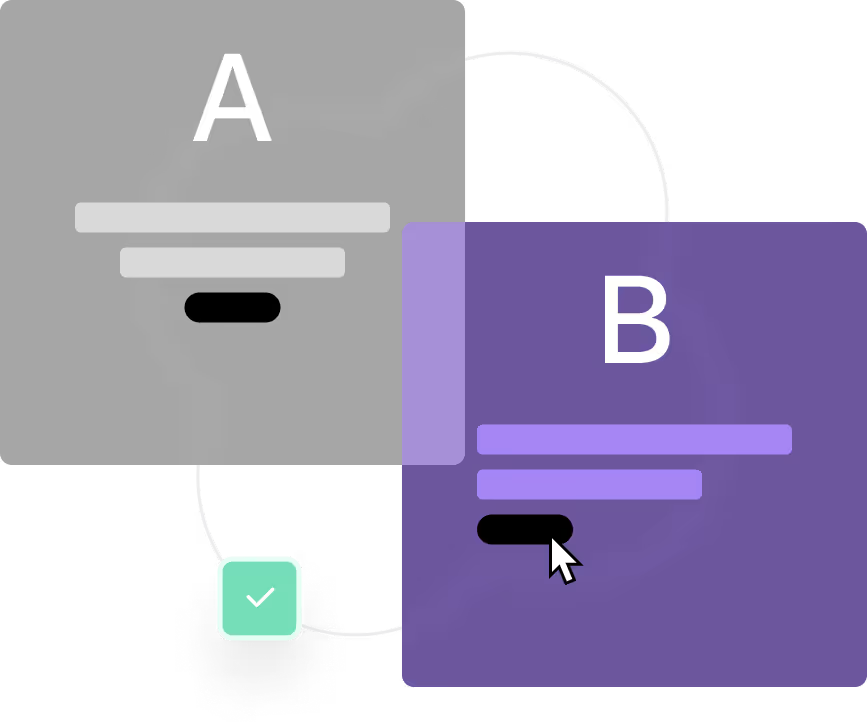
Payment orchestration makes it easy to test PSPs side by side. You can run A/B experiments to compare cost, latency, and authorization rates, then use those results to strengthen your negotiation position.
Negotiation advantage: You’re not negotiating based on estimates — you have verifiable data proving which PSP earns your volume.
The best payment orchestration platform for negotiating better rates
Primer is a unified payment infrastructure that lets merchants integrate, automate, and optimize their entire payment ecosystem through a single API.
With Primer, you can:
- Connect multiple PSPs without engineering effort
- Build routing rules and A/B tests in minutes
- Access unified reporting and reconciliation to uncover hidden costs
- Use real-time performance data to better negotiate rates
Primer gives you full control over your payments and empowers you to negotiate from a position of strength, not dependency.
FAQs: Negotiating better rates with payment orchestration
1. How does payment orchestration give merchants more negotiation power?
By consolidating all PSPs and transaction data in one platform, merchants gain transparency and flexibility. This lets them compare providers directly and negotiate based on real performance metrics.
2. Can I really switch PSPs easily with an orchestration platform?
Yes. Payment orchestration removes technical barriers, letting you add or replace processors through a single integration. This vendor independence gives you leverage in any negotiation.
3. How does A/B testing help in rate negotiations?
Running transactions through multiple PSPs in parallel gives you clear data on fees and success rates. You can use that evidence to demonstrate which provider deserves more volume or lower rates.
4. What if a PSP refuses to adjust its pricing?
With orchestration, you can easily route traffic to other providers offering better terms. This flexibility ensures you’re never locked into uncompetitive pricing.
5. How can Primer help me negotiate better rates?
Primer gives merchants a unified infrastructure for routing, reconciliation, and analytics. With transparent data and flexible connections, you can benchmark performance, test new providers, and negotiate rates that reflect your true payment value.

%20(1).png)