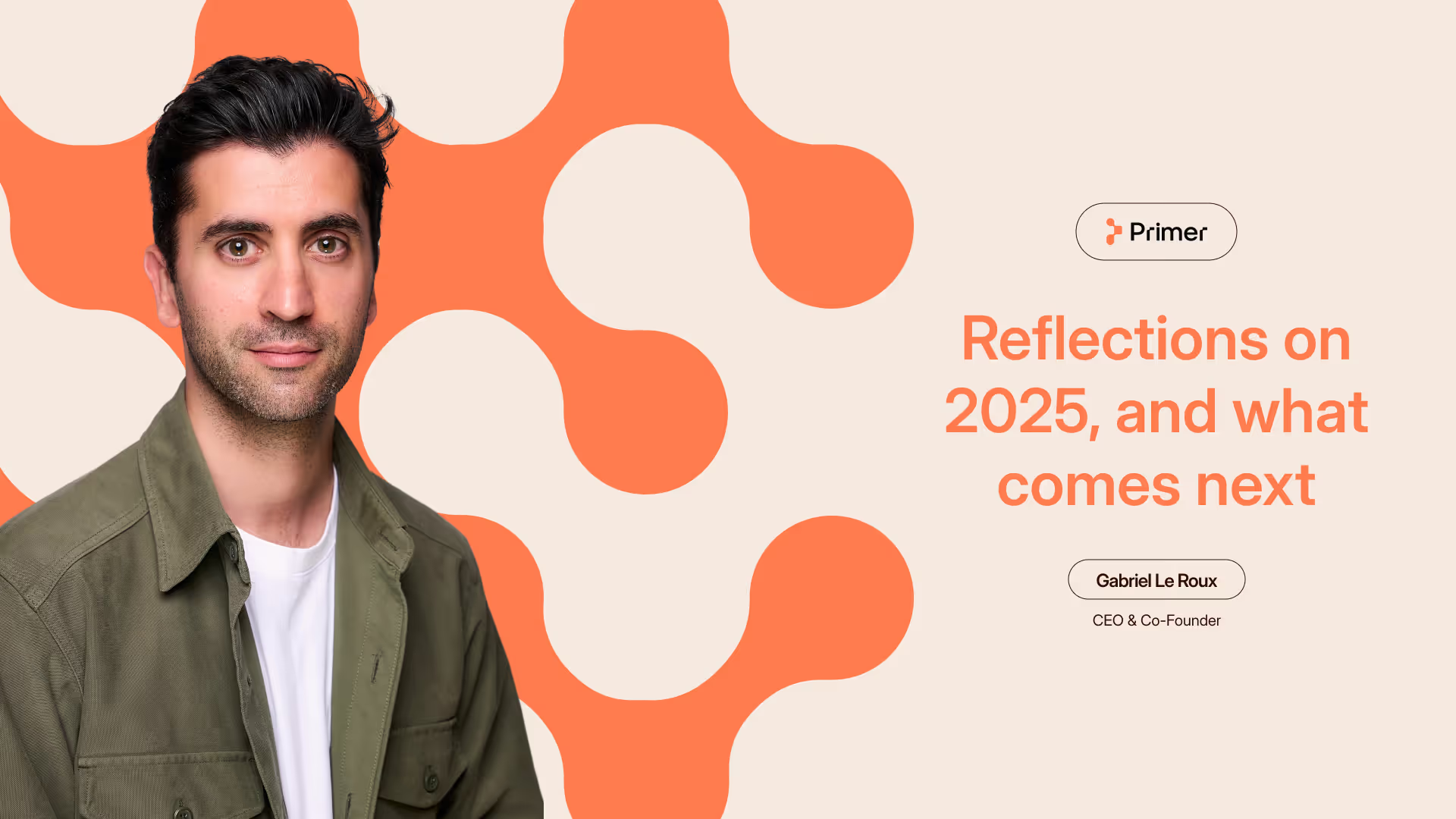
In my last CEO letter, I wrote: “As we look ahead to 2025, it’s clear we’re on the cusp of something transformative, not just for our company, but for the entire industry.”
Looking back, that’s exactly what happened.
2025 was the year Primer started to become the company we set out to build.
Innovation is not optional
In January 2025, Primer was in a position that many companies would have been happy with.
From a commercial perspective, 2024 had been a strong year. Revenue was growing, merchant adoption was increasing, and from a product perspective, we had invested heavily in strengthening the foundations of the platform, building a unified and open payments infrastructure that gives merchants complete control over how they run and orchestrate their payments at a global scale.
And if I’m being honest, we had a choice to make.
We could have consolidated what we had. I wouldn’t say this was an easy route—nothing in payments is easy—but it would have been comfortable and relatively risk-free.
But comfort is dangerous. If you want to be a pioneering company, you can't just follow the market; you have to define where it's going.
I’ve said it many times before, but when we founded Primer, our vision was never to be the best PSP orchestrator. The ambition was always bigger than that: to build a unified financial infrastructure. A single system that powers the money movement journey end-to-end.
So in early 2025, we made a clear decision. We were not going to settle for being comfortable. We were going to push forward and define what comes next.
That meant going back to a principle that has shaped Primer from the beginning: asking ‘what if?’ What if we could accelerate our roadmap, deliver innovation sooner, and continue to evolve and strengthen the foundations we had already built?
To the world, the result of this work is what you all saw during The Primer Showcase in November as we launched the next generation of Primer with products like Global Accounts, AI Companion, and Primer for Partners.
But behind the scenes, we saw something just as important occurring that validated our decision.
By the end of the year, our merchants were, on average, processing 97% of their payment volume through Primer, something that is pretty unheard of in the payment industry. They were also adopting more of the platform across multiple product areas.
That level of adoption reflects the belief and trust merchants have in Primer. Trust to route the vast majority of revenue through Primer. Trust that the platform could handle scale reliably. And the belief that as more of the platform is used together, the value compounds.
.avif)
Taking a central role in the ecosystem
2025 was the year that marked the point at which the full-stack model in payments reached its limits.
Over the course of the year, we saw many of the world’s leading PSPs begin to acknowledge this openly. The conversation started to move away from owning the entire stack, and towards openness, collaboration, and interoperability.
It’s a shift I’ve been talking about for some time, and one of the reasons I founded Primer in the first place.
At PayPal and Braintree, I saw firsthand that the full-stack model simply isn’t sustainable for merchants. No ambitious global business can, or should, rely on a single PSP. Payments are too complex, too fragmented, and too critical to be locked into one provider.
Of course, nearly every merchant that I speak with knows that already. Over the last two years, we’ve seen growing demand from some of the world’s largest and most sophisticated businesses to use Primer to run their payments globally.
That, in turn, had a direct impact on the rest of the ecosystem. To win and retain those merchants, PSPs increasingly needed to work with Primer. Primer became part of how deals were won, delivered, and operated.
As a result, the dynamic changed. Rather than us having to convince providers to work more deeply with Primer, they were coming to us to collaborate because that’s what their customers expected.
This is always what we wanted Primer to be. Not a competitor or disruptor to anyone in the ecosystem, but infrastructure that both sides—merchants and providers—see value in using.
And it made 2025 an incredible moment to launch Primer for Partners.
As Primer became more embedded in how payments were run, we wanted to change how partners interact with us. To give them the freedom, tools, and visibility to work with Primer in a way that scales, and to deliver innovation more effectively for the merchants we serve together.
I’ve always believed that when a service is genuinely neutral and valuable to both sides, collaboration replaces friction. Innovation accelerates because it doesn’t need to be reinvented in isolation. And the ecosystem becomes more resilient as a result.
Learning through hard decisions
For all the success we had in 2025, not everything went to plan.
I’ll be the first to admit that we made some big bets that didn’t pay off. I remember one in particular that we had strong conviction in, but it simply wasn’t showing up in the numbers. Stopping that initiative wasn’t easy, but it was the right call.
Primer is, by design, a lean business. We don’t have the luxury of doubling down on strategies that aren’t working in the hope they turn around.
As a CEO, it’s not always comfortable to talk about what isn’t working or to admit when mistakes have been made. But it’s not something we shy away from. What matters is learning quickly and coming out stronger on the other side.
I’m proud of how the team responded and adapted over the course of the year. As a business, and as a leadership team, we’ve learned to make calls earlier. To reprioritize without hesitation. And to stop things that weren’t working, even when the ambition behind them was sound.
Would I rather not have dealt with those challenges? Of course. But as we head into 2026, I’m glad we went through them. They’ve left us operating with more clarity, more discipline, and a much stronger sense of where to focus.
Agentic commerce and the risk of fragmentation
That brings me to 2026. I’m incredibly excited about this year. Some incredible things are happening, and the pace of change is like nothing I’ve seen before.
No trend encapsulates that more than agentic commerce.
Agentic commerce is one of the most talked-about shifts in the industry right now. And like most major transitions, it’s surrounded by a lot of noise.
Away from the technology itself, what’s interesting for me right now is the behavior forming around it.
Everyone is trying to define the protocol of choice. AI platforms, networks, and payment providers are all positioning themselves as the default path through which agent-driven transactions should flow.
Does that sound familiar?
What’s emerging in agentic commerce closely mirrors what happened in payments over the last twenty years: multiple players trying to own the interface, fragmenting the ecosystem in the process.
I’ve already had merchants come to me and ask which one they should use. And my answer is you shouldn’t have to.
We’ve already spent years building abstraction layers that help merchants operate across fragmented payment ecosystems without being locked into a single provider. Extending that way of thinking into agentic commerce feels like a natural continuation of the work we’re already doing.
Expect to see more from us in this space.
.avif)
What I’m focused on in 2026
2025 was a great year for Primer. 2026, I believe, will be even better. We have a clearer vision than we’ve ever had before, an incredibly strong and sticky product, and one of the strongest teams in the industry.
This year, I’m particularly focused on doubling down on openness. On collaborating more deeply across the ecosystem and continuing to build Primer as a truly two-sided platform that delivers value for merchants and providers alike. That has always been the ambition, and as I outlined earlier, it is more relevant now than ever.
Becoming a genuinely multi-product company is another major focus. We’ve taken important steps already, including launching products for finance teams and running pilots with multiple merchants. But this is still early. Our ambition here is significant, and we’re excited to work closely with finance and treasury teams to build products that solve real problems at global scale.
The final focus is learning. As the business scales, the environment around us changes faster. If we don’t build the confidence to make better decisions earlier, momentum fades. New technologies, including AI, can help us move faster and reason through complexity with more clarity.
But learning isn’t just about tools. It’s about depth. I want people across Primer to truly understand the industry we operate in and the problems we’re solving, well enough to internalize the vision and explain it with conviction. When that happens, decisions improve, execution sharpens, and the business stays completely aligned.
Looking forward
As we move into 2026, I feel more confident about where Primer is heading than I ever have.
We have a clear vision, a platform that’s proving its value in the real world, and a team that continues to raise the bar for itself.
I’m incredibly grateful to the people building Primer every day, to the customers who place real trust in us, and to the partners across the ecosystem who choose to work with us openly and constructively.
I’m looking forward to what comes next.
%20(1).png)